MGM produced this odd Japanese-American-Italian hybrid film in 1968. It played in Japan in 1968, America in 1969. The Green Slime was shot in Japan, using western actors speaking english (though often still dubbed). The story was written by one of the writers of the Italian Gamma One quadrilogy. One of the screenwriters was from the Batman TV series.The extensive models and miniatures work was done with former Toho craftsmen, guided by Akira Watanabe -- special effects director for many of Toho's kaiju epics. The resulting film is a medley of many flavors.
Quick Plot Synopsis
Space radar has detected a rogue asteroid named Flora which will hit Earth in 10 hours. General Thompson of United Nations Space Command sends up his best man, Jack Rankin and a team, to set explosives on the asteroid and destroy it. En route, there is a stop at space station Gamma 3. We learn of a former team mate and now simmering rivalry (for command and Dr. Lisa) between Jack and Vince Elliot, commander of Gamma 3. The beautiful italian doctor Lisa Benson is also abroad Gamma 3. The team embarks and lands on Flora. They drill for their explosives, but also discover green slime which is attracted to their gear. For no apparent good reason, Jack smashes the doctor's sample in a glass jar, spattering a bit of slime on the leg of a team mate. They all return to Gamma 3. They're decontaminated, but the slime fed on the energy and grew to a monster. It kills a couple of expendable crewmen. The doctor wants to save it for study, but it gets loose and kills still more. They discover that even drops of its green blood can grow into a new monster, so shooting them is a bad idea. Instead, they try to lure the (now) herd of monsters into a store room with a generator as bait. This eventually works, but the one they trapped in the infirmary grows too strong to contain and rampages, setting the others free too. After an explosion, the creatures are on the outside of the station, gathering energy from the sun. The station crew can't escape while creature keep the hatch closed, so Vince and a team go EVA and fight the monsters with laser rifles. Two escape ships get away. The last ship is ready to go, but Earth command can't control Gamma 3 remotely (to send it to a fiery doom). Jack stays behind to set the controls manually. He gets in trouble, but Vince comes to his rescue. In the fight, Vince is killed by a monster. Jack sets the controls, sending Gamma 3 hurtling earthward. He, with Vince's body, escape and are picked up by the third ship. Gamma 3 burns up obligingly, along with all the creatures stuck to its hull. On earth, a solemn ceremony (of sorts) commemorates Vince's sacrifice.
Why is this movie fun?
GS has many faults, which can make it amusing to watch in a sort of MST3K mood, but even if enjoyed as a "serious" B-grade sci-fi, it moves along at such a quick pace that viewers never have a chance to get bored.
Cold War Angle
There doesn't seem to be any real Cold War allegories going on. Instead, GS taps into the old Space Is Dangerous theme.
Notes
Gamma Five -- Fans of the Gamma One series will see many similarities, making GS almost the fifth installment in the series. Note the very similar modern cityscape, the Jetson cars, and of course, the big-wheel space station named, handily, "Gamma 3." Also similar are the characters. You have your hunky, gruff, bossy hero type, your rebellious rival and of course, your space babe who happens to be italian. Since Ivan Reiner was producer and writer for GS AND a writer for all four of the Gamma One stories, this similarity is no coincidence.
No Trope Unturned -- One interesting feature of GS is how many tropes it uses. Many of them have been entire movies on their own. The rogue object which will crash into earth has been done several times. When Worlds Collide ('51), The Day the Sky Exploded ('61) and Gorath ('62) to name just a few. Then there is the rogue monster hiding aboard and killing crewmen trope. The Thing ('51), It: Terror From Beyond Space ('58) and many others. Innocuous slime creatures: Space Master X-7 (58), The Blob ('58), H-Men ('59) to name some biggies. Mutiny in Outer Space ('65) featured a wheel-like space station overrun with some alien life (fungus instead of slime). GS is like a sampler platter of sci-fi plots.
Cast of Cliches -- With all the action in the plot of GS, there is no time for character development. As such, the writers have relied on stock characters at every turn. The hero is Mr. Gung-Ho guns ablazin' who is (almost) always right. His commander is gruff but it's all empty bluster, as the hero can do whatever he pleases. The rival can't do much of anything right, and "screwed up" in the past. He atones for his sins by sacrificing himself while saving the hero. The love interest is beautiful and torn between the flawed nice guy and the tough hero, but otherwise she's just a damsel in distress to be rescued or a prize to be fought over. The monsters are mindless killing machines. The misguided doctor wants to save the creature for study, but gets killed by it instead. (How many times has THAT been used?) Lastly, the crew is well stocked with expendable crewmen for the monsters to kill.
Hair of Iron -- Note how Jack's seriously cantilevered hair defies being mussed up, despite running, explosions, multiple tuck-and-roll escapes from creatures, and however many times he puts on and takes off his space helmet. That's tough heroic hair.
Bottom line? GS is proof that sci-fi had not necessarily matured just because Kubrik produced 2001. GS is a campy and at times absurd B sci-fi with a very strong 60s flavor. (note the colors, the styles, the dancing, the music ! The story has huge holes in it, leaving it ripe for riffing. Fans of the Gamma One series might appreciate this film as a sort of "lost episode." Those seeking thoughtful science fiction will likely catch themselves asking, "What were they thinking?"
Showing posts with label Gamma Quadrilogy. Show all posts
Wednesday, September 21, 2011
Friday, January 21, 2011
Snow Devils
MGM released the fourth in the Gamma One quadrilogy in early 1967. Snow Devils (SD) is considered the weakest of the four, but perhaps not by much. SD may have gone direct to TV without a theatrical release. Hence the Italian poster. This fourth installment of the Gamma One series re-used some of the characters from the prior films, but was not a sequel in the usual sense. Its plot about alien yeti-men was a stand-alone.Quick Plot Synopsis
A remote UDSCO weather station in the himalayas monitors strange global warming events. It is attacked by strange beasts. Everyone is killed, but one man missing. General Norton sends Commander Rod Jackson and his trusty sidekick, Captain Pulowski to investigate. Lisa, fiancee of the missing Lt. Harris wants to come along, but Rod says no. Their "helijet" is blown up, so they must trek on foot with porters. Lisa tags along disguised as a porter. Weird noises in the night scare off all the porters. Rod, Frank, Lisa and the odd Sharu press on. They find a cave, which turns out to be the base of the Yeti men. All four are captured. The yeti-men are actually aliens from the planet Aytin. They came over a hundred years ago to build their base. Now operational, they're warming Earth to melt the ice caps. When the earth is flooded, they'll cool the planet to an ice ball just like Aytin -- which is doomed by a cloud of radiation, btw. Rod and crew escape via an air shaft, make homemade ether which knocks out all the yeti-men. The leader yeti shoots up his own equipment trying to get the humans, then he dies. After that, Rod and crew are sent into space to check out Jupiter's moon Calisto. The Aytians have a base there too. A force field surrounds Calisto, so no ships can get near (nor missiles sent in). Rod notices a meteorite strike the moon, so figures that's the key. His fleet gather up asteroids from the asteroid belt, using magnetic 'cables'. They then tow and hurl these at Calisto. The Aytian base is destroyed. Back on earth Rod is free to resume being a shallow playboy. The End.
Why is this movie fun?
Alien Yeti-men is quirky enough to hold some interest. There are several recycled tropes (always fun to spot), and a sense of nostalgia for the other three Gamma One movies, since so many actors, props and sets are re-used.
Cold War Angle
There is little of the usual Cold War themes, beyond the by-now customary aliens plotting to invade trope.
Notes
Unexpected Timeliness -- One might doubt that Antonio Margheriti was trying to be prophetic, but he depicted catastrophic global warming, AND had it beginning about a hundred years ago, when the Aytians arrived on earth. Perhaps the yeti-men are unintended metaphors for carbon-dioxide spewing industry?
Cool Music -- Perhaps the best part of SD is the theme music composed by Angelo Francesco Lavagnino. He had done the music for the other three Gamma One films, but he was really firing on all four cylinders for SD. The vast, epic-sounding score seems misplaced on SD. It sounds like it should be for an epic western. Little surprise, perhaps. Lavagnino composed scores for many westerns too.
Chaotic Casting -- Anyone who watches the four Gamma One movies in close order, will see some confusing casting switches. Margheriti was using the same stable of actors, but for some reason opted to give them different characters in the different movies. Jack Stuart plays Commander Rod Jackson again, and Enzo Fiermonte plays General Norton, as they both had in Gamma One III. But oddly, Amber Collins, who played Jackson's closet love interest, Lt. Terry Sanchez in Gamma One III, plays Lisa Nielson. (he still gets to kiss her though). In Gamma One IV, there is still a Lt. Terry Sanchez, but she is now played by Halina Zalewska, who played General Norton's daughter Janet -- Jackson's (unloved) fiancee. A very odd swap. Other actors, too, are given new and different rolls. Jeffrey Unger, for instance, plays Capt. Pulaski in Gamma One IV, but he played the doomed Perkinson in Gamma One III. He also played minor roles in the first and second movies too. Why the mix-ups? It scrambles what little continuity the four movies had.
Yetis In Space -- Sci-fi writers are fond of supplying aliens to explain earth's mysteries. But, SD is not the first. The obscure Swedish-American film Invasion of the Animal People ('62) proposed that abominable snowmen were alien monsters, brought to earth in meteors.
Throwing Rocks -- Commander Jackson's epiphany, to lob asteroids at the Aytian base, was also not very new. In This Island Earth ('55) the Zagons were steering meteors to bomb Exeter's home planet of Metaluna.
Prop Watch -- Many of the sets, models, props and costumes are re-used from the prior three movies. Of sentimental interest are the two "Jetson" cars, the white one and the red one. We get to see the white one drive up and then away (in the rain!).
Cold War Scrap -- Watch for stock footage near the end, when Jackson sends a scout ship to investigate Calisto. Stock footage is played of the AGM-28 "Hound Dog" missile. It was an early iteration of the cruise missile idea. Hundreds were built during the 60s and stayed in service into the 70s. They were nuclear, but never fired in earnest. In the Cold War chess game, the soviets had trumped America's tactical nuclear first strike (via nukes in B-52s) by building a ring of anti-aircraft defenses. The answer, was the Hound Dog. Two, carried under the wings of a B-52, would be fired while still scores of miles away from the target. The Hound Dogs would take out a hunk of the soviet anti-aircraft ring, letting the B-52s in. America had its tactical deterrence clout back. Trivia: In order to do any good, the Hound Dogs had to fly at supersonic speeds to get to the target well in advance of the bombers. To do this, the jet engines (same as in the A-6) were tuned to run so hot and fast, that they could only last for six hours. For a cruise missile, that was enough. No market in used cruise missiles.
Bottom line? SD is worth seeing if you liked the other three Gamma One movies. The character shifts can be disorienting, though. As a stand-alone story, it's a bit weak, and it drags at times. The yeti leader exposits for a few minutes to give you the back story. The space "action" is vintage 50s stuff. This late into the 60s, it looks dated.
Monday, November 22, 2010
War Between the Planets
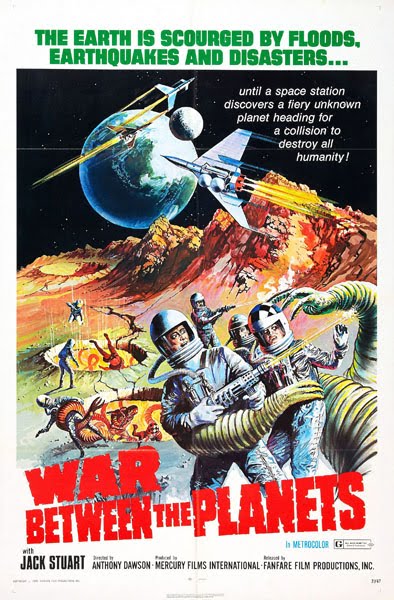
The third film in the Gamma One quadrilogy was titled Il pianeta errante (The Errant Planet) in its original Italian. The english dubbed release in America was retitled War Between the Planets (WBP). Director Magheriti's economizing continued. Sets, costumes and props were reused from the first two movies, but the cast was different. WBP is yet another rouge-planet film, though not a strong one. Yet, the proto-Star Trek-like saga continues.Quick Plot Synopsis
The earth is being wracked by earthquakes, tsunamis and storms. Scientists cannot find a source. Computers suggest an unknown planet may have moved into the solar system in Gamma One's quadrant. Space Command's leader, General Norton, sends his best "space man" to space station Gamma One to find the cause. Once back on Gamma One, Commander Rod Jackson barks out orders and is a jerk to his clandestine girlfriend, Lieutenant Terry Sanchez. Gamma One has been wracked by odd gravity forces too. Jackson's second-in-command, Dubrowski is miffed at having his earth-leave canceled. He belittles Jackson's love life. A fist fight breaks out, but is interrupted. General Norton and Jackson's finacee, Janet Norton, are coming. A faint distress call from station Echo alerts Jackson to the likely place to find the errant planet. He mounts a recon squadron of ships to find it. In his absence, the General arrives as also barks out a lot of orders. Dubrowski, Sanchez and some others take another ship and join the recon party. Dubrowski is intent to blow up the planet as revenge for the death of his wife in an earthquake. One of Jackson's ships finds the planet. It has many odd features, such as very low density, able to alter its direction and an ability to expel and recover a "school" of asteroids. it can alter it's gravity too. One of Jackson's ships is caught in a gravity burst/ It crashes on the surface and begins sinking in red goo. Eventually, the others go EVA to explore the planet's surface, some of which is solid. Dubrowski falls into the red goo and sinks away. Jackson, Sanchez and Perkinson go down a crater, into a labyrinth of caverns. The walls are lined with red "arteries", the floor has moving "breathing valves." They seek a deep enough place to plant their anti-matter bomb. An artery grabs Sanchez. She drops the detonator into some goo. Perkinson must use some extra circuits in Jackson's helmet as an alternate detonator, so they trade helmets. There is a tremor and a cave-in which traps Perkinson. Jackson must hack the arteries with an axe to open passageways so he and Sanchez may escape. Eventually, they do and float back to their rocket. All ships power away and the order is given to detonate. The errant planet is destroyed. At a solemn funeral for Dubrowski and Perkinson, Janet realizes she's lost Jackson. Jackson, Sanchez and Dubrowski's red-headed son Ricky walk off hand in hand. The End.
Why is this movie fun?
There are the usual charms of "spaghetti space opera" films. Of particular interest is the notion of a planet-sized life form. Commander Jackson's very tall, Trump-esque hair is amusing.
Cold War Angle
There is a subtle subtext about nuclear arms control that is late-Cold-War thinking. It is a capital offense to have weapons of mass destruction. Yet, there is early-Cold-War thinking too. The way to deal with an outside threat is to gather up one's nukes and go blast it!
Notes
Planet Life -- An intriguing trope in WBP which gets little exploration, is the idea of a planet-sized life form that can exist (and move) in space. It apparently has an outer protective shell with hard spots, soft gooey spots, and some breathing vents. It exhales and inhales its own air It has a circulatory system and a heart. (The narrator speaks of a pulse) Perhaps the planet-beast's ability to generate intense gravity is how it gets around? The script does nothing with this living planet -- no science-blather theorizing. The pianeta errante is just something threatening Earth which (therefore) must be destroyed. Sci-fi potential, but wasted.
Curse You Wells! -- The American distributors of Magheriti's movies must have been miffed that H.G. Wells took the best title: War of the Worlds. They kept dancing around it, getting as close as they could. War of the Planets, Battle of the Worlds, War Between the Planets. The Italian titles at least represented their films. The American titles were poor fits, but as close as the promotors could get to the ideal Wells denied them.
Tedious Triangle -- Repeating the character formula of the previous two Gamma One dramas, the commander of Gamma One is a macho hunk who has a back-story relationship with a beautiful officer aboard Gamma One. As a side note, Roddenberry's Star Trek pilots employed the same trope. An added, but pointless, wrinkle in WBP, is that commander Rod Jackson is engaged to General Norton's daughter Janet. Perhaps a politically expedient, Jackson doesn't really love Janet (apparently). Instead, he has real feelings beneath all his jerk facade, for Lieutenant Terry Jackson, the communications officer. The triangle adds nothing beyond banal drama.
Jerks in Space -- Similar to how, in the first two movies, Mike was frequently a jerk to Connie, Rod is frequently a jerk to Terry. Like Connie before her, Terry demurely puts up with his jerkness, and melts into smiles at any crumb of civility. Apparently, Magheriti liked these characterizations. Was this an Italian role model?
Prop Watch -- Viewers will see the cool "Jetson" cars from the previous two movies, in the first few minutes. The model city is the same too. Also reused are the various rocket models from the previous two and from Assignment Outer Space. The Gamma One sets are, of course, reused too.
Bottom line? WBP is a weak installment in the Gamma One series. The first 3/4ths of the film is slow, talky and filled with distracting drama. Once the recon squadron finds the mystery planet, things get brisk, but it takes a long time getting there. Fans of Magheriti and/or the Gamma One style of films, will be more forgiving. Viewers accustomed to bold action and deep plots, will probably be annoyed.
Thursday, November 18, 2010
War of the Planets
MGM gave the second installment in the Gamma One Quadrilogy the rather incongruous english title of War of the Planets (WotP) and re-using the Italian poster from the first movie, Wild Wild Planet. The Italian title of the second installment was, I Diafanoidi Vengono da Marte, at least mentions the hostile aliens: the Diaphinoids. There really isn't a war of planets. It's the humans against the wispy energy beings. As part of a four-film package deal, WotP shared sets, costumes and cast with the first film, Wild Wild Planet, but much like a television episode, the stories are unrelated. Like the first episode, Wild Wild Planet, WotP suffers from a too-ambitious script.Quick Plot Synopsis
Captain Dubois of Space Command gets out of his car to report for duty. He sees green lights in the sky which rush up to him and possess him. It's New Year's Eve on earth and all of its space stations are celebrating with parties. The parties aboard Gamma One are famous. The fun is interrupted by a distress call from Delta 2. Something is attacking them. The transmission is cut off. A rocket is sent to investigate. Inside, the crew are motionless (and slightly greenish tinted). Some are dead, but some alive, though catatonic. A green fog envelopes and invades Delta 2. The recon team fire their lasers. Their communication ends. Delta 2 disappears. HQ orders all stations evacuated. Halstead and a small team defy orders and stay aboard Gamma 1. The green fog penetrates Gamma 1, but Halstead and his men hole up in a room lined with lead-titanium. They fire lasers too. The fog leaves. Halstead is congratulated and chewed out by his superiors. The green lights appear in earth's sky. Dubois enters to deliver a message from the Diaphinoids. Join with the collective. Host a Diaphinoid, or die. HQ complies. Green-ified people, including Connie, are loaded into rockets. Halstead and others are too. The Diaphinoids take them to Mars. In an unmanned mining complex, the Diaphinoids plan to complete the "hosting". Some humans resist and are killed. Halstead and his men start a big brawl with the possessed humans. They break a window, escape and stagger through the thin martian air to a small supply rocket. Dubois and the possessed humans asphyxiate. An attack fleet of rockets from earth come to blast the Diaphinoids. Halstead and group barely escape in the little rocket. The mining base and all Diaphinoids are destroyed. Back on earth, Halstead gets a belated Happy New Year kiss from Connie. All is well again. The End.
Why is this movie fun?
There is something of an "old shoes" comfort in seeing the cast, sets, props, etc. from Wild Wild Planet again. The trope of alien-takeover is like an old friend too -- been around for ten years. There is also something entertaining in the Italian-style chaotic script. Never a dull (or at times, logical) moment.
Cold War Angle
Alien-takeovers are usually a Cold War trope. In WotP, however, it seems to be more sci-fi tradition than socio-political metaphor.
Notes
Old Possessions -- The concept of mysterious (incorporeal) aliens taking over human bodies was pretty old stuff by the mid 60s. It wasn't totally new in 1956 when Invasion of the Body Snatchers made the trope famous. Nonetheless, in the mid 60s, it was enjoying a new surge of popularity in Italy. Mario Bava used it in his Planet of the Vampires in 1965. Perhaps not-so-coincidentally, Bava also had his evil intelligent beings exist as "lights" until they enter a human.
Diaphinoid Saga -- The possessed Dubois tells Halstead that the Diaphinoids are energy beings who used to live on the planet Diaph in the Andromeda galaxy. They existed symbiotically with corporeal hosts there, but the hosts all died off. The Diaphinoids want humans to be their new hosts.They promise peace and bliss in the union. The "hosting" is apparently more involved than mere take-over, which is what they've done thus far. They had a slick sales pitch, to try to sell the idea to the humans, promising utopian bliss. Their use of deadly force suggests that the symbiosis was going to be more akin to conquest.
Plugging Holes in Space -- A 90 minute screenplay was too small to contain all the subplots the writers had in mind. The result is a collection of odd holes in the plot. Here are some proposed solutions: The Diaphinoids, as energy beings, can travel intersteller distances without ships, at the speed of light. A few of them find earth and decide they're suitable host bodies. They inhabit Dubois and a few others, who send a message calling in the rest who beset the space stations. The Diaphinoids can "possess" a human, but it is a limited arrangement in which the human still has too much autonomy. (q.v. all the arguing Dubois does with his Diaphinoid) A true merger requires (somehow) the presence of uranium. Hence the need to ship all people -- the possessed and prospects for it -- to the mine facility on Mars. If the possessed human dies, the Diaphinoid does too. It must be harder to un-possess a human or the Diaphinoids would simply pop out before their host died. They don't. That's why the fleet can blast them all. How do they know they got them all? All of them were in the mine expecting permanent hosts.
Take Two -- The two cool future cars that debuted in Wild Wild Planet got a bit more screen time at the beginning of WotP. Also, note that in the final scene, Connie is wearing the same yellow and green blouse outfit that she was wearing at the dinner party in WWP.
Bottom line? WotP is weaker, as a story, than the first movie. It suffers many of the same flaws. It makes a bit more sense if viewed right after the first. Watch it as a sort of Italian prototype for Star Trek, the Original Series, and it's not so bad.
Monday, October 25, 2010
Battle of the Worlds
We continue Digression Week with an oversight from 1963. Shortly after making his first sci-fi film, Assignment Outer Space ('60), director Antonio Marhariti put out a much more ambitious sci-fi tale: Il Pianeta Degli Uomini Spenti (Planet of the spent (dead) beings). Dubbed into english and retitled Battle of the Worlds (BotW), it was released in America in 1963. The extremely low budget takes its usual toll, prompting casual viewers to disparage the film. Actually, the story is much more ambitious -- perhaps too ambitious. In some ways, BotW is a bridge between Margheriti's very 50s-minded Assignment Outer Space ('60) and his very-60s "Gamma One" quadrilogy of the mid-60s.Quick Plot Synopsis
A rogue planet is discovered entering the solar system. The news is no surprise to a crotchety old mathematician named Professor Benson, part of an astrophysics team. He had predicted it days early, calls it The Outsider. A base on Mars studies the Outsider. Two rockets narrowly avoid destruction from its gravity. The planet appears to be on a collision course with earth. Panic ensues. Benson says it will pass 90,000 kilometers away. It goes into orbit around the earth. Benson did not think it would. He is humbled, thinking he made a math error. The authorities send a rocket and crew to explore The Outsider. Benson realizes he made no error, but that the Outsider had to have been steered into orbit. Too late, he calls for the rocket to return. When they approach, a dozen or so flying saucers come out of The Outsider and laser-blast the rocket. Benson then tells the authorities that The Outsider's orbit is gradually decreasing. In 840 hours, it will hit the earth. Before that, environmental disasters will wreck civilization. Space Command sends some rockets to destroy the planet. The saucers defend again, destroying some rockets. Fred (on one of the rockets) figures out that they home on radio signals, so his captain turns all off and flies manually. They destabilize a saucer which crashes to earth. Benson's team study the glowing glass tube from it. Music, sonics. That's the secret controlling the saucers. Another squadron of rockets is dispatched. This time, they use sonic controls to confuse and finally destroy the saucers. Benson argues to be allowed to explore The Outsider. He is sure it's hollow and piloted. Reluctantly, the authorities agree, but with a time limit. After that, they launch nukes and blast it. The Benson expedition land on The Outsider. Benson follows signals and opens a secret door with his sonic controller box. Inside, things are totally tubular. The team find a control room with many dead beings. They left their dying world in hopes that their "Noah's Ark" would find them a new world. They died before it did. But, their planet-ship continued on autopilot. (Self-defense mode too). Time is up. They're ordered to leave, but Benson refuses. He wants the secret of the Outsider. The others flee amid cave-ins, but get to the rocket just in time. Benson finds the data core and is elated. The nukes are launched anyhow. The team's rocket blasts off safely. Benson is euphoric at his discovery. The missiles blow up The Outsider, and Benson. The rocket pilot gives a disparaging eulogy. The End.
Why is this movie fun?
Italian sci-fi movies (as in spaghetti westerns) are prone occasional irrational bursts of emotion, and BotW has plenty of those. Claude Rains gives a flamboyant portrayal of the eccentric Professor Benson. Yet, behind the hammy outbursts lurk some intriguing understated themes. (See Notes section)
Cold War Angle
There is an analogy in the threat of global destruction posed by The Outsider, which is emitting dangerous levels of radiation. In more of a bravado mindset than a gloom-and-doom mindset, the answer to the threat is massive nuclear missile strikes.
Notes
Shadowy Government -- A subtle plot feature is the somewhat sinister world government which is running things. They seem more of a military-industrial hybrid than civilian. Note that it was the not-very-remorseful General who decides to launch the nukes, even though the expedition team was pleading for just a few more minutes. Note, too, the rather 1984-like quality of the "council" which Benson communicates with. They're all cold, aloof, authoritarian talking heads. Magheriti was painting a rather dystopic picture of future government. This dark government idea would continue in his Gamma One quadrilogy.
Hidden Love -- Another of the subtleties in BotW is the relationship between young Eve and old Professor Benson. Nothing is stated overtly, but there is something there. Perhaps they've developed a father-daughter sort of attachment to each other. She rushes to him to share good news. He calls out for her to assist him. She frets over how he fared during liftoff, etc. Yet, it seems like something more. Magheriti gave us a long look at the opening of the film, of running her down the cliff stairs to her fiance, Fred. Later, after she's decided she cannot abandon Benson, Magheriti repeats the move, having another long scene of her running down stairs to Benson. Fred calls to Eve, but she doesn't respond. Mrs. Collins (the "black widow") tells Fred "You don't even exist to her." Perhaps Magheriti just liked how actress Maya Brent looked when she rushed down stairs. Or, perhaps he was drawing a symbolic parallel for his audience. She rushes to Benson the same way she rushed to Fred. He often directed them to walk arm in arm.
Ark of Death -- An intriguing plot element in BotW, is notion of a failed "ark." Other sci-fi movies have featured "arks". Sometimes, they're carrying earthlings (When Worlds Collide, or Space Probe Taurus (and more recently 2012). Typically, space arks carry aliens to earth, fleeing their dying world. The earthlings usually defeat them. In BotW, however, the ark arrives on autopilot. The beings it was to deliver to a new world had all died in transit. This rather poignant facet is easily overlooked.
Delightful Dis -- Cantankerous Professor Benson was quick with barbs and put-downs to his colleagues. He was usually unapologetically curt with Dr. Cornfield (the erstwhile head of their unit). But one of Benson' digs seemed amusingly subtle. They are all in their lab's communications room, watching TV reports of the rocket taking off to go explore The Outsider. Dr. Cornfield says, "The crew is made up of the very best scientific minds." Benson says, over his shoulder, and with apparent sincerity, "I don't understand why they didn't invite YOU, Cornfield."
Canards in Space -- BotW uses rocket models with a 50s style. They sport big wings near the stern and little canard wings on their noses. Such were the notions of 50s dreamers such as Bonestell. The reality of takeoff and re-entry into earth's atmosphere was proving such wings were impractical. Also still evident was the equally impractical notion of backing-down style landings. More fuel is burned than the ship could carry. Yet, this was how the moon rocket in Destination Moon ('50) landed. The pattern had been repeated ad infinitum. Watch for these canard rockets, still back-down landing, in Magheriti's Gamma One movies.
Bottom line? BotW is often branded a "cheesy" spaghetti sci-fi, but it has more to it than that. Look beyond the capricious acting styles and low-budget effects. Look beyond the (likely) poor quality of the public domain print. There are nuggets for the patient viewer.
Monday, September 27, 2010
Wild Wild Planet
MGM, looking for some budget television products, contracted with Italian film makers for a series of movies. The Italian team wrote four unrelated stories, but used a common setting: Space Station Gamma One. So, the four films are often called the Gamma Quadrilogy. The Italian title of first film was I Criminali della Galassia (Criminal of the Galaxy). The actors spoke english, but with strong italian accents. The American release, dubbed with American english voices, was titledWild Wild Planet (WWP). MGM was pleased enough with the quality of the Italian films that they opted for a theatrical release too. As usual, the poster promised more than the movie could deliver. (the evil Barbies don't wield laser rifles, while wearing metallic bikinis and tall boots) The poster does suggest a story too ambitious for a 90 minute film. Several plot elements (some important) are easily lost in the rush of scenes. (see notes below)Quick Plot Synopsis
Aboard space station Gamma One, a scientist from "the corporation" conducts experiments creating artificial human organs for transplant. There is no love lost between Gamma One's macho commander, Mike Halstead, and the creepy perfectionist, Dr. Nurmi. At a dinner party, Halstead is not especially kind to his girlfriend, Connie. She's drunk, so accepts Nurmi's offer of a vacation on planet Delphus: a Corporation research base. Meanwhile on earth, people have been disappearing at an alarming rate. The authorities suspect The Corporation, but can prove nothing. A bevy of evil Barbie women arrive in the city. Each has their own evil minion in a black trench coat. They make people disappear. Actually, they shrink them so they can be smuggled back to Delphus. The abduction of a Dr. Fried is interrupted ahd he's found half size and in a coma. After another failed shrink attempt, the authorities are alerted to the evil Barbies with black coated minions. The authorities find a dead minion. It has four arms and cat-like eyes, and appears to have been assembled. Halstead and Jake confront the evil Barbies in their apartment. They fight, but the men win. Some books are found with lists of names and ties to planet Delphus. Halstead and a team of men fly a rocket to Delphus. Nurmi is ready for them and takes them prisoner. Before executing Halstead, Nurmi gives Halstead a tour of his facility and explains his work and dream. Nurmi is creating a race of perfect humans. Part of that perfection is to merge a man and a woman into one body. Connie is to be Nurmi's merge mate. Halstead and his men start a big fight with the clones and minions, interrupting the merge process. Halstead and Nurmi fight, damaging the super computer which runs everything. Windows and doors break, allowing the red lake water to flood the subterranean complex. Halstead puts his men and Connie into stasis pods so they can float up. He and Jake use O2 cylinders to breathe through the swim to the surface. Once on dry land, two rockets arrive from earth. All is well again. Back on earth, Halstead, Connie and a few others lounge around a pool. Halstead offends Connie by being a jerk (again), but he kisses her and she melts into his arms. The End.
Why is this movie fun?
The 60s vision of the future is entertaining. The very 60s evil Barbies, with tall hair and tall boots is amusing
Cold War Angle
There is more of a modern paranoia of big corporations than angst over commies.
Notes
Economy Four Pack -- Director Antonio Margheriti was given just three months to produce four movies. To save time and money, he shot all four in parallel. Sets and props were shared -- the interiors and exteriors of space station, the futuristic city, the rocket models, the jetson cars, etc. Location shoots would double up to avoid set-up and take-down of cameras and lights. Movies 1 and 2 used Tony Russell as the leading man and Lisa Gastoni as his girlfriend. Movies 3 and 4 starred Jack Stuart as the leading man and Ombretta Colli as his girlfriend.
Lost in Space -- The plot of WWP has too many complex facets for a 90 minute film to flesh them out. Here are a few that might help, next time you watch.
Dual Personalities: Dr. Nurmi's "perfect" human was a merging of male and female. That's why he wanted Connie. She would be his merged "other half". That's why the evil Barbies kept using the plural "we".
Cleaning Solution: Those chest pins contained a chemical that would almost instantly dissolve living tissue. That's why the minions or others disappeared when poked with one.
From Concentrate: Nurmi needed a lot of humans in order to find perfect specimens. This perfection was apparently genetic, not simply developmental, as youth and older guys were taken too. Somehow, the black-coated minions are able to shrink people to doll size. That way they can be transported to Delphus. (in the era of no luggage screening) Once on Delphus, Nurmni had a tanning bed that would reconstitute them back to full size.
Robota: Much like Karel Capek's 1920 original "robot", the four-armed clones in black rain coats are manufactured biological humanoids. The workers on Delphus create them, crate them, and ship them to earth for the evil Barbies to use.
Balance of Power: There are two separate (and competing)"authorities". The civil (and military) government is the United Democracies. The Corporation is the amalgam of science and industry. Both have people, resources and power. An uneasy cooperation exists between them.
Jetson Ride -- To car buffs, the two "modern" cars are a terrific look at the mid-60s view of the automotive future. There were just the two props: the white unit with two fins and the red unit with one.

They have a similar look and feel to the flying car in Planeta Bur ('62) which American audiences had only just seen in mid 1965 via the english dubbed version, Voyage to the Prehistoric Planet. Designers of the early and mid-60s were sure that the future would be pointy.

That is, until Mr. Nader convinced Congress that drivers are too stupid to actually drive correctly, and must be protected from themselves. This dulled the future into a bleak era (for car buffs) of mega-bumpered rolling safety cages with a style only a soviet tractor engineer could love. Ah, but in the mid 60s...
Seeds of Trek -- The Gamma Quadrilogy was an early attempt at a space adventure drama for the television market. It wasn't as cohesive as Roddenberry's "space western" in the works, but the Quadrilogy showed that the time was right for television series about space adventures, set in earth's future. Gamma One was more akin to Deep Space 9, perhaps, but the motif of a square-jawed tough-fisted captain and his loyal crew, battling earth's enemies, (both home grown and alien), -- oh, and lots of beautiful space babes -- are clearly features that audiences were ready for.
Bottom line? For a sci-fi fan, WWP is worth watching -- perhaps several times to catch the many complex threads. It is also a fun look at what the mid-60s vision of the future would be.
Subscribe to:
Posts (Atom)