1910s & 20s * 30s * 40s * Pre-50s * Frankenstein * Atomic Angst * 1950 * 1951 * 1952 * 1953 * 1954 * 1955 * 1956 * 1957 * 1958 * 1959 *
1960 * 1961 * 1962 * 1963 * 1964 * 1965 * 1966 * 1967 * 1968 * 1969 * 1970 * 1971 * 1972 * 1973 * 1974 * 1975 * 1976 * 1977 * 1978 * 1979
Showing posts with label 1967. Show all posts

Monday, June 25, 2012

The President's Analyst

As an antidote for all the dystopian gloom of the early 70s, Digression Week steps back to the mid 60s for some sci-fi humor. First up is Paramount's The President's Analyst (TPA) from 1967. The sci-fi part is scant, but it's there. Written and directed by Theodore Flicker, this satire comedy has ardent fans, and viewers who just don't get it. James Coburn stars as the troubled psychiatrist who gets what he thinks is a plum job, but later regrets it. Flicker's script spoofs just about everyone -- right-wing extremists, left-wing extremists, corporate America, the counter-culture, psychoanalysis and international politics. Not all the humor survives 40 years, but some does.

Quick Plot Synopsis
Dr. Sidney Schafer is a NYC psychiatrist with the usual clientele. One of his patients, Don, (played by Godfrey Cambridge) is actually a CEA agent (thinly disguised CIA). Sidney has been chosen to be the President's analyst. With the weight of the free world on his shoulders, he needs someone to talk to. Sidney is thrilled, as is his girlfriend, Nan. They move into a tidy suburb of Washington. Henry Lux of the FBR (FBI) is all negative about the whole thing. Sidney begins to get a bit paranoid that enemy agents are all around him. He also tires of the President's frequent and irregular summonses to talk. The FBR send Nan away because Sidney talks in his sleep. Overwhelmed by it all, Sidney schemes to escape. He goes home to New Jersey with a tourist family who were doing a White House tour. The Quantrill's are self-professed liberals, but tote many guns to protect them from the right-wingers. After a meal at a restaurant in the city, agents try to grab Sidney. He runs, eventually hiding in a bus belonging to hippy musicians. They drive out to the Great Lakes. Dressed as a "hippy", Sidney enjoys some quiet and some free love from the vacuous hippy babe: Snow White. While Sidney and Snow are "busy" in the meadow, various agents try to kill him, but are in turn killed by other agents, etc. etc. Sidney and Snow leave, unaware. The hippy band plays in a remote club. Hallucinogenic drugs in the patrons' drinks turn the room full of poorly disguised spies into mass ineptitude. Yet, some spies grab Sidney and escape. He awakens on a yacht on a Great Lake to find he's been abducted by Canadian spies. They are killed by an FBR man sent to kill Sidney, but he's out of bullets. The chief Russian spy, Kropotkin, kills the FBR man and steers the boat to international waters to meet a Russian trawler. En route, Sidney befriends, then psychoanalyzes Kropotkin. Eventually, he realizes he actually hates his father and the spy business. Kropotkin wants Sidney to cure him, so he agrees to let Sidney be rescued by the CEA (Don). However, when Sidney gets stuck in a phone booth, a telephone truck comes and swaps out the booth for an empty one. He is taken to a high-tech bunker of The Phone Company (TPC). The Phone Company wants to implant microchip cell phones in the brains of all citizens -- replacing names with numbers -- thereby eliminating the need for lines, poles, trucks and excess personnel. They want Sidney to convince the President to get legislation passed to make this work. Sidney says no, so is tortured with mind beams. Don and Kropotkin break in and rescue Sidney. It turns out the phone company executive was a robot -- a recording. Kropotkin sabotages the central exchange and they all shoot their way out. Back in DC, it's Christmas. Don and Kropotkin are welcomed to Sidney and Nan's tidy home for festivities. While the congratulate each other, several rows of phone company robots watch it all on their big view screen. The executive robot smiles. Fade to black. The End.

Why is this movie fun?
It's a comedy! (That was easy.) While TPA drags in a few spots, some of the set piece gags are funny -- not in a slap-stick Three Stooges way, but with a bit more thought behind them. More on some of those below. The best part, for a sci-fi fan, is near the end, when The Phone Company executive reveals their plan to implant phones in everyone's brains, to reduce the need for human personnel. The executive turns out to be a robot. Silliness for 1967, but now? We're close. The chips are stuck to the sides of everyone's faces instead of in their brains.

Cold War Angle
Overall, there is the absurd spy vs spy satire of the secret agent genre. Telling, is the casual friendship of Don and Kropotkin. They're both just professional men in the same career. At one point, Kropotkin explains to Sidney, the foolishness of all the cloak and dagger business. "Every day, your country becomes more and more socialist. My country becomes more and more capitalist. One day, we'll meet in the middle and join hands." A nice deflation of the usual Cold War rhetoric.

Notes
Dated Humor -- Many of the small jokes were products of their time. As such, people unaware in the mid-60s are likely to never get them, or at best, not think their all that funny. For instance, unless you were well aware that the head of the (real) FBI was J.Edgar HOOVER, and that Hoover was a vacuum cleaner brand, and that Lux (as in Electro-Lux) was a rival vacuum cleaner brand, having the head of the FBR be Henry Lux, just wouldn't be a joke. As such, some viewers find the movie terribly funny, while younger ones might not even know there was one. That's humor, though. 40 years from now, will people born after 2000 get jokes about Ross Perot, Jay Leno or? Probably not.

Lasting Humor -- Some of the set pieces have a surprising (if not slightly eerie) relevance to today's world. For example, the Quantrills. They are self-proclaimed "Liberals, like the President…all for civil rights and all." Yet, they exhibit all the traits of the "right-wing extremists" they supposedly loathe. (a remarkably relevant satire, even today). The best part is when the Quantrills are ambushed by many spies and agents outside of the Chinese restaurant. "Muggers!" shouts Mrs. Q with a Christmas-morning glee. Now she can use her Karate lessons. She chops and kicks and subdues many. Mr. Q whips out his big .44 and starts blasting an equal number. Dirty Harry was an underachiever by comparison.

Missing Scene? -- It is said that the TV cut omitted an important scene. Some evidence in the remaining film suggests this is true. In the TV cut version, Nan is Sidney's pre-existing girlfriend. But was she? The omitted scene comes when Sidney is all giddy and "on the town" at news of his promotion. He takes in a movie and meets Nan. They have a fling. (Resume Rest of Film) This explains why Nan was so taken aback at Sidney's proposal of marriage. They just met. She suggested they live together for awhile. This sort of thing would have already happened in an established relationshp. The omitted scene would also explain why Nan acts like an agent, recording Sidney's phone call. Odd, if she was his pre-existing girlfriend and "turned" so quickly, but natural enough if she was a CEA plant assigned to befriend Sidney.

The Real Enemy -- Despite all the spies of many nations, the real enemy in the film is The Phone Company. (This worked better when there was just one huge AT&T with their monopoly.) Hating the phone company was just a cultural thing -- like hating Mondays. Their insidious plot to get phone microchips implanted in the brains of everyone -- even babies in the womb -- is surprisingly relevant for today. It's almost in place today via cell phones (and angst over government tracking their every move and word). But, TPA had it in the mid 60s! A further element in the dark plot is how the phone company "men" are actually life-like robots. Their brain-implants harken to those used in Invaders From Mars ('53).

Bottom line? If you were alive and aware in the mid-60s, the humor and satire in TPC will be fun. If you were born after 1960 or so, TPC will likely seem odd and not particularly funny. (The Quantrills, excepted) The plot of The Phone Company -- staffed by robots seeking to expand their control -- is good ol' fashioned sci-fi stuff.

Tuesday, October 25, 2011

1967

The comparatively stable (if anxious) mood of the 50s and early 60s was morphing into the turbulent 60s. The Vietnam War was heating up, as were protests against it. The middle east was a hot bed, with the pivotal '67 War. It was a hippy high point, the "Summer of Love". NASA launched probes to the moon and Venus as well as Apollo 4 -- an unmanned test of the whole Saturn V and Command Module system needed to put men on the moon. Films in theaters and drive-ins during this transition time, were almost all low-budget B movies in the spirit of the late 50s and early 60s.

  Island of Terror -- On an Irish island, scientists try to engineer cancer-eating cells, but create a new life form that "eats" human (and animal) bones.

  The Projected Man -- A matter-transporter experiment goes wrong, creating a scientist-monster whose touch electrocutes people.

  Snow Devils -- Fourth in the "Gamma One" quadrilogy. Yeti-like aliens plan to turn Earth into an ice planet. Rod Jackson flies to a moon of Jupiter to stop the plot.

  Night of the Big Heat -- An English island is being made hotter and hotter by aliens resembling glowing rocks, as prelude to an invasion.

  The Terrornauts -- A small SETI team are whisked off to an asteroid by an automated alien base to help stop an attacking fleet of red "enemy" rockets.

  The Vulture -- A rogue scientist uses a nuclear reactor to bring to life the bones on an ancestor. It works, but he is sometimes a man, sometimes a giant vulture.

  They Came From Beyond Space -- Meteorites in England contain energy beings from a dying race, who seek new bodies to possess. The Brits object.

The Reluctant Astronaut -- A Don Knotts comedy about a bumbling NASA janitor drafted to fly a space capsule to prove how automatic it was.

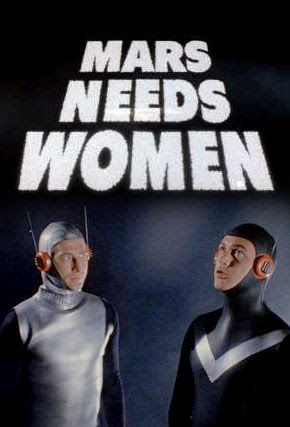
  Mars Needs Women -- Young men from Mars plan to steal a few choice women from Earth, but one of the Martians falls in love.

  Journey to the Center of Time -- Scientists with a time-travel pod visit earth's future and prehistoric past, and encounter themselves.

  In the Year 2889 -- Essentially a modernized remake (copy) of the '55 film Day The World Ended.

  Rocket to the Moon -- A British comedy retelling of the classic Jules Verne moon journey story, but no one gets to the moon.

  Planetary Giants -- An alien dictator wants the secret of an earth scientist's rocket, so he can build a fleet and conquer the earth.

  Planet of Invading Women -- A planet of pretty (but ruthless) women plan to steal earth children to use their lung tissue, so they can breathe earth air and invade.

  The Frozen Dead -- An old Nazi scientist uses the kept-alive head of a young woman, intending to use mind control to revive 1500 cryogenically frozen Nazis.

  Night Fright -- A space capsule returns from radiation-infested space, the monkey aboard has become a murderous gorilla monster.

 ---

Thursday, August 18, 2011

The Last War


In 1961, the same year as Beast of Yucca Flats,Toho Studios put out a blatantly preachy anti-nuke film titled Sekai daisensô. It was their rendition of On The Beach but with the anti-nukes message unencumbered by subtlety or allegory as in Gorath. Toho Studios president M. Shimisa said, "We of the Toho Company are employing every vestige of our technical skill to present as realistically and appealingly as possible exactly what will happen if this colossal horro befalls us. It is our sincere hope that by producing and exhibiting this film we can serve the cause of peace."Sekai daisensô was later edited and dubbed into english, released as The Last War (TLW) in early 1967. This review is for the dubbed version, but comparisons are drawn to the original as well.

Quick Plot Synopsis
The sailors on a Japanese merchant ship say they wish to return to Tokyo, even though they'll die of radiation. The main character, Takano, narrates the story as flashback.Tokyo was a busy, bustling city. It was also the home of the Tamura family whose eldest daughter, Saeko, was his girlfriend. Takano returns from a voyage. He and Saeko deal with how to best ask for her father's blessing for getting married. Intermixed with the family story are news reports of worsening international tensions between two super power alliances (thinly disguised America/Nato and Russia/Communist Block). Military maneuvers with live nuclear weapons increase tensions. A spy sub is captured. Things get more jittery. Both sides experience accidental almost-pushed-the-button moments that were narrowly averted. Other human interest characters are introduced. Takano's ship's cook recovers from surgery (kidney?), so is helping his daughter who is a kindergarten teacher. Lots of cute kids. One of them, Suzuo, is sick and her single mom works far away. Opposing air patrols start firing at each other over the arctic. Nuclear air-to-air weapons are used. The vaguely communist block cross the 38th parallel in Korea but their tanks are stopped. There are appeals for peace by the Japanese government, but summits break down. Takano must ship out again. Saeko goes to Yokohama to see him off, but they get married and enjoy their one night before he does. He ships out. The communist block decide to push their buttons. Missiles are launched -- some to Japanese cities. Panic in the streets as millions flee. Suzuo's mother dies of exhaustion trying to get to her girl. Saeko returns home. There is no defense, so everyone just sits and waits. Tokyo is blown up and consumed by fire storms. Other missiles are launched. Models of Washington DC, London, Paris, and Moscow are blown up too. Everything everywhere is destroyed. Takano finishes his contemplative flashback. Excerpt recordings of JFK's UN speech talk of need for disarmament. Fade to black. The end.

Apocalypse Suffered
Like On The Beach ('59), TLW is a tale in which total global nuclear war is not averted and everyone on earth dies. Like OTB, the intent is to preach disarmament by shocking audiences with the utter horror of global nuclear war. TLW provides a graphic look at how the war started, which OTB left as unseen and unexplained prior events.

Cold War Spotlight
TLW depicts the Cold War scenario with two super power alliances (The Federation and the Alliance, in the original movie), both of which have amble nuclear weapons to annihilate each other. TLW focuses on the hair-trigger dangers in a tense international arena. There is nothing allegorical. Only the names America and Russia are thinly disguised.

Notes
Original vs. Remix -- The original movie ran 125 minutes and told the story in chronological order. About 15 minutes of non-essential footage was edited out of the english-dubbed version. The major re-edit involved starting at the ending (the sailors deciding to return to destroyed Tokyo), and telling the story via flashback and narration. The dubbed dialogue is fairly faithful to the original, though no less awkward as most dubbed foreign films are. A few other peculiar variations exist too, which will be covered below.

No Kaiju -- TLW feels like a typical kaiju movie. It has model landscapes and cities which get destroyed. It has model tanks and planes which fire their little missiles. All it lacks is the monster. Both the special effects men, Eiji Tsuburaya and Akira Watanabe, worked on many of Toho's popular kaiju films: Godzilla, Rodan, The Mysterians, Mothra, Gorath, etc. Their work has a distinctive look and feel, even if there isn't a monster. I suppose the nuclear explosion is their kaiju in this case.

Heart Strings -- The story centers around the Tamura family. Father Moichi, mother Oyoshi, beautiful adult daughter Saeko, and her two young siblings, Hanu and Ichiro. Moichi is the good father, working hard to provide his family with prosperity. Oyoshi is the kindly but sickly mother and family peacemaker. Saeko is in love with merchant seaman Takano (who is also a boarder at the Tamura household, no doubt how he and Saeko got to know each other). Hanu and Ichiro are stereotypic kids. All of the character development is crafted to make the viewer care about the Tamura family. Thus, the viewer's heart strings are supposed to be pulled when at the end, they sit together silently in their living room, waiting for the missile to hit Tokyo.

Blasted Landmarks -- As has become traditional for apocalyptic movies, many familiar landmarks get destroyed. Among them are the US Capitol building, the Manhattan skyline and the Statue of Liberty, London's Tower Bridge, the Arc d'Triumphe, the Kremlin and Japan's National Diet building. The pyramidal top of the latter gets show several times at the end, the only recognizable bit amid the rubble and flames of Tokyo. How to show the destruction of Paris? Blow up the Eiffel Tower or Arc de Triomphe. Must faster on screen. This pattern of destroying symbolic landmarks would become an almost-required element for later doom films.

Bad English -- In the original, the two super powers both spoke English (and were played by caucasian actors). Japanese subtitles translated. But, the english spoken by these actors was mumbled or inarticulate, or just badly delivered. To Japanese ears, it probably sounded fine -- a bunch of "foreign" blather anyhow. Interestingly, in the english dubbed version, TLW, the caucasian actors' english was dubbed in too, by better voice talent. Listen for the distinctive voice of Paul Frees.

Random Act of Disney? -- In the original, the old cook's daughter has her kindergarteners sing him a farewell song. It is a traditional New Year's song (though the lyrics were not subtitled). In the english-dubbed version, the kids are dubbed to be singing "It's a small world (after all)." As unrelated as a Disney tune seems to an anti-war film, it actually does have a connection. Disney's songwriters Robert B. Sherman and Richard M. Sherman wrote the tune in the wake of the Cuban Missile Crisis -- which occurred only a year after the original film was released. The song debuted at the '64 New York World's Fair, and later became a Disneyland hallmark.

Biblical Variants -- In the original, Saeko sees that the sweet potato street vendor has a Bible at his cart. She picks it up and reads from it James 4:1-3. These are the verses that say "why are there wars among you? Because you lust and have not." On the one hand, it's clear that Toho was using western tradition (the Bible) as an indictment. On the other hand, it's interesting that a bible in Japanese is included at all. The old street vendor took it with him everywhere, and Saeko was familiar enough with it to flip it open and read from James. In the english version, Saeko reads from the Bible too, but the writers started with Psalm 140, verse 1 and 2, " Deliver me, O LORD, from the evil man: preserve me from the violent man". Then they added excerpts from Jeremiah 49:2,3 about alarms of war and daughters burned with fire. After that, they resumed the original verses out of James.

JFK Epilogue -- TLW wraps up with an extended quote from JFK's speech to the UN assembly in September 1961. The occasion was a memorial for the death of the Secretary-General Dag Hammarskjold. He died when his plane crashed in Rhodesia (later Zambia) while on a peace-brokering mission. The loss of such a capable peace-maker at a time when US/Soviet tenses were flaring, was troubling. JFK used the occasion to denounce nuclear proliferation. The writers/editors remixed parts of JFK's 3rd and 13th paragraphs, including the famous quote that mankind must end war, or war will end mankind.

Bottom line? TLW is interesting as a snapshot of Cold War mood. Told from the Japanese point of view (not one of the warring sides), it captures some of that helpless feeling most people had. The message is delivered with little subtlety, but even this conveys some of the sense of urgency people felt. The model work has its interest, but it's not the focal point. For a personal (if depressing) double-feature, watch TLW to get the war, then On the Beach for doom of survivors, such as the sailors on Takano's ship -- A double dose of doom.

Saturday, March 26, 2011

The Ambushers

The mid 60s saw many spy movie spoofs. The Ambushers (TA) was Columbia Picturers' contribution. TA was the third in their series of four Matt Helm films, starring Dean Martin. All four were based (very loosely) on novels by Donald Hamilton. TA only barely qualifies as a sci-fi movie, and even then, only because it features a flying saucer as the MacGuffin. As a Bond parody, the Matt Helm movies pushed the boozing, womanizing, innuendo and crazy gadgets to absurd degrees. Such parodies are the foundations for later parodies, such as "Austin Powers." Senta Berger and Janice Rule star as the lead females.

Quick Plot Synopsis
I.C.E (Intelligence Counter Espionage) launches their experimental flying saucer, which uses electromagnetic levitation which is fatal to men. It flies off successfully, but is hijacked by a controlling ray from deep in the Mexican jungle. The pilot, Sheila Sommers, wanders out of the jungle in a catatonic state of shock. She was abused by the evil Leopold Caselius, pretending to be a beer company owner. He plans to sell the saucer to the highest bidder. Back at I.C.E. Sheila suddenly comes to, but thinks she's married to Matt. (they were in the dim past). Mac sends Matt and Sheila, posing as honeymooners, to Acupulco to investigate Ortega and his beer company. Amid much scenery and shots of scantily clad women, Matt eventually gets a tour of the beer factory. Caselius is onto Matt. A fez-wearing baddie named Nassim and a pretty foreign agent named Francesca, are also following Matt. Through plot twists and turns, Matt finally learns that the saucer is hidden in one of Caselius' remote haciendas. Matt sends Francesca in first, to play the loyal buyer. Matt lets himself get captured and brought in. Nassim captures Sheila and brings her in. Both Nassim and Francesca put in bids for the saucer, but it's already sold. Caselius orders Matt shot by firing squad. He escapes this by blowing laughing gas from a specially tainted cigarette. Nassim and Francesca each escape murder too. Francesca finds the saucer first, but Nassim kills her. He goes inside to steal it, but the radiation it emits kills men. He emerges screaming. Sheila escapes being ravaged by Caselius via drugged lipstick. She gets to the saucer, but Caselius recovered and traps her inside, again attempting a ravage. Sheila kicks the power on and Caselius is radiated. Scream and die. The brakes on the railway flat car are released, so the saucer begins a long careen through the jungle. Matt chases it on a motorcycle. He catches up, lifts Sheila off the speeding flatcar with a levitation ray gun, and places her on the back of the motorcycle. The flatcar flies off the end of the obligatory cliff moments later. The saucer explodes, obligingly, at the bottom. Everyone returns stateside. Matt resumes his boozy playboy spy role. The End.

Why is this movie fun?
It's a comedy. It's supposed to be fun. Granted, most of the humor is fairly low, but some jokes are okay. The saucer itself is classic 50s stuff.

Cold War Angle
Most spy movies involve infiltrator and evil despots, but not necessarily in the Cold War angst category.

Notes
Based on the Book? -- David Hamilton's Matt Helm novels were not high literature, but were at least serious spy fiction. Hamilton must have been embarrassed at Columbia's action-comedy "spoof" adaptations. Imagine Ian Fleming's Bond stories set as a Muppet Movie, with Kermit playing James Bond. It would be hard to follow the book very closely. The 1963 novel, "The Ambushers," did feature his super spy Matt Helm, and was set in Central America (Mexico is close enough, I suppose). There were a few characters borrowed, such as Sheila and Mac, but there is little affinity beyond that. In lieu of a stolen Soviet missile, the movie has a stolen flying saucer. Beyond that, the movie is packed with innuendos and boob jokes.

Got Boots? -- Note the very 60s costuming of the ladies. Tall boots and very short skirts are aplenty. Sheila goes through several outfits with tall matching boots. The white outfit is for the beer factory shoot out only. The orange outfit is for getting captured. Francesca (Berger) has her own tall boots outfits, as do many of the "Slaygirls".

1950 Dejavu -- The plot of TA is reminiscent of the 1950 film The Flying Saucer, written, directed and produced by Mikel Conrad. TFS had a secret government saucer which was stolen by enemy agents. They planned to sell it to the highest bidder. A hard-drinking secret agent and his female sidekick (who pretends to be a non-agent), track down the stolen saucer in a remote location. Multiple bad guys emerge and almost succeed. The saucer is destroyed in the end. Sound familiar? Hamilton's novel wasn't this close to TFS. It's Herbert Baker's screenplay that was.

Wasted Mod-Mustang -- Nassim, the vaguely
arabic sinister agent, drives a modified '65 Mustang fastback. It has some winged antennae thing and a taller roof, open in the back. Other than getting Nassim from A to B, this special Mustang does nothing special. Perhaps there were car gizmo scenes or a gimmick-charged chase scene that showed off what the car could do, but they were cut. A pity. The car looks like it had potential.

Joke Samples -- The humor and sex references in TA are, for the most part, aimed at a pretty low common denominator. Typical example: (Sheila wants to 'carry on' with Matt while they watch Caselius' hacienda). Matt: "In broad daylight?" Sheila: "What's wrong with a broad in daylight?" Example of the better ones: (Matt faces the firing squad. His requests for a last meal or a blindfold were turned down with a simple "no".) Matt: "Can't I have a last cigarette?" Quintana: "No, they're bad for you."

Rat Pack Inside Joke -- The "Rat Pack" of the 60s included Dean Martin, Sammy Davis Jr., Frank Sinatra, Joey Bishop and a few peripherals. They regularly spoofed each other. At the end of TA, Matt is instructing a new recruit on how to make out. He puts on music -- his own "Everybody loves somebody sometime..." tune. This puts the recruit out of the mood. He then plays Sinatra's "Strangers in the night..." and the recruit turns nympho. Matt says: "I had no idea you were such a Perry Como fan." (barrroom ching) (For those not familiar with 60s culture, Perry Como was the clean-cut, good-taste crooner counterpart to the booze-n-women Rat Pack crooner, Sinatra.)

Bottom line? TA is a comedy spoof of the Bond-style action spy thriller movie genre. As such, there is little sci-fi in it. It does have a flying saucer. If Bond parodies, with lots of cleavage and innuendo, are not what you're after, but you do like flying saucer movies, you could watch the first 10 minutes and the last 10 minutes. That is all that has the saucer.

Tuesday, March 22, 2011

Night Fright

This low-budget indie production was probably aimed at the television market rather than the usual theatrical release. Television programming is normally outside the scope of this study, but since Night Fright (NF) starred John Agar -- a familiar name in 50s B movie-land -- and since NF follows the 50s idiom for monster-horror-scifi stories, it has earned a spot here. In fact, if the cars had been older, and it shot in black and white, it could pass for a 50s B movie without question. NF is said to have been released in the UK with the title E.T.N. (ExtraTerrestrial Nasty).

Quick Plot Synopsis
A couple of "teens" are necking on a remote dirt road with the catchy name: Satan's Hollow. They hear a radio report of a flaming object that fell from the sky nearby. They resume necking and are attacked by a lurking monster we don't get to see. The victims are discovered by Chris and Judy. The sheriff's (Agar) murder investigation is hampered by federal investigators who have sealed off the area. The flaming object was a returned space agency rocket. There is some extended time spent on good teens vs. bad teens and a couple of weak but interlocking love triangles. The bad teens all decide to go have "a blast" out by the lake, even though that was where the murders took place. Bad teens don't listen. A professor friend of the sheriff tells him of a space project called "Noah's Ark" that sent animals into space. It was lost of six months, then suddenly crashed just outside of town. Lots of radiation-mutants in the wreckage. Some were half eaten by a larger mutant they never found. Chris and Judy try to warn Rex and the bad teens of their danger. A show of egos turns into a fight which the good teen wins. Everyone leaves except the ego-damaged Rex and his girlfriend Darlene. The monster arrives (a gorilla suit and mutant bald gorilla demon mask). The monster chases Darlene through the woods. She meets up with her sister Joan (girlfriend of the sheriff). The monster almost gets them, but the sheriff gets them to safety. Darlene was scared stiff like a manikin, Joan says. This gives sheriff Clint an idea. He has Chris get him a bunch of stuff and meet them at the danger zone. He does, and several men begin a lot of waiting in the woods. Clint fashions a decoy out of Joan's nurse uniform on a manikin. The monster eventually comes chasing Chris and Judy, (who were not making out, btw). The monster goes for the seated manikin. Clint pushes the plunger, setting off the dynamite. Blamo. No more monster. Everyone is happy. Clint and Joan kiss. The End.

Why is this movie fun?
The story is so typically 50s that it has nostalgia value. The acting is amusingly flat or erratic. The "hip" teen lingo brings a smile. The monster is like Robot Monster turned Sith. Rocket science is fraught with danger, but good triumphs over evil.

Cold War Angle
This is peripheral, but there is the customary (if not cliche, by the mid-60s) warnings about the nasty things radiation can do to living creatures.

Notes
Aging Agar -- John Agar had been in B movies throughout the 50s. His high points were probably Revenge of the Creature ('55) and Tarantula (also '55). He had the lead in many lesser films, such as The Brain from Planet Arous (57) and Journey to the Seventh Planet ('62). By 1967 he was in his mid 40s and looking a bit less hunky. Nonetheless, Agar gives a fairly good effort as sheriff Clint.

Teen Monster -- The sub-genre of teens (often dancing) and a rogue monster had perking along for several years. Not that the movie featured teens or "teens" played by twenty-somethings. (e.g. The Blob or Teenagers From Outer Space).The movies with dancing / partying teens typicallly fall victim to the monster. In this odd sub-genre are: The Giant Gila Monster ('59), The Horror of Party Beach ('64), The Creeping Terror ('64) and Monster A-Go-Go ('65). These, and NF, featured extended footage of "teens" dancing their crazy kid dances. Often, the dancing scenes have a hint of voyeurism to them, with close ups of girls' gyrating backsides. NF upholds this tradition with multiple shots of Carla's plaid dancing butt. It should also be mentioned that writer Russ Marker's other screenplay, The Yesterday Machine ('63) opened with a long look at short-skirted baton twirler dancing to pop rock. It was a 60s thing.

Traditional Evil -- A regular feature in 50s B sci-fi was the danger of radiation. It turned some hapless sea creature into Godzilla. It mutated humans, and wasps (Green Hell) and causes untold damage. By the mid-60s, space exploration was pulling back the veil somewhat on the mysteries of space. This makes NF more of an anachronism.

Cars Aplenty -- NF offers a nice sampler platter of mid-60s Detroit cars. There are several mainstream staples, like Chevy Impala, and Biscane, and Ford Galaxy and a tidy '66 Mustang fastback. There is a "vintage" '63 Chrysler Newport wagon as the ambulance. It gets lots of screen time. The ill-fated neckers were in a '67 Pontiac Firebird. The good teen, Chris, drove around a hulking (but interesting) Oldsmobile Toronado. Not your typical teen boy choice.

TNT: Man's Best Friend -- Dynamite has been the monster-fighting weapon of choice in many B movies. Sometimes it hasn't worked, but often enough, it does. To keep from being too obvious, Russ Marker did not let the cat out of the bag too soon. Clint just handed Chris a note of some supplies he needed. If he had said "get me some dynamite," viewers would have known too soon. It's always dynamite. Nor did Marker give it away with the manikin. Only the quick cut of the detonator at the last second let viewers know that mankind's best anti-monster tool had saved us all again.

Bottom line? NF is sometimes called one of the "worst movies ever," and not without cause. It has a plot that was a decade old when released, lower-teir actors (Agar excluded), a cheesy monster costume, pointless love triangles and alpha-teen rivalries, and way too much footage of men walking through woods, or sitting in woods. Yet, for fans of movies with monsters and dancing teens, NF has both.

Friday, March 18, 2011

The Frozen Dead

Yet another British import of 1967 was another Gold Star Production, written and directed by Herbert J. Leder (of "It!" fame). The Frozen Dead (TFD), avoids some of the pitfalls of one-man-band projects, but not all. Star Dana Andrews lifts TFD from the sea of B-movie obscurity, though not too high above the waves. The story is a horror / sci-fi hybrid, in the Frankenstein mode, made up from a combination of traditional tropes. TFD is another installment in the head-in-a-box subgenre.

Quick Plot Synopsis
Dr. Norberg is former Nazi doctor leading a quiet life in a rural english mansion. His clandestine project is trying to revive frozen Nazi party elite. His work has only been partially successful. Of the dozen frozen men he had, the first seven suffered brain damage. They're kept in his basement like prisoners. The eighth, Joseph, is an expressionless mute who serves as Norberg's butler. Norberg's financial backer (and shadow Nazi party boss) drops in to witness the successful reviving of the 9th man. If successful, it will be the start of thawing 1500 loyal Nazis. The revival fails when Norberg's assistant, Karl, interrupts with news. Norberg's niece, Jean, and her friend, Elsa, dropped in. Norberg laments that he wished he had a fresh brain to study so he could figure out why prior attempts failed. Karl takes this as an assignment. He drugs and strangles Elsa, but blames Prisoner #3 (who happens to be Norberg's brother and Jean's father) who when unfrozen suffers violent outbursts. Karl coaxes Norberg into taking the opportunity. Elsa's head is kept alive in a box. Karl fakes Elsa's sudden departure, but Jean is suspicious. Norberg invites a Dr.Roberts to help him. They fail to get the head to control a wall of severed arms. Roberts becomes conflicted between his devotion to science (the head project) and his developing love for Jean. Meanwhile, Elsa's head (now inexplicably blue) develops telepathic powers. The prisoners are fearful. Karl is obsessed. Jean has bad dreams. She also keeps investigating Elsa disappearance, This eventually involves a police inspector. Turns out that Karl was not fetching body parts from the morgue, but killing people for the parts, so everyone has a lot to hide. Norberg's Nazi bosses grow impatient. Misbehaving Karl is tossed in the freezer. Lubeck is about to shoot Jean for knowing too much. Norberg struggles with him for the gun. They stray too close to the wall of arms. Elsa's head controls the arms to strangle Norberg and Lubeck. Jean rushes to the basement cell to see her father (Prisoner 3), but he starts to strangle her. The police inspector shoots Prisoner 3. Jean, Roberts and the inspector go to Elsa's head, which whispers over and over, "Bury me....bury me..." The End.

Why is this movie fun?
Dana Andrews does a reasonable job of portraying Dr. Norberg as both a dedicated scientist and a man with some scruples. Alan Tilvern plays the role of minion with a bit more depth than minions usually get.

Cold War Angle
Aside from the customary science-is-dangerous theme, TFD pushes the older Nazi Boogey Man buttons. There's nothing particularly Cold War about it.

Notes
Best Fiends -- As memories of WWII continued to morph into legend, film Nazis became more and more a caricature. TFD dabbles in that legend mode. The only German word Karl ever says is: "Schnell!" to his line of "prisoners." The frozen nazis wore full uniforms (with medals!). Clothes make the nazi. Tirpiz and Lubeck indulge in some stereotypic beating/torture of Karl. Mean, cruel, ruthless Nazis. The ideal film villains. So easy to write. The implication of a potential shadow threat of 1500 nazis waiting to emerge and resume their quest, is more of this legendary role.

Getting A Head -- Leder was writing on familiar ground with his head-kept-alive trope. Prior examples of the living head include Man Without a Body ('57), The Brain That Wouldn't Die ('62) and demonstrating that living-heads and nazis are a natural, Madmen of Mandoras ('63) Why Elsa's head had to be blue, is a bit of a mystery. Perhaps she could not be a girlish pink and still inspire fear. She was made up to look older and more haggard.

Brain Power -- Another retread trope in TFD is the notion that a brain separated from its body will most likely develop telekinetic and telepathic powers. This featured in Donovan's Brain back in '53 -- there, just a brain in a jar. The phenomenon appeared in Colossus of New York too, with Jeremy's brain inside the robot. Of course, Jan in the Pan in The Brain That Wouldn't Die started developing psychic powers. So, it's not too surprising that Elsa's head does the same. Interestingly, the brain prop showed a pulsating brain, is it were a heart.

Traditional Desert -- Customary in sci-fi / horror hybrids, is for the misguided (or mad) scientist to be killed by his monster. It is the traditional just-deserts for the hubris of playing God. The man who caused the problem is himself killed by it. In TFD, Elsa's head and the wall of arms make a sort of disassembled Frankenstein monster. They work together to extract just revenge -- not only on Norberg, but the shadow Nazi Lubeck too. TFD also has a subtle bit of cultural catharsis in that Norberg's "work" amounts to Nazis being maimed and killed by experiments by a Nazi doctor. More just deserts.

Low Rent Space -- Another well-worn trope is that the mad scientist lives in a big old house with his lab downstairs in the medieval-looking stone basement. Perhaps this is a legacy of that first Frankenstein movie. Good science takes place is well-lit modern campuses. Evil science takes place underground in dim rooms with stone walls. It's easier to track that white hats and black hats.

Bottom line? TFD is somewhat slow paced and constructed of many prior tropes. As such, it won't impress much of anyone familiar with the genre. Beyond Andrews and Tilvern, the acting is quite flat, except for a few rare, but well done, little moments. TFD is old-school rehash, but fairly watchable, if you're patient.

Monday, March 14, 2011

It!

Even though, It! is listed in some places as a sci-fi, there is really no sci-fi in it. Perhaps the science of archeology is the rationale, but there is little of this. Instead, this low-budget British film is a horror or monster story. Copyright 1966, It! showed in America in '67. Herbert J. Leder is the one-man-band of writer, producer, director. Roddy McDowell stars as the imbalanced assistant curator. The other 'star' is the invincible rustic statue: The Golem. This fact is tactfully avoided in the posters.

Quick Plot Synopsis
After a fire at a warehouse that contained a museum's storage, a big ugly statue is found unscathed. The statue kills the curator (for no apparent reason). Assistant curator, Arthur Pimm, (played by McDowell) hopes to be promoted. Pimm lives alone with the mummified corpse of his mother. He talks to it as if she was alive. Pimm keen on the pretty blonde Ellen, but she's indifferent to him. Pimm does not get promotion.The statue kills a disrespectful electrician. Pimm figures out that the statue is doing it. An American museum man arrives, telling legend of Golems. Jewish guardians, controlled by whoever put a special little scroll under its tongue. Pimm takes rubbing of inscription on statue to an old jewish librarian. He reads that it can be controlled by the scroll, but cannot be destroyed. Pimm finds the scroll in the toe of the statue. Pimm's new boss is an annoying pedant who fires him. Pimm impulsively tells statue to kill his new boss. It does. The police are starting to suspect Pimm. Pimm is keen on the buxom Ellen, but she's keen on the American. Pimm boasts to Ellen about his power. He has the statue wreck a bridge to prove it. Police suspicions grow.He tries to burn the statue to be rid of it, but it is fire proof and returns to its pedestal. Off camera, Pimm kidnaps Ellen from her bed and steals a hearse. He drives the statue, Ellen and his dead mother to rural cloister. The caretaker woman can tell things are bad, but Pimm forces her compliance. Pimm has the statue guard the gate, but has no other real plan. The army tries bazookas and artillery, but the statue cannot be blasted. The only course of action left is to use a tactical nuke. Meanwhile, Pimm has grown angry at Ellen when she calls him mad. He orders the statue to get rid of Ellen. While carrying her across the lawn, he drops her. With only a minute before bomb time, the American sees Ellen run free. He grabs a handy motorcycle and races in. He grabs up Ellen and rushes back to the sandbag barrier just in time. Cue stock footage of a nuclear test. The old brick building is just flaming rubble. But, the statue walks along undamaged. It walks to the sea, wades in, and disappears. The End.

Why is this movie fun?
Even though It! is not really sci-fi, it is a fairly briskly told tale. A statue as monster different enough. Roddy McDowell puts in a colorful performance.

Cold War Angle
Unstoppable destructive power tends to corrupt. This is the cautionary moral.

Notes
Psycho Brother -- Arthur Pimm seems patterned after Norman Bates in Alfred Hitchcock's Psycho. Both are peculiar nervous types who live alone with the dead bodies of their mothers seated in rocking chairs. Both take a juvenile liking to a pretty blonde. Pimm, as a sort of British brother to Bates, puts a strange spin into the story. His imbalance makes misuse of the Golem's power far more likely and takes less rational forms.

Juvenile Anti-Hero -- The Pimm character is written with some sympathy, almost as an anti-hero, designed for young male audiences to identify with. He's a capable enough young man at this job, but frustrated in his career, having to endure oppressive elders. He has 'bipolar' relationship with his mother. He is keen on a pretty young woman, but she's not interested in him. Thus far, Pimm is an Everyman for teen guys. Into those inexperienced emotional hands is given great power. Understandably (but not commendably) he uses that power for selfish gain -- the promotion, to impress the girl, to silence an enemy. Also typical of youth was to never once consider the larger stage he was acting upon. He kidnaps the pretty girl (another juvenile male fantasy solution to their dilemma), but had no larger plan than that. Eventually, the world comes crashing back in on him.

Plot Gap or Commentary? -- Near the end, Pimm is holed up in the cloister with his pretty captive. He has the indestructible statue guard the gate. The British army try blasting it with a bazooka. (strange, that usually works) Then with an artillery piece. When the nuke is about to fall, Perkins races up to the house on a motorcycle to rescue Ellen. Couldn't the army have done that all along? It was just one lumbering statue. Was the writer this sloppy? Perhaps not. A hint to a possible reason comes when the inspector says that the army is going to drop a nuke on it. The earlier failures were blows to their pride. That's the key. Stopping the unstoppable (by military means) became an obsession. Herein lurks another Cold War commentary. This also fits the ambiguous ending. When the statue stomps off into the sea, its immediate controller (Pimm) might have been neutralized, but the lingering threat of that unstoppable power remains.

Bottom line? It! is not really sci-fi. It is a low-budget horror/monster film crafted to resemble the more famous Hammer films. Much of the action is told via dialogue rather than shown (a feature of a low-budget). Despite these shortcomings, as a story, it has some redeeming qualities.

Thursday, March 10, 2011

Planet of the Invading Women

Estudios Americas, produced a sort of sequel to Planetary Giants, in 1966. La Planeta de las Mujeres Invasoras, (Planet of the Invading Women) (PIW), is more of a "continuing adventures" than a true sequel. It opened in Mexico in 1966, in the United States in 1967. PIW stars the same four stars from the prior film, playing the same characters: Professor Daniel Wolff, rocket scientist, Sylvia, his pretty secretary, Marcos the boxer and Taquito, his trainer. Shot in black and white, and with the opening footage of a blinking flying saucer, PIW has a very 50s look to it. The plot, too, is very 50s, owing much to Catwomen of the Moon, and others in the "Planet of Beautiful Women" sub-genre.

Quick Plot Synopsis
A flying saucer lands near an amusement park at night. Two pretty female invaders incapacitate two men who operate a saucer-shaped 'moon' ride. Cut to a parallel story of Marcos the boxer. Professor Wolff and Sylvia urge him to win (not throw the fight like last time). Marcos wants a date with pretty Sylvia. She agrees, provided he wins. A shadowy gangster, Toño, reminds him he agreed to lose. In the ring, Marcos wins Sylvia agrees to a date. Later, Toño's thugs ambush Marcos, but they're poor shots. Macros takes Sylvia to the carnival and board the very saucer ride the aliens had commandeered. Toño and his thugs follow them in. They're all kidnapped when the saucer flies off. On the planet Sibila, a planet of only young women, Queen Adestrea smiles but tells them they're prisoners. Obey all commands. In a scuffle, on thug is killed. He's taken to a lab where the Sibilians remove lung tissue. They can only breathe earth's air for a few hours. The earth tissue will create breathing a apparatus. The other thug escapes, but is blinded by the intense Sibilian sun. He is taken for lung surgery too. The queen's twin sister, Alburnia, is good, so helps the earthlings. She sends back her servant, Fitia, to earth to give professor Wolff a "send help" message. Adestrea sends two of her women to stop Fitia. They have the new lung filters. Fitia does not, so she dies before delivering her message. However, Wolff figures out enough that he and Taquito take Dr. Walters' rocket and fly to Sibila. Once there, they pretend to be rogues interested in selling humans to Adestrea. The two women report that the new lung filters wear out fast. Adult lung tissue is worn. Adestrea orders them to kidnap 20 school children. She has a mirror weapon that can kill only adults. They do this, and the saucer has its load of kids. Adestrea is captured by the good guys. Alburnia trades clothes with her. Wolff and the others gain control of the mirror. They kill the alien guards, freeing the children. They then use the mirror on Adestrea's guards too. As they all head for the rocket to leave, Adestrea stops them. Toño shoots Alburnia, but since they're special twins, both Adestrea and Alburnia die at the same time. The earthlings take Alburnia's body to earth for a proper burial. The End.

Why is this movie fun?
The Planet of Beautiful Women trope is amusing in itself. PIW is a worthy member of the group. The format, sets, props and photography are all very reminiscent of 40s and early-50s serials, so there is some nostalgia value.

Cold War Angle
Such themes are secondary at best. You do have a 'heartless' despot with agents operating in "our" land. She might intend to invade. (unclear) The bulk of the film is more adventure than angst.

Notes
Women! -- PIW is a solid example of the time-honored 50s sub-genre featuring planets inhabited by only 20-something pretty women. Others include Catwomen of the Moon, Abbott and Costello Go to Mars, Missile to the Moon, and Queen of Outer Space. PIW offers no reason why there are only pretty young women on the planet. It's just a fact.

Good Girl, Bad Girl -- PIW also employs the dualism featured in several of the other Planet of Women stories. There's a bad girl who doesn't like men and a good girl who does. PIW does the dualism one better by having them be identical twins! Queen Adestrea is the heartless, scheming and vain bad side of womanhood. Her twin sister Alburnia is kind and compassionate. An interesting twist is the lightly metaphysical notion that evil cannot exist without good, and wherever there is good, there will be evil, is that if one of the twins dies, the other will immediately die too.

Night and Day -- In the spirit of dualism, viewers may note that the alien planet in the first movie, Planetary Giants, was referred to as the "planet of eternal night." Sibila, the planet of beautiful women, was referred to as the "planet of eternal day." This makes the two movies a sort of film diptych.

Prop Watch -- As sister films, Planetary Giants and PIW share props and scenery. The conehead helmet of El Protector is duplicated as headgear for all of Adestrea's minions. The saucer is the same -- and even makes the same beeping sound. Of course Walters' rocket is the same, as it's a carryover too. Note the alien planet landscapes of the two movies. It's the same rocky barrens -- perhaps the Mexican equivalent of Bronson Canyon.

Pre-Jaffa -- Fans of the Stargate SG1 television series will note with some smile the spear weapons of Queen Adestrea's guards. They don't throw them, but use like Klingon pain sticks to subdue (or kill) their victims. Ruthless Queen Adestrea, flanked by her spear-toting guards looks like a retro-prototype of a Stargate Goa'uld "system lord" and her Jaffa.

Bottom line? PIW has all the faults and foibles of a low-budget production, capitalizing on the appeal of leggy young women. The special effects are vintage 40s, but therein lies some of its charm. Watch PIW, not as the best the mid 60s could do, but as a lost episode of the Planet-Of-Beautiful-Women series.

Sunday, March 6, 2011

Planetary Giants

This Mexican production is said to have played in the US in 1967. An english-dubbed version of Gigantes planetarios doesn't seem to exist, so perhaps it played in primarily spanish-speaking markets. Planetary Giants (PG) is the first of two sibling films by Director Alfredo B. Crevenna. Apparently patterned after tastes in populist Mexican television, the film's fabric is a mix of serious sci-fi, comedy (Marcos and Taquito) and "pro" fighting. (q.v. Santo and Neutron serials). The mix is definitely not in the Hollywood formula.

Quick Plot Synopsis
Flying saucers are landing at various spots around the world. People are killed with a beam weapon. Evidence suggests that the aliens are completely human in appearance, so undetectable. They are sabotaging key earth installations. Professor Daniel Wolff seeks the advice of Dr. Walters (dismissed by the scientific community as a crack pot).Walters tells of receiving transmissions from a "planet of eternal night," about a dictator there named El Protector. Walters suspects El Protector plans to invade Earth. First comes sabotage, then bribing vulnerable earth scientists to help. Finally, the invasion. Walters has one rocket for space travel. He says Daniel should use the plans to build a defense fleet. Daniel's pretty secretary Sylvia is pestered by a brash boxer named Marcos. Walters is killed by a ray gun blast. Sylvia suggests Daniel pretend a playboy gambler's lifestyle and complain of debts to attract an alien bribe, to gain access to the aliens. He does this, attracting the busty blonde Mara and her bald sidekick. Baldy wants Walters' rocket plans. He and Daniel fight. Baldy falls into a tub of water, fizzes and dies. Daneil must take Walters' rocket to the alien planet to defeat them. Marcos, the champion, boxes a contender. He bet against himself, then throws the fight in the first round. While fleeing a mob of bet losers, Marcos and his trainer, Taquito hide in the hotel room of the other two astronauts. They put on the space suits as disguises, but are put into hibernation and aboard the rocket. Sylvia joins Daniel too. The four zoom to the planet of eternal night. Once there, El Protector demands the rocket plans. He intends to invade and be the Emperor of Earth. Daniel refuses. They become embroiled in a palace coup that goes awry. Marcos escapes. With the help of the coup leader's daughter, Alice, manage to upset El Protector's plans. He takes Sylvia hostage, intending to flee to earth in Daniel's rocket, but is stopped. The planet is free to live peacefully. The four earth people zoom away. The End.

Why is this movie fun?
Even though filmed in 1965 (or '63?), PG is a thoroughly 50s B-grade sci-fi. At times, it's even a 40s style sci-fi. Saucers, ray guns, pointy rockets, pretty alien women, PG is a nostalgic pleasure cruise.

Cold War Angle
It is uncertain how much the Mexicans worried about commie spies, so the themes of fifth columnist saboteurs and oppressive dictators may have had a more conventional intent. Yet, those elements were common to American sci-fi's Cold War themes too.

Notes
Unexpectedly Timely -- Watching PG in the early months of 2011, made some unexpected parallels to current international events in Egypt and Libya. El Protector was a dictator who ruled with an iron hand and had no qualms about turning his weaponry on his own people if it suited him. His people were happy to see him overthrown. Life imitating art.

Plot Medley -- Fans of 50s sci-fi will note some familiar plot tropes. The first half of PG, set on earth with alien agents (who look like us) engaged in sabotage, was a frequent theme. Not of this Earth ('57), War of the Satellites ('58), Planets Against Us ('62) and The Human Duplicators ('65), to name a few. The second half is a close parallel to Flight to Mars ('51) More on that below. The format of PG is akin to a variety show. There are moments of serious sci-fi, with shadowy alien agents, death by ray gun, etc. Then there are moments of extended comedy (such as Taquito's budding romance with Alice's plumpish maid named Frijo (bean). This is not just the Hollywood notion of comic relief. It is like sections of an Abbott and Costello movie were intercut into Crash of the Moons. Then too, there are many minutes of boxing, almost for its own type of entertainment value. The result is an odd mix by Hollywood's yardstick, but perhaps the way Mexican audiences liked their entertainment.

Serial Redux -- Much about PG's second half resembles the old Buck Rogers, or Flash Gordon serials of the 40s. Likewise, a resembles to the early 50s' Video Ranger episodes. All have: cigar-shaped rockets that take-off and land on a dime, and fly slow, alien worlds just a few days journey by rocket, alien civilizations somehow stuck in an era of earth's past, and aliens who are all plain ol' people. Oh, and ray guns.

Viva Aelita! -- The plot of the second half of PG is a close parallel to Flight To Mars. FTM was itself an adaptation of the 1924 Russian film, Aelita, Queen of Mars. Both PG and FTM have a planetary despot intent on invading earth if/when he can get the secret of the earthlings' rocket. In both, the alien planet is (or is supposedly) doomed. Both have a ranking cabinet minster who is the clandestine opposition leader. Both ministers have beautiful daughters who aid the humans. The coup succeeds. Aelita lives on in yet another retelling.

Galactic Lingo -- A common scoff for American sci-fi films is that the aliens, wherever and whoever they are, always managed to speak pretty good english. So it was amusing and refreshing to see that the people on the Planet of Eternal Night, spoke pretty good spanish.

Bottom line? PG is far from a slick production with cool sets or models. Nor does it have a thoughtful plot. PG is old fashioned low-budget sci-fi like it used to be done in the 40s and early 50s. Fans of Flash Gordon, et al. can enjoy the homage.

Wednesday, March 2, 2011

Rocket to the Moon

Yet another British import for 1967, was Rocket to the Moon (R2M). While not a big studio production, (Jules Verne Productions did only this one film) R2M is a bigger budget production. It seems patterned after the successful star-sudded, retro-Victorian comedy epics of the mid-60s:: 20th Century Fox's Those Magnificent Men and Their Flying Machines ('65) and Warner Bros.' The Great Race ('65). R2M features many comedic character actors, such as Lionel Jeffries, Terry-Thomas and Gert Frobe. R2M was later re-released in America with more farcical title of Those Fantastic Flying Fools. R2M's claim to science fiction rests only in its tenuous connection to Jules Verne. It is otherwise an earthbound comedy romp.

Quick Plot Synopsis
The film opens to a montage of failed technological "triumphs". P.T. Barnum flees to England to escape the collapse of a business deal. At an Academy of Sciences lecture, he hears Professor von Bulow suggest his explosive could send a projectile to the moon. PT suggests they do more: send a man to the moon. A committee is formed. Dillworthy (Jeffries) will design the projectile. Bulow (Frobe) will design the propellant. The Duke will supply the land. PT (Burl Ives) will be fundraiser. Washington-Smythe (Thomas) will be treasurer. Gaylord Sullivan (Troy Donahue) is the American engineer. Madeline (Laliah Levi) is his fickle love interest. Through a complex web of subplots interspersed with gag vignettes, we learn that Smythe has embezzled all the funds. Dillowrthy's design is rejected so he's miffed. They team up to sabotage the project, wagering heavily on its failure. When the accounts are discovered to be empty, Madeline's other fiance steps up as investor. Despite bumbling and foolery, the project is ready to launch. Gaylord is strapped in, but gets his arm stuck, so cannot pull the launch lever. A spy of the Tsar is aboard, but knocks him out with chloroform. Gaylord is extracted. Dillworthy and Smythe sneak aboard to do more sabotage. The spy launches the Moon Ship, which sails into the sky. Everyone is sad at first, at the loss of the ship, but cheer up when coal rains down from the explosion. The Duke is now a wealthy mine owner. Meanwhile, Dillworthy and Smythe are at the head of a line of slaves pulling the Moon Ship along a country road. Dillworthy and Smythe argue about whether they are in Russia or on the Moon. Could be the moon if the Russians got there first. The End.

Why is this movie fun?
Well, it's a comedy. It's fun by design. There are some amusing gags and a few cute lines. Lionel Jeffries plays his usual nervous, befuddled Englishman. Thomas does an excellent job with his scoundrel character: Smythe.

Cold War Angle
In lieu of a Cold War spin, R2M has a Space Race spin with the apparent contest being who will get to the moon first, the Americans or the Russians.

Notes
Once Again -- Verne's story, "From the Earth to the Moon" (1865) had already been adapted to film in 1958. RKO's From the Earth to the Moon used Verne's basic plot, but wove in some Cold War cautionary themes. Peter Welbeck's story, ( and David Freeman's script) for R2M was only very a loose adaptation, with little in common with Verne's book.

Comedy Epic Pattern -- R2M fits into the comedy epic sub-genre of the mid-60s. It's not a strong example of a sub-genre, but it fits. The pattern was to have a cast of many stars (usually comedy actors) and a complex plot which allowed for many gags. It's a Mad Mad Mad Mad World ('63) is one of the best. A subset cast in Victorian times include:. The Great Race and Those Magnificent Men and Their Flying Machines (both '65), which were well done examples. R2M tries to follow the pattern, but falls short. It lacks the energy of the previous examples. It may be that Director Don Sharp was just not as skilled at directing comedy.

Missing Mockery
-- Making fun of Kaiser Wilhelm II had once been almost a cottage industry for the first two decades of the twentieth century -- especially in England. Wilhelm was typically mocked for his pomposity, fondness for ostentatious uniforms and his signature upturned mustache. By 1967, the contempt must have faded. Don Sharp (or his producers) portrayed Wilhelm as rather ordinary, apart from the fancy dress uniform. It is a bit puzzling why a British production passed up an opportunity to make fun of Willy. They used to be quite fond of the sport.

Moonless Mission -- Almost all of R2M's plot consists of getting the Moon Ship built. Only the last several minutes involve any "rocket" travel. The Moon Ship never leave's Earth, but is flown to Siberia by the Tsar's spy. This sets up one of the amusing (and final) gags, in which Smythe thinks they've landed on the moon. The fact that the other slaves sing the Russian labor song, "Volga Boatmen" is because the Russians got to the moon first.

Bottom line? R2M has its funny moments, but other films of the comedy epic sub-genre are funnier. For sci-fi fans, there is very little in the way of sci-fi elements, beyond a wee bit of steampunk. R2M is adequate as entertainment. Though the plot lags in many places, some parts are amusing.

Saturday, February 26, 2011

They Came From Beyond Space

Embassy Pictures brought American viewers another Amicus sci-fi film from Britain. They Came From Beyond Space (TCBS) was a modest budget film -- not ultra-cheap, but not lavish either. It is yet another installment in the alien-takeover sub-genre. It does carry a distinctly British flavor to its paranoia.

Quick Plot Synopsis
A "V" shaped formation of meteorites lands in a farm field in Cornwall, England. A team of scientists is dispatched to investigate. While they examine the rocks, they are taken over by beings of pure thought who rode inside. One of the scientists is Lee, girlfriend of Curtis, the extra-brilliant scientist who was not allowed to travel with the team. Curious at the loss of contact, Curtis travels to the site anyway. The possessed humans have built a fence, posted guards with guns and have run up big bills buying all manner of equipment and supplies. Government agents investigate too, but a mysterious plague breaks out. People suddenly fall dead (apparently) with red spots on their skin. There is no known cure for the Crimson Plague. The possessed people convince the government that they're building a rocket to take the dead for burial on the moon -- as the only safe solution. Curtis senses something else is going on, so keep trying to get into the compound. Eventually, he succeeds, but is taken prisoner. His former colleagues are all possessed by aliens. Even some people thought dead of plague are alive and working. Curtis escapes his cell, stuns Lee and carries her out. He takes her to a geeky friend's lab. They devise an anti-possession helmet (almost a tinfoil hat), a set of goggles that can "see" who's an alien or not, and a ray gun to stun or kill them. They devise a process to free Lee of her alien. Using Lee pretending to be still possessed, they get back into the compound. They sneak aboard the rocket bound for the moon. Once on the moon, they are monologued by the Master of the Moon who tells how they evolved into energy beings but were dying out. They needed some new bodies to possess, but crashed on Earth's moon. In a play for pity, the Master says they just want to go home to die. Curtis lets down his guard and is captured. The Master plans to remove the silver plate in his head and transfer himself to Curtis. Meanwhile, Farge escaped and foments a workers' revolt. This interrupts the operation. The aliens are all dejected about losing. Curtis says earthlings would have helped them build a ship to go home, if they had just asked nicely. The energy alien leaves his host body, who gets all cheery and shakes hands with Curtis. The End.

Why is this movie fun?
Yet another alien-takeover flick could be dull, but the eclectic British flavor keeps it different. Curtis' very clean 1924 Bentley is quite a rare treat to watch. It's almost a co-star.

Cold War Angle
The alien-takeover trope is a handy metaphor for patriots being "turned" to ally with the Dark Side. The not-so-subtle moral of the story is that someone might look like a soulless fiend intent on conquest, but deep down, they're just regular guys. If we'd just talk more, we could all get along. Kumbayah.

Notes
Based on the Book -- Joseph Miller wrote a novel titled, "The Gods Hate Kansas" in 1941. This basing means that TCBS's roots are among the oldest of the alien-takeover tribe. TCBS follows the book's plot fairly closely, except for the location (Kansas vs. Cornwall). All the major plot points are there: Meteorites with aliens aboard, who had crashed on the moon. Energy beings take over people and start building a secret compound and a rocket. An unstoppable plague breaks out which turns out to be a tool of the aliens to get workers, the hero has a metal plate in his head so he can't be taken over AND the ending where the hero says they just had to ask.

Possessing Lineage -- Just as a recap, the notion of aliens taking over humans is old. The Man from Planet X ('51) even went so far as to have the taken-over humans acting as manual labor too. It Came From Outer Space ('53) also featured aliens taking over townsfolk to act as manual labor to repair their ship. Apparently, it's tough to find repair shops in this stretch of the galaxy. The most famous take-over film, Invasion of the Body Snatchers ('56) was an earth conquest theme, not a repair job. From that famous example, to lesser examples, such as War of the Satellites ('58) and The Day Mars Invaded Earth ('63), the plot device of aliens taking over humans for nefarious deeds was becoming traditional to the point of becoming cliche.

Forbidden Fruit Fascination -- A recurring element in British sci-fi, is the notion of a closed-off compound. There must be something in the British psyche -- like a cat that cannot resist an empty box -- that is fascinated by the idea of a cordoned off zone that no one is permitted to enter. Perhaps the Brits have an innate conspiracy theory gene. All of the "Damned" movies featured secret compounds.

Bottom line? TCBS is a notch above the cheaper B sci-fi of the mid 60s, yet it's not all that special either. The alien-takeover trope has gotten long in the tooth, so lost most of its tension value. The peculiarities inherent in a British film, such as the Bentley, add some interest.

Tuesday, February 22, 2011

In The Year 2889

Larry Buchanan produced modern remakes of three of American International Pictures' 50s B sci-fi films for A.I. Television. (Hence the VHS cover art in lieu of a theatrical poster.) The third of these remakes, In the year 2889 (2889), is a very close copy of Roger Corman's 1955 cheapy, Day the World Ended. TV movies are out-of-scope, but since it is a remake of a 50s sci-fi, it's worth including. Buchanan did very little to the script, so 2889 is essentially Corman's '55 movie with different actors and shot in color.

Quick Plot Synopsis
See the synopsis of Day the World Ended ('55) for the original plot and notes. Below is a very brief recap. The story opens with a montage of nuclear test blasts and a narrator reading the same Bible verse, 2nd Peter 3:12, about the heavens being on fire and elements burned with fervent heat. Captain John and his daughter Joann are set to wait out the fallout in his protected valley hideaway. Joann's fiance, Larry is late, and presumed lost. Several strangers arrive at John's refuge. Steve, the handsome young geologist and his badly irradiated older brother Grainer. Tim, the grizzled alcoholic rancher from other the ridge wanders in. Mickey (the hood) and his girlfriend Jada (the dancer) arrive to make it seven. John has the gun, so he's in charge. Steve likes Joann, but she pines for Larry. Mickey likes Joann in all the wrong ways. Tensions flare. Grainger "gets better" but craves raw meat, so stalks the woods. Another mutant creature stalks the woods too. Joann feels it's calling to her. Jada and Mickey fight over his shifting affections. Tensions flare. Mickey drowns Jada. Tim, distraught over his lack of hooch goes over the ridge into the deadly fog. John follows trying to retrieve him, but gets a lethal dose for his trouble. Joann goes outside in a trance, to the mutant. She screams, faints and is carried by said mutant. Steve interrupts. Joann flees to a stream. Steve too. It rains, and kills the mutant. Mickey gets John's gun and plans to kills Steve and take Joann. John, hiding a second gun, shoots Mickey dead. Steve and Joann hold hands. Text over still: "The Beginning". The End.

Why is this movie fun?
If you're familiar with the original, it is fun to see it re-enacted by another cast. Knowing the story already, lets you focus on how differently (or badly) the new actors play their parts. It's a compare-and-contrast moment.

Cold War Angle
This is, necessarily, the same armageddon angst as the original, but some missing bits of opening narration suggest that the producers did not feel the audiences of 1967 were living in quite as abject fear as they were in 1955.

Notes
Commonalities -- See the notes on the original, as much of it still applies. Overall, 2889 is a very close copy of DWE. In many cases, the dialogue is exactly the same. Certainly it is a scene-for-scene copy with only a few deviations. (cited below)

Differences -- While 2889 does not differ much from the original, here are the main differences: The Father/Captain is named John, not Jim. The Lovely Daughter is named Joann, not Louise. The Mutant Fiance is named Larry (a joke about the director?), not Tommy. The Handsome Geologist is Steve, not Rick. The Radiated Man is Grainger, not Reddik, and he's cast as Steve's brother, not just a random businessman. The Hood is Mickey, not Tony. The Dancer is Jada, not Ruby. The Rustic is now Tim the neighbor rancher, not Pete the Prospector. Tim has no mule, like Pete did, though he is still fond of hooch. A more significant plot change is that The Hood kills the Dancer more in cold blood. In DWE, Ruby is accidently stabbed with the knife while she and Tony struggle over it. In 2889, Mickey deliberately drowns Jada. The Hood got more odious.

Water: Our Savior -- Since the original film, many others have come out in which good ol' ubiquitous water is mankind's savior. Of course, water melted the Wicked Witch of the West in The Wizard of Oz ('39). Salt water killed the triffids in '63. Salt water also stopped the Monolith Monsters in '57. Rain killed the heat aliens in Night of the Big Heat ('67) and mutant Tommy in Day the World Ended ('55). Much later, it was plain ol' water that stopped M.Night Shamaylan's aliens in Signs. Of course, just as many movies used good ol' fire to stop the monsters/aliens. We like our simple cures.

NOT From the Book -- The title of 2889 is entirely misleading. Jules Verne wrote a short story by that title, published in 1889. American International had purchased the rights to Verne's story, but had no script to go with it. They applied their owned title to Buchanan's remake, even though the two have nothing to do with each other. Verne's storoy was a sort of day-in-the-life of an American newspaper editor in the year 2889. As such, it served as a vehicle for delivering several predictions and marvels, such as travel by pneumatic tubes. Verne imagined audio-file newspapers (podcasts) replacing print, but still had physical delivery. No internet. He imagined England becoming a de facto colony of the United States, but also imagined that France would still have her African colonies, etc. etc.

Bottom line? 2889 is an even cheaper production than the movie it copied, which was itself pretty cheap. The acting is marginal and the creature too cheap (basically, a fright mask) to have much appeal to modern audiences -- particularly those with no empathy for the nuclear angst of the 50s. Fans of the original movie, Day the World Ended may be amused at the reenactment.

Friday, February 18, 2011

Journey to the Center of Time

David L.Hewitt produced and directed this low low budget remix of the usual time travel ideas. That this film, Journey to the Center of Time, (JCT) bears more than a passing resemblance to The Time Travelers ('64) is no coincidence. Hewitt co-wrote the latter and directed the former. There is more on the parallels in the Notes section. Production values are low, as JCT tells yet another tale of man traveling to the future and earth's prehistoric past.

Quick Plot Synopsis
Dr. Gordon and his team are trying to use laser technology to photograph the past. Thus far, they can only go back 24 hours. Mr. Stanton is the bombastic new owner/director of the lab facility. He scoffs at their project and demands results within 24 hours, or he'll shut them down. While demonstrating their time lab for Stanton, Mark is compelled to push the 'laser cycling' beyond safe limits to force results. The time lab hurtles 5,000 years into the future. They see a sleek rocket and a war going on. "Aliens" (plain men) escort our four time travelers to their alien leader, Dr. Vina. She monologues about leaving a dying world, looking for a new home and how earth seemed nice until this war broke out. Earth combatants breech the aliens' defenses. A melee breaks out. Vina is shot with laser. She gives a cautionary warning as she dies. The other aliens help the travelers back to the time lab and send them on their way. The time lab overshoots the present and travels back into the past. Our travelers watch extended clips from old movies. WWII. Civil War. Cowboys and Indians. Sailing ships firing at each other. (history = war, apparently). They encounter another time travel ship hurtling at them towards the future. Mark radios it, but no response. Stanton panics and fires their laser at it, blowing it up. The time lab finally 'lands' in the year one million B.C. Stanton goes out to look around. Mark and Doc go to retrieve him. Karen stays behind, but is scared by a "giant" lizard. She fires the laser to fend it off, but shatters the laser's ruby in the process. She then runs outside too. They all meet up in a cave. Lining the cave walls are large precious gems. They look for a ruby to fix the laser. Stanton, as the greedy capitalist, just pockets gems. In a lava chamber, he greedily pulls another gem from the wall, which somehow causes more lava to rise. They try to flee along a narrow ledge, but Doc falls into the lava. Stanton gets back to the time lab well before Mark and Karen. He puts his pile of rubies on the laser table and sets the controls for home. This strands Mark and Karen. En route to the present, Stanton sees another time lab hurtling toward him. He hears Mark's radio warning, himself panicking, and firing. Stanton and the time lab blow up. Mark and Karen emerge from the jungle to find an empty time lab with settings the same as when they first landed. Oh well. Mark and Karen travel back to the present, but their time synchronization is off. They arrive several minutes too soon. Everyone in Time Central is frozen in the present. Worrying that when the present catches up with them that they might explode, or implode, or something bad, Mark and Karen get back into the time lab and set off for some undefined time in earth's future. They might be a new Adam and Eve for a brave new world. Star field, fade to credits. The End.

Why is this movie fun?
JCT is undeniably low budget and full of inane techno-blather, but it has 60s . It tries hard to be deep and complex. Despite some laggy padding, the story does at least move along to its denouement.

Cold War Angle
Like many of its 50s brethren, JCT is a cautionary tale about unchecked militarism in the future, and mega-weapons getting out of control. They arrive in the year 6,968 in the middle of a "nuclear war."

Notes
Time Travelers Retread? -- There are lots of similarities between JCT and The Time Travelers, but there are many differences too. This should be no surprise, as Hewitt co-wrote TTT and directed JCT. Below are some commonalities and differences.
Same Stuff: A time viewer project. Funding about to be cut off. Push the lasers beyond safe limits. Three scientists, one a woman, and a non-scientist. Future earth is bleak. A big fight between factions in the future. Return to present with people frozen. Time loops.
Different Stuff: A spherical 'ship' travels to the future instead of stepping through a portal. Obnoxious capitalist in lieu of comic relief janitor. Aliens in the future instead of mutants. Some of the travelers die. Instead of ending in a perpetual loop, Mark and Karen avoid the loop and set off for a (linear) future.

Ruby: The New DiLithium -- Throughout JCT the scientists keep talking about lasers and coherent light, etc., which is all fine and scientific. But, at other times, they talk about their ruby as if it were a Star Trek di-lithium crystal -- their quasi-nuclear power source. Near the end, Stanton piles some rough rubies he's collected in the cave, on the "laser" stand and somehow this restores the time lab's power. An amusing mix of fancy and factoids.

Slick Cheap -- Cheap sci-fi "space ship" sets in the 50s were cobbled together out of military surplus, and resembled the insides of a submarine. Note how cheap in the mid 60s had gone through an upgrade. Smooth orange octagonal walls (no boiler rivets) for the interior of the time lab. There were lots of flush-set blinking lights and that really cool quarter-opening sliding door. And what about that utterly pointless scissor lift that lowered Stanton three feet from the 'mezzanine' to the sunken-livingroom center area? It was still cheap, but it was following a different vision.

Want Babes? Be A Computer -- Note the background of the Time Central facility. The back wall is filled with their "computer" (lots of lights and non-moving tape reels.) Yet, this beast requires a bevy of beauties to attend to it. Half a dozen or so pretty, and leggy young women in high heels (and white lab coats) stand there in glamor poses. Hewitt (also the film's producer) must have been quite the man around town with the ladies. "Hey, I can get you part in a movie..."

Pre-Carol -- Watch for Lyle Waggoner in his brief role as alien squad leader. He doesn't get much for a part. This is before he became famous on the Carol Burnett Show.

Poupee, We Hardly Knew Ye -- The credits announce: "Introducing: Poupee Gamin" in the usual style for launching a career. Her part in JCT was minimal as Dr. Vina. She stood, for awhile, in her tight "bald" cap and very ample cleavage. Perhaps that was Poupee's outstanding feature(s). Yet, Poupee did not go too far. She played small parts in two more movies in 1967, then disappeared from the screen.

Spider-Rat-Bat Cameo -- In a nod to Ib Melchior, Hewitt included a very brief glimpse of the Spider-Rat-Bat creature from Melchior's Angry Red Planet ('60). Hewitt and Melchior collaborated on TTT. This brief glimpse occurs when our band of four are viewing glimpses of the future before they get there. No explanation. It's just there.

Bottom line? JCT is a rehash of time travel tropes and stocked with utterly stereotypic two-dimensional characters. The overall quality is marginal, and enough pointless padding to frustrate the attention-span-challenged. It feels like it was a one-hour TV episode padded out to just barely make "feature film" runtime. Yet, for fans of 60s time travel stories, it has plenty of psuedo-science babble and LASERs. Lots of laser talk. The result, while not deep nor cerebral, has some entertainment value.

Sunday, February 13, 2011

Mars Needs Women

This study looks at sci-fi movies which had a theatrical release, even if very small. It seems that Mars Needs Women (MNW) was made for television only. It's included here, "granfathered" in, on the coat tails of Larry Buchanan's work remaking 50s B sci-fi for television. Where his other projects were 50s sci-fi remade for the 60s, MNW was NOT a remake, but a new product by Buchanan himself. He wrote and directed it. Yet, MNW is very much a kindred spirit of 50s cheapy sci-fi in many ways -- complete with "aliens" who are exactly like us, but wearing hooded body suits.

Quick Plot Synopsis
Several young women disappear (via cheap camera stop). Messages are received coming from outer space. Once decoded, they say "Mars Needs Women." The martians contact the Air Force to say that remotely snatching women didn't work out, so they're coming to earth in person. The leader martian (looking like a 40s 'martian' in hooded unitard) tells Colonel Page that due to genetic decay, few women are born on Mars. The male-female ratio is now 100;1. They want to ask for volunteer earth women. Colonel Page refuses. Dop says they'll just steal them then, and pops out. The world is placed on high alert. Page scrambles fighters to shoot down the martian ship. The "Cheetah-15" (X-15) is kept at bay with force beam. The early F-111 is also kept at bay. The martians land near an abandoned ice factory in Houston. The leader (Fellow 1) says they'll need some chemicals, earth money, earth clothes and a car. Fellow 3 robs a Phillips 66 station, so they have money and a map. Fellow 4 steals a Buick from a parking lot. Fellow 5 steals some suits from a men's store. To complete Operation Sleep Freeze, each of the Martians is to go find a suitable earth woman and bring her back. Fellow 5 settles on a stripper. Another Martian sets his sights on a college "co-ed." Yet another scopes out an airline stewardess. Meanwhile, Fellow 1 has decided to go for Dr. Marjorie Bolen, (Yvonne Craig) a young, sexy, space geneticist (?) in town as an advisor for the Martian Hunt alert. Fellow 1 hypnotizes a reporter to hand over his identity papers, then drive back to Seattle and forget the whole thing. Fellow 1 then pretends to be the reporter so he can get close to Bolen. Fellow 1 charms Bolen, so they do some quasi-romantic walks and talks. Bolen starts to like the Martian-fake-reporter. Meanwhile, Fellow 3 has homed in on a homecoming queen as his target. Fellow 4 gets his co-ed. With four women reported missing, authorities know there will be one more victim. All the abductions are centered on the abandoned ice plant. Bolen points out the chemicals there could be used to "freeze" people for long space flights. The army plans to attack. At supper, Bolen lets slip the army's plans, so Fellow 1 rushes to the ice plant. He implores his fellows to abort the mission and flee. They argue. Fellow 1 admits to rediscovering "love". Hug. Kiss. The army arrives and starts shooting. The Martian ship flies away. Women not stolen after all. Bolen all weepy. Text as final frame: "Earth is the cradle of man, but he cannot live in the cradle forever." -- Konstantin Tsiolkousky. The End

Why is this movie fun?
From the 40s-style martian outfits, to the 50s-style aliens-want-our-women plot, MNW is a throwback to the golden age of B sci-fi. It's not quality cinema, but it is amusing as nostalgia.

Cold War Angle
More as a side-effect of using 50s motifs, MNW rehashes the metaphors of enemy infiltrators. Spy-phobia abounds.

Notes
They're After Our Women! -- One of the old traditional tropes for sci-fi was to play on the primal (male) angst that outsiders wanted to steal OUR women. (How DARE they?) This played out as metaphor with the likes of Ro-Man carrying off pretty Alice, or the Gill Man absconding with Julie Adams. In other movies, the angst played out less subtly, such as the Mysterians demanding five earth women for breeding purposes. MNW is one of the blatant stories. Very clearly, they state that they (the Martians) want our best babes for breeding. Like the Mysterians, at first, they ask politely. When that fails, they steal them. The basic plot line of MNW would still work if it had been a Trojan raiding party that captured some prime Greek girls, but were chased off by Athenian warriors, or if Apache raiders had captured some pretty settler women, but the raiders were chased off by squad of cavalry, etc. etc. For MNW, the raiders just happen to have come from the tribe of Mars, so it's sci-fi..

Choice Women -- The Martians select five women, who apparently meet their stated criteria of being "young, healthy and with good reproductive capabilities." By this, they don't mean healthy ovaries and wide-set hips. No, they want sexy single babes. These also happen to be American teen archetypes of "available" females. What a coincidence!
1. The Stripper = sensual, voluptuous and blatantly available (on display)
2. The Stewardess = pretty, sophisticated, unattached.
3. The Co-Ed = Young, independent, away from home.
4. The Homecoming Queen = pretty, popular, "The ideal young woman."
If the Martians had demanded five plain, but sturdily-built farm girls with wide hip bones, would the men of earth have fought so hard?

Mars Got Morals -- It's interesting that the Martians wanted only single, unattached young women. Perhaps Buchanan felt strongly that married women ought to be off limits to such abductions. Perhaps he figured his audiences felt this way, so he wrote it in. Either way, the morality of the 50s and early 60s was still in place. The "sexual revolution" of the later 60s had not yet eroded the sanctity of marriage. Buchanan's moral Martians are an example of the 'before' times.

Second Wave? -- Curiously, Tommy Kirk, who plays Fellow 1 in MNW, also played a Martian in the 1964 comedy, Pajama Party. He was supposed be an advanced scout for an invasion. After Go Go reported all the young ladies in bikinis, the Martian authorities apparently decided that staying home with a batch of new earth babes was a better plan.

Stock Footage Stars -- A bit less common, but figuring into MNW, are shots of the X-15 and the early F-111. Lest viewers scoff at the X-15 portrayed as a fighter, recall that X-15s were cast in the role of space fighters in Toho's Battle in Outer Space ('60)

Bottom line? You can't take MNW too seriously. It's an old plot, performed by lack-luster actors (except for Yvonne Craig, of course), with stock footage and ultra-cheap effects. Yet, if watched in the spirit of the Commando Cody serials, it can be entertaining -- in a "lite" sort of way. Forbidden Planet, it's not.