1910s & 20s * 30s * 40s * Pre-50s * Frankenstein * Atomic Angst * 1950 * 1951 * 1952 * 1953 * 1954 * 1955 * 1956 * 1957 * 1958 * 1959 *
1960 * 1961 * 1962 * 1963 * 1964 * 1965 * 1966 * 1967 * 1968 * 1969 * 1970 * 1971 * 1972 * 1973 * 1974 * 1975 * 1976 * 1977 * 1978 * 1979
Showing posts with label 1963. Show all posts

Monday, October 25, 2010

Battle of the Worlds

We continue Digression Week with an oversight from 1963. Shortly after making his first sci-fi film, Assignment Outer Space ('60), director Antonio Marhariti put out a much more ambitious sci-fi tale: Il Pianeta Degli Uomini Spenti (Planet of the spent (dead) beings). Dubbed into english and retitled Battle of the Worlds (BotW), it was released in America in 1963. The extremely low budget takes its usual toll, prompting casual viewers to disparage the film. Actually, the story is much more ambitious -- perhaps too ambitious. In some ways, BotW is a bridge between Margheriti's very 50s-minded Assignment Outer Space ('60) and his very-60s "Gamma One" quadrilogy of the mid-60s.

Quick Plot Synopsis
A rogue planet is discovered entering the solar system. The news is no surprise to a crotchety old mathematician named Professor Benson, part of an astrophysics team. He had predicted it days early, calls it The Outsider. A base on Mars studies the Outsider. Two rockets narrowly avoid destruction from its gravity. The planet appears to be on a collision course with earth. Panic ensues. Benson says it will pass 90,000 kilometers away. It goes into orbit around the earth. Benson did not think it would. He is humbled, thinking he made a math error. The authorities send a rocket and crew to explore The Outsider. Benson realizes he made no error, but that the Outsider had to have been steered into orbit. Too late, he calls for the rocket to return. When they approach, a dozen or so flying saucers come out of The Outsider and laser-blast the rocket. Benson then tells the authorities that The Outsider's orbit is gradually decreasing. In 840 hours, it will hit the earth. Before that, environmental disasters will wreck civilization. Space Command sends some rockets to destroy the planet. The saucers defend again, destroying some rockets. Fred (on one of the rockets) figures out that they home on radio signals, so his captain turns all off and flies manually. They destabilize a saucer which crashes to earth. Benson's team study the glowing glass tube from it. Music, sonics. That's the secret controlling the saucers. Another squadron of rockets is dispatched. This time, they use sonic controls to confuse and finally destroy the saucers. Benson argues to be allowed to explore The Outsider. He is sure it's hollow and piloted. Reluctantly, the authorities agree, but with a time limit. After that, they launch nukes and blast it. The Benson expedition land on The Outsider. Benson follows signals and opens a secret door with his sonic controller box. Inside, things are totally tubular. The team find a control room with many dead beings. They left their dying world in hopes that their "Noah's Ark" would find them a new world. They died before it did. But, their planet-ship continued on autopilot. (Self-defense mode too). Time is up. They're ordered to leave, but Benson refuses. He wants the secret of the Outsider. The others flee amid cave-ins, but get to the rocket just in time. Benson finds the data core and is elated. The nukes are launched anyhow. The team's rocket blasts off safely. Benson is euphoric at his discovery. The missiles blow up The Outsider, and Benson. The rocket pilot gives a disparaging eulogy. The End.

Why is this movie fun?
Italian sci-fi movies (as in spaghetti westerns) are prone occasional irrational bursts of emotion, and BotW has plenty of those. Claude Rains gives a flamboyant portrayal of the eccentric Professor Benson. Yet, behind the hammy outbursts lurk some intriguing understated themes. (See Notes section)

Cold War Angle
There is an analogy in the threat of global destruction posed by The Outsider, which is emitting dangerous levels of radiation. In more of a bravado mindset than a gloom-and-doom mindset, the answer to the threat is massive nuclear missile strikes.

Notes
Shadowy Government -- A subtle plot feature is the somewhat sinister world government which is running things. They seem more of a military-industrial hybrid than civilian. Note that it was the not-very-remorseful General who decides to launch the nukes, even though the expedition team was pleading for just a few more minutes. Note, too, the rather 1984-like quality of the "council" which Benson communicates with. They're all cold, aloof, authoritarian talking heads. Magheriti was painting a rather dystopic picture of future government. This dark government idea would continue in his Gamma One quadrilogy.

Hidden Love -- Another of the subtleties in BotW is the relationship between young Eve and old Professor Benson. Nothing is stated overtly, but there is something there. Perhaps they've developed a father-daughter sort of attachment to each other. She rushes to him to share good news. He calls out for her to assist him. She frets over how he fared during liftoff, etc. Yet, it seems like something more. Magheriti gave us a long look at the opening of the film, of running her down the cliff stairs to her fiance, Fred. Later, after she's decided she cannot abandon Benson, Magheriti repeats the move, having another long scene of her running down stairs to Benson. Fred calls to Eve, but she doesn't respond. Mrs. Collins (the "black widow") tells Fred "You don't even exist to her." Perhaps Magheriti just liked how actress Maya Brent looked when she rushed down stairs. Or, perhaps he was drawing a symbolic parallel for his audience. She rushes to Benson the same way she rushed to Fred. He often directed them to walk arm in arm.

Ark of Death -- An intriguing plot element in BotW, is notion of a failed "ark." Other sci-fi movies have featured "arks". Sometimes, they're carrying earthlings (When Worlds Collide, or Space Probe Taurus (and more recently 2012). Typically, space arks carry aliens to earth, fleeing their dying world. The earthlings usually defeat them. In BotW, however, the ark arrives on autopilot. The beings it was to deliver to a new world had all died in transit. This rather poignant facet is easily overlooked.

Delightful Dis -- Cantankerous Professor Benson was quick with barbs and put-downs to his colleagues. He was usually unapologetically curt with Dr. Cornfield (the erstwhile head of their unit). But one of Benson' digs seemed amusingly subtle. They are all in their lab's communications room, watching TV reports of the rocket taking off to go explore The Outsider. Dr. Cornfield says, "The crew is made up of the very best scientific minds." Benson says, over his shoulder, and with apparent sincerity, "I don't understand why they didn't invite YOU, Cornfield."

Canards in Space -- BotW uses rocket models with a 50s style. They sport big wings near the stern and little canard wings on their noses. Such were the notions of 50s dreamers such as Bonestell. The reality of takeoff and re-entry into earth's atmosphere was proving such wings were impractical. Also still evident was the equally impractical notion of backing-down style landings. More fuel is burned than the ship could carry. Yet, this was how the moon rocket in Destination Moon ('50) landed. The pattern had been repeated ad infinitum. Watch for these canard rockets, still back-down landing, in Magheriti's Gamma One movies.

Bottom line? BotW is often branded a "cheesy" spaghetti sci-fi, but it has more to it than that. Look beyond the capricious acting styles and low-budget effects. Look beyond the (likely) poor quality of the public domain print. There are nuggets for the patient viewer.

Thursday, May 27, 2010

Invasion of the Star Creatures

Sci-fi from the Golden era (the 50s) was sufficiently established as part of American culture that it was a candidate for parody. This wasn't new in 1963, of course. Abbott and Costello Go To Mars had done this ten years earlier. Invasion of the Star Creatures (ISC) is a rather amateurish effort at comedy and parody in the Abbott and Costello style. ISC was written by a second-teir B actor, Jonathan Haze, and directed by a third-teir B actor, Bruno VeSota, Like A & C, their story is about a couple of bumbling earth men and some leggy space babes. The poster suggests something more serious. This notion is quickly dispelled.

Quick Plot Synopsis
The opening credit is "An R. I. Diculous Production," so you know a farce awaits. Private Philbrick and Private Penn are two bumbling soldiers on a fictional Nike missile base in the southwest. They are sent with (some only slightly less bumbling) other soldiers to investigate a cave discovered in a nuclear test's blast crater. Philbrick and Penn, as human pack mules, are left outside while the other four investigate the cave. These four are chased by Vegemen, and disappear from the story line. Philbrick and Penn asleep outside, are captured by the Vegemen. They are monologued at by two tall and leggy beauties: Professor Tanga and Dr. Puna. Their planet is small and over-crowded, so they are scouting for suitable planets to conquer. Philbrick and Penn escape when Philbrick discovers that the amazons are rendered helpless by kissing. They flee the cave, but are pursued by Vegemen. The Vegemen almost succeed, but are called (telepathically) back to the cave. Tanga and Puna plan to depart in their rocket. Philbrick and Penn get their commanding officer and some random (un-PC) "indians" to help stop the rocket. The helpers get uselessly drunk on moonshine, so Philbrick and Penn must go it alone. They bumblingly launch the empty rocket, stranding Tanga and Puna. These two decide to make the best of being marooned by becoming Philbrick and Penn's wives. Philbrick and Penn are awarded a medal for saving the planet and then drive off with their 7' tall brides. The End.

Why is this movie fun?
This is tough, as ISC is almost painfully lame. Yet, some of the parody references can bring a small smile to fans of 50s sci-fi. Of course, Puna and Tanga aren't hard on the eyes, and may actually be the best part of the movie.

Cold War Angle
As a spoof, no serious messages exist in ICS.

Notes
Amateur Hour -- The two big forces that shape a movie, the writer and director, were both novice efforts. Jonathan Haze usually played bit parts in low-level B movies. For example, he played the contaminated man who dies pretty early into Day the World Ended ('55). Haze is more famous for his role in Little Shop of Horrors. He was not particularly adept at writing comedy. ISC was his sole effort at writing a movie screenplay. Bruno VeSota was another bit-part actor in B films. His lasting fame was as the fat shop owner in Attack of the Giant Leeches ('59), whose unfaithful wife got everyone out in the infested swamps. To his credit, VeSota had enough technical experience to get the job completed. Comedy/parody takes a skillful hand, which Haze & VeSota were just too green to have. The overall effect of ISC is sophomoric (especially the stereotype indian gags). ISC was VeSota's third and last film as a director.

Ro-Man Reunion -- Fans of 50s sci-fi will recognize the cave as the one at Bronson Canyon. This, ten years earlier, was the lair of the infamous Ro-Man of Robot Monster, and several other aliens too. Little wonder that Tanga and Puna set up their digs there too.

Budget Bud and Lou -- Bob Bell and Frankie Ray were cast as a low-rent version of Abbott and Costello. A budget pair Stooges might be more fitting. Penn functions as the "straight man" only because he's only slightly less idiotic than Philbrick. To their credit, they do try to act in stooge-esque fashion with many bits of slapstick. The script, however, contains only lame jokes. For instance, at one point, a Vegeman pushes Philbrick to the floor (for refusing to leave when commanded). Philbrick says, "That's the first time a salad ever tossed me! " Now and then, Ball occasionally lapses into a vague Jimmy Cagney impersonation for no particular reason.

Space Babes -- Even though parodied, ICS does manage to pay homage to the 50s tradition that outer space is populated with tall, leggy beauties in their mid-twenties. Part of that tradition is that said space babes are always man-hungry for earth men. While nothing new, this trope was at least amusing to see (again).

Space Rangers -- A running gag throughout ICS is a spoof of the 50s phenomenon of Space Rangers, those pseudo-clubs built around TV shows or movies which appealed to young boys. First Philbrick, then his commanding officer, Colonel Awol, the indian leader and even General Brass at the end, are all revealed to be members of the Space Commander Conners Club, which supersedes all other allegiances. Also, quick-eyed viewers will spot that Puna and Tanga's rocket is Rocky Jones, Space Ranger's "Orbit Jet."

A Thing For You -- The Vegemen are a mildly amusing nod to The Thing. They're plant men, grown in little flower pots, reminiscent of the famous '51 thriller.

Bottom line? ISC is a film which only devoted sci-fi collectors might endure. It may have played better to the drive-in crowd in 1963, who were children raised on 50s sci-fi. ISC has some archeological value as a time-capsule of base humor in the early 60s. To modern viewers, however, the jokes are lame or tedious.

Thursday, April 22, 2010

1963

As the early 60s were morphing into the mid 60s, sci-fi offerings were no more numerous. '63 was a mix of low-budget quirkiness and better fare. Some of the old tropes get a retread and the Nazis make a surprising come-back.

Reptilicus -- Another Danish-American production, essentially Danish Tourism Board's version of Godzilla.

Day of the Triffids -- A British version of the classic apocalyptic invasion story, but with iconic walking man-eating plants.

Mantango: Attack of the Mushroom People -- Ishiro Honda's thoughtful tale of seven castaways who one-by-one start turning into giant mushrooms. Only one of them escapes.

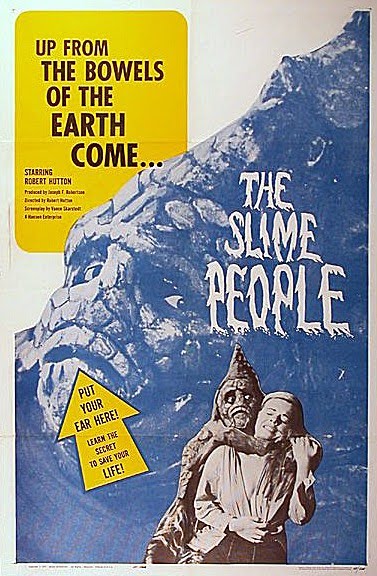
The Slime People -- Low-budget invasion tale in which creatures from within the earth take over Los Angeles. Trapped within the invisible dome is a plucky band of survivors.

The Day Mars Invaded Earth -- Low-budget mix of Angry Red Planet and Invasion of the Body Snatchers. Energy beings from Mars replace a scientist and his family.

X: The Man With The X-Ray Eyes -- One of Roger Corman's best films. A doctor invents a drug that lets him see through objects. He goes too far and sees and is terrified at what he sees.

Madmen of Mandoras -- Quirky low-budget story of nazis hiding in a tiny South American country who have kept Hitler's head alive since 1945, and plan to take over the world.

The Yesterday Machine -- Another low-low-budgtet story about nazis. This time, a nazi scientist has invented a time machine so the Nazis can win WWII.

Wednesday, April 14, 2010

The Yesterday Machine

For some reason, Nazis were hot in 1963. Madmen of Mandoras was an outrageous nazi-revival tale that was conspicuously thin on "science." The Yesterday Machine (YM) is another nazi-revival story, but it overcompensates with too much "science" at the expense of story. Time travel and Nazis has potential. YM tends to suffer the usual ills of a film written, produced and directed by the same man. With only two experienced actors (not stars), a bevy of amateur actors and a tiny budget, YM is a low-B sci-fi with a very 50s flavor. The notion of time travel in the wrong hands is, at least, more ambitious for a premise.

Quick Plot Synopsis
Margie, a college baton twirler, practice her moves while her boyfriend, Howie tries to fix a balking fuel pump. It's getting late, so he gives up and they walk through a woods to get help. They encounter two civil war soldiers who shoot Howie. Margie is unaccounted for. Howie's wound and Margie's disappearance has the local police and a reporter asking questions. The bullet in Howie, and a cap found at the scene were authentic civil war items. This causes Lt. Partane to recall an odd experience in WWII where old men prisoners were, by the records, actually young men. The camp's Kommandant was a rogue physicist, but was never found. While reporter Jim and Margie's sister Sandy explore the scene, they are transported to Dr. von Hauser's underground lab. Sandy and Margie are reunited in a dungeon cell. Von Hauser lectures Jim, (at some great length) about his science. The two rehash the old arguments over Nazi machiavellianism, which gets Jim tossed into an adjacent cell. They try to talk Didyama, (a female minion from ancient Egypt) into helping them escape. One nazi guard enters the women's cell with ill intent. Didyama stabs him in the back, but he chokes her to death before he dies. The women get out and let Jim out. In a showdown back in the lab, Jim shoots the other nazi guard and puts two bullets into the time machine before fleeing. Coming up through a secret hatch in a private graveyard, Jim, Sandy and Margie meet Lt. Partane and other policemen. They hear the time machine start up again. Partane goes down to the lab. Von Hauser shoots, but Partane hits von Hauser, who slumps into the time machine's chair and fades out to some other time. Partane destroys the machine. He gives a speech about man not being ready for such technology. The End.

Why is this movie fun?
The plot unfolds with such unHollywood quirkiness, that it keeps viewer interest up. The story opens with a college coed twisting and twirling her baton to old style rock and roll. From the get-go, FY is different. Also, Jack Herman's flamboyant acting as Nazi scientist Ernst von Hauser is entertaining.

Cold War Angle
Lt. Partane delivers the cautionary moral at the end. To justify his smashing the time machine, he says, "Hydrogen bombs are enough (world destroying trouble) Yesterday should be left alone. The world has enough problems just trying to ensure that we'll have a tomorrow." (i.e. we don't need Nazis and other enemies (commies?) going back to rewrite history so they win)

Notes
Time Travel on $5 a Day -- Time travel movies can involve expensive sets (retro and or future), such as George Pal's The Time Machine ('60) or the Back to the Future trilogy. YM, however, was done on such a tiny budget that even low-budget film, Beyond the Time Barrier ('60) looks lavish in comparison. For YM, we have only a pair of actors in civil war garb, an ornately clothed Egyptian servant and a couple of minimal Nazi uniforms. The rest is suggested, giving YM a sort of stage play atmosphere. Despite the title, the actual "machine" gets very little screen time.

Deeper Question -- Overshadowed by its many shortcomings, YM still manages to raise an interesting question. What if time travel was done by villains? All the usual noble ethics of non-interference would be in the bin. Von Hauser wanted to give his favorite Führer a few more months so that superweapons under development could be finished. Von Hauser talks wistfully of a Reich that would continue more than a thousand years. Why not? With his time machine, the regime could enact as many do-overs as necessary. But, what if TWO powers had time travel? Who's mucking would prevail?

Science Lecture -- Often enough, the villain monologues to the hero for no logical reason other than the scriptwriter's need for some exposition. Von Hauser gives Jim an extended science lecture in front of a chalk board, to explain time travel to him. The briefer version runs like this: if you speed up light so it goes faster than the (um) Speed of Light, it begins to move backwards in time. The more you speed it up, the more quickly backwards time travels. Just how von Hauser does this with some surplus radio parts is not explained.

Ideological Rehash -- Where Madmen of Mandoras offered the satisfaction of killing Hitler again, YM provides one more opportunity to argue the old Nazi ideology. Is such tight state control really a benefit to mankind? Or, are people entitled to be free, even if imperfect. The script writers let von Hauser and Jim rehash that debate with the usual inconclusive result.

Bottom line? YM is a quirky and obscure low-budget indie movie. If quality acting and impressive special effects are important to you, YM will probably annoy you. Fans of quirky shoestring indie sci-fi may find YM somewhat charming.

Thursday, April 8, 2010

Madmen of Mandoras

If Roger Corman's "X" was 1963's sci-fi high point, Madmen of Mandoras (MMoM) is its low point. This ultra-low budget film is a low grade B movie with only the slightest claim to being sci-fi. There were some doctors in white coats, and some surplus electrical equipment among the props, but no real attempt is made to use science to explain anything. The premise is bizarre, yet not without precedent. The plot has an almost Indiana Jones potential. All this is stymied by a lack of budget, a bland, confused script and flat directing. Nestor Piava, who plays Mandoras' sweaty police chief, was the boat captain in Creature From The Black Lagoon.

Quick Plot Synopsis
Professor Coleman tells a small group of Generals and secret agents how he, and only he, has the antidote for the toxic "G Gas." The professor and his younger daughter are kidnapped. A tall shadowy hispanic man tells a CID agent and wife Kathy that they've been taken to Mandoras. Drive-by hoodlums shoot him dead. Phil and Kathy fly to the tiny South American country in search of them. Camino, the son of the slain hispanic above, tells the back story of how his father witnessed an operation in the bunker in Berlin in which Hitler's head is cut from his body and saved so he can be immortal. In a stereotypic cantina, a gunfight breaks out. Young blonde "nazis" killed a creepy assasin/police agent, but Phil is arrested for it. In the palace basement "jail", Phil, Kathy, Suzanne and the professor are reunited. The professor's former assistant, Dvorak, now in a minimal nazi uniform, pontificates about world conquest. He shows them Hitler's head in a big glass bucket. Back in their cell, the police chief and el presidente come in and announce that they oppose the nazis. They escape with the help of friendly guards and scheme how to foil the nazi plot. The deadly gas is to be released at midnight, but this fails. Dvorak drives Hitler's head (in a big black Mercedes) to meet two German Generals who are flying in. World conquest will follow. Our plucky band of resistance fighters get to the canyon in time to throw hand grenades. These kill the half dozen soldiers, the generals, blow up the plane and engulf the black Mercedes in flames. Hitler's head melts like wax in the flames, leaving only a skull. In the happy post-Hitler world, Suzanne marries Camino, Phil and Kathy exchange flirty innuendos. The End.

Why is this movie fun?
It might be more appropriate to say fascinating. The script is a confusing mash-up of stock tropes, stereotypes and non-sequiturs. The writer clearly had some grand tale to tell, but contracted severe laryngitis. It's more puzzle than story, yet its bizarreness has a fascination to it.

Cold War Angle
The world-domination theme is clearly present, but blaming the nazis diminishes any Cold War theme.

Notes
Not Dead Enough -- In the late 14th century, reformer John Wycliffe upset the Catholic church so much that they wanted him dead. Wycliffe died of natural causes as an old man, but that wasn't enough. The Catholic leadership hated him so much, that some 30 years after Wycliffe died, they dug up his bones and burned them. Wycliffe wasn't dead enough to satisfy them. Hitler, the penultimate villain, did not die enough in 1945 to satisfy many people. MMoM, reminiscent of Wycliffe's bones, burns Hitler's head in a rather long scene. Hitler seems to be a character cannot be dead enough.

Evil Twin -- Easily lost between the many cracks is how we end up with Hitler's head in a jar in the first place. You see, back in the 40s, Hitler feared for his life and wanted immortality. He had genius scientists create clones of himself (we see two) to act as body doubles. Nevermind that they're taller and fatter than him. (Clones eat too well). One is dispatched to the bunker to commit suicide and be found by the Allies. The other just wanders off, apparently. The clones look like Hitler (sort of) but do not have his keen mind. In a quest for immortality, the doctors cut off Hitler's head and preserve it because only a head-sized package can be flown out of Berlin. Later, and elsewhere, other doctors will figure out how to get real-Hitler's keen mind into a new clone. It almost makes sense.

10 Years Later, More is Less -- In 1972, Crown International wanted to re-release MMoM as a TV movie, but it was too short (74 minutes). A typical TV movie, running two hours, needed a run-time of around 90 minutes. New footage was shot on even less of a budget than the original, using UCLA film students. The new footage was grafted onto the beginning and recycled some old footage from Thunder Road. The new footage padded the story with more cloak-and-dagger and tried to set up a spy plot in Mandoras better. The re-release was titled: "They Saved Hitler's Brain," which was a much grabbier title than the original. The resulting film, however, only added to the confusion. The 70s clothing and hairstyles are flagrantly different than the original's 1963 attire.

Brains on the Brain -- MMoM is yet another in the sub-genre of movies that featured brains. Donovan's Brain ('53), The Brain From Planet Arous ('57), Colossus of New York ('58), Evil Brain From Outer Space, etc. It also belongs to a smaller sub-genre of disembodied (but still living) heads. The Man Without A Body ('57) which turned out to be Nostradamus. Then there was poor Jan in The Brain That Wouldn't Die ('62). Hitler in MMoM was just the latest talking head.

Don't Need No Body -- The writers did not seem concerned with biology. What kept Hitler's head alive in his jar? At least Jan's head in The Brain That Wouldn't Die was hooked up to tubes and pumps to supply what her missing body would have. In MMoM, heads can just keep on living without bodies. It talks and goes for car rides, sitting all snug in a glass jar.

Plot Holes Aplenty -- The script is so full of disconnects, non-sequiturs and holes that it feels like every third page was somehow lost, but they kept shooting anyway. Where did all this G-Gas come from? Couldn't the source be stopped? This one professor is the only source of an antidote? An antidote to poison gas? The only man with the antidote (in his mind) that can save the world, is kidnapped and only his son-in-law rides to the rescue? The matchbook signal was important enough for Camino's dad to use his last breath to explain it, yet it never gets used for anything important. If the gas kills off almost everyone in the world, why does Hitler still want it? What does the Chiquita dancer have to do with anything? Vasquez is an assassin or a policeman or part of the nazi ring? He dies before doing anything beyond looking shifty. And finally, even though not all, why did burning Hitler's head stop the other cells that El Presidente spoke of from executing their part of Plan G?

Stuffed With Stereotypes -- The unimaginative writer filled his cast with almost-cliche stereotypes: A big sweaty south american police chief, in a white suit, a shifty pointed-beared killer, lazy minions, screaming women, a tall, dark, handsome (I guess) latin love interest, and of course, cardboard nazis. They swagger, wear tall black boots and have a vocabulary limited to: Mach Schnell, Dumbkopf, Schweinhund, Raus and Verboten.

Bottom line? MMoM or They Saved Hitler's Brain are too bizarre and poorly done to qualify as purposeful entertainment. Sober sci-fi fans will likely be annoyed at the lack of science. Cinema fans could be annoyed at the swiss cheese of plot holes. MST3K fans could not find a better "bad" movie to enjoy. Those who think Hitler didn't die enough in 1945 may enjoy the fiery ending, though.

Saturday, April 3, 2010

"X" The Man With The X-Ray Eyes

Despite its limited budget, "X" The Man with X-ray Eyes is more of an A film than a B film. X is also one of Roger Corman's best films. American International Pictures gave Corman more rein than usual on this project. Though with only a $300,000 budget and 15 days to shoot, it was still B level project. The results, however, were far above the usual B. A well-meaning doctor thinks mankind would benefit from being able to see much more than the visible spectrum of light. He finds the power helpful, but nearly impossible to control. Plus, he often as not, does not like what he sees.

Quick Plot Synopsis
Dr. Xavier tells his friend, Dr. Brandt, about his research to help man's eyes to see far more than the visible spectrum. The blonde and lovely Dr. Fairfax tells Xavier that the hospital is going to cut off his research funding. This pushes Xavier to use the drug on himself to provide instant proof. The board cuts his funding anyway. Xavier "sees" that a patient's heart trouble is misdiagnosed by chief surgeon, Dr. Benson. Xavier cuts Benson's hand to stop the surgery. Even though his vision was correct, and the girl will live, Xavier is made a professional outcast. At a party, Xavier can see through the people's clothes, providing some juvenile amusement. Diane Fairfax likes Xavier. Later, while arguing about what to do, Xavier accidentally causes the death of Brandt. Now a fugitive and an outcast, Xavier flees. We find him performing as Mr. Metalo, a midway in a carnival. With his x-ray vision, he is able to "see" hidden info in the crowd. This creeps out the other carny folks. When a woman is thrown from a ride, Xavier can see her broken bones. His hawker, Crane, schemes to make money off Xavier's healing "gift." Crane sets up shop in a seedy basement flat and brings in people to be diagnosed. Diane finds him. Crane, knowing who Xavier is, threatens to turn him in, so Xavier and Diane flee. They go to Las Vegas to raise money for research and a cure. Xavier uses his x-ray vision to cheat and wins over 20,000 dollars. The casino accuses him of cheating. Xavier steals a car and drives into the desert. Pursued by a highway patrol helicopter and unable to see well enough to drive, Xavier crashes. He staggers into a tent revival meeting. He tells the preacher that he's seen the vast darkness and at the center of the universe is a great eye that sees all. The preacher says he's seen the devil and should pluck out his offending eyes. Xavier plucks out his eyes. The End.

Why is this movie fun?
The story has great depth. The acting is good. Corman does a good job keeping the story moving. There is much to muse over, long after the film is done.

Cold War Angle
X is more of a spin on the traditional Frankenstein or Dr. Jekyll themes. There is little in the way of Cold War theming.

Notes
Alternate Ending? -- Steven King wrote of X having an alternate ending in which Xavier says, after plucking out his eyes, "I can still see!" The released version has nothing after the quick flash of Xavier's empty eye sockets. Corman was not as sure that such an ending was ever shot, but thought he might have, on a whim. It was not in the script. No such footage has surfaced.

Eye on Drugs -- Corman started out wanting to use a jazz musician as the protagonist. The story would then be more of an analogy for the growing drug culture. LSD, etc, were imagined to bring transcendental insights, etc. The musician character presented too many problems, so Corman switched to a medical doctor. This opened up the story, adding much-needed credibility and philosophical depth. Yet, some of the original drug-culture theme remains, as Xavier becomes addicted to his x-ray powers, taking more and more of his drug until it ultimately destroys him.

Frankenstein Resumed -- The trope of the well-meaning, but misguided scientist is as old as Frankenstein and used many times. The customary moral of those stories is science is dangerous. Corman thought the Cold War had made the evil-scientist dominant. Yet, the various doctors are usually painted in a somewhat sympathetic light. They meant well, for mankind, but things go wrong, usually destroying the doctor (and others). Dr. Xavier follows the traditional pattern. Like Dr. Jekyll, he himself, becomes the monster.

Juvenile Dreams -- Recognizing that the drive-in crowd might not necessarily identify with Xavier's lofty ambition to use X-ray vision for the good of mankind, Corman inserts two scenes for the less altruistic. He has Xavier attend a party with lots of beautiful young adults. Of course, he can see through their clothes. Corman shows no more than naked knees and bare shoulders, but the implication is clear. Naked Women! The second is that strain of avarice to cheat at gambling. Corman has Xavier use his gift (intended to benefit mankind) in order to beat a casino at blackjack. Neither satisfy.

Glimpsing the Dark Side -- In a twist rather deep for a drive-in movie, Corman's story shifts from the philosophical (should a man use special power for good or for self-gain?), to the metaphysical. Xavier sees the vast darkness of the universe. We know this is not merely outer space, but being surrounded by the darkness of men's souls, because he's telling a preacher at a religious meeting. The script gave us plenty of examples of dark souls -- Crane, the schemer, only thinking of profit and naked women, the other carny who would use such power to hurt those who disagree with him, the chief surgeon who was more concerned about his status than his patient's life, the hospital board who was more worried about money than miracles, the smug young man who deserted his girlfriend, the Vegas crowds grubbing for tossed money, etc. etc. Corman makes a bit of social commentary.

Seeing The Light -- Corman and Russell didn't stop with a depressing commentary on mankind's darkness. They had Xavier see past the surrounding darkness to a great light at the center of the universe. "And in the center of the universe, the Eye. It sees us all." Seeing this great light is terrible, making Xavier scream whenever he saw it. Pop spirituality liked the idea of an all-happy grandpa god -- a warm, fuzzy, comforting "light." Corman's light is surprisingly biblical. When Isaiah, Ezekiel and John each "saw" God, they thought they were doomed.

Star Gazing -- Ray Milland stars, and is excellent, but comedian Don Rickles does a great job as the scheming Crane. John Hoyt, who plays Dr. Benson, was the misguided Mr. Franz in Attack of the Puppet People ('58). Harold J. Stone, who played Dr. Brandt, had a long career in television. He also played General Swayne in The Invisible Boy ('57). Look for Morris Ankrum in the uncredited role as the hospital board chairman.

Bottom line? X is a great movie on many levels, and one of Corman's best (if not the best). It has something for viewers who aren't sci-fi fans. It has some depth and pathos for the Frankenstein theme, for those who are sci-fi fans.

Wednesday, March 31, 2010

The Day Mars Invaded Earth

If you took the underlying premise of Invasion of the Body Snatchers ('56) and mixed in a bit of Angry Red Planet ('60), you would have The Day Mars Invaded Earth (DMIE). Black and white films were becoming less common by '63, so it was clearly second-bill drive in material. This low-budget production has its weak points, but maintains a moderate level of quality, a certain film-noir flavor and tension. It tells the tale of martian energy-intelligences replacing key people on a Mars probe program.

Quick Plot Synopsis
A NASA probe to Mars lands and. Its rover explores for a few minutes before being burned up by an energy surge. Dr. Dave Fielding feels oddly empty for a moment, but goes out to face a crowd of reporters. When he leaves, his double is seated at his desk. Dave flies home to California to be with his family who are staying in the guest house of a mansion belonging to his wife's family. The kids, 10 year-old Rocky and teen Judy are happy to see him, but his marriage to Claire is in deep trouble. Tensions between Dave and Claire make it less obvious, at first, that they are seeing their doubles walking around the estate. Eventually, things get obviously creepy and the family pulls together. They are unable to leave the estate, due to a stuck main gate. Dave encounters his double in the "Big House". Double-Dave tells him how martians are energy-like intelligence beings without bodies. They traveled to earth via the probe's radio transmitter. (that's what fried it) On earth, they plan to replace key people to squash any further earth missions to Mars. Since Dave's wife and kids would recognize a duplicate, they had to be replaced too. Family friend, Web, gets the gate open, but on his way back, Mars-Dave uses his energy-ness to burn Web into ash. The family all get in the car and leave with Mars-Web driving. The camera pans down into the empty swimming pool to reveal five body shapes of ash. The pool's jets turn on, washing the ash outlines away. The End.

Why is this movie fun?
The alien-takeover trope is usually fun. The empty mansion and estate make for an interesting closed environment for the drama. The unresolved ending, in which the duplicates all drive away happily on their way to subtle sabotage, is interesting. In DMIE, the pods win and probably still among us.

Cold War Angle
This is more allegorical than overt. The traditional fear of nefarious "others", the not knowing who you can trust, the sinister plot behind it all, these are solid Cold War angst themes.

Notes
Venerable Sub-Genre -- The alien-takeover sub-genre is one of the key features of 50s (and 60s) Cold War angst movies. The earliest include The Man From Planet X ('50) and It Came From Outer Space ('53). The most famous of the genre is Invasion of the Body Snatchers ('56). Films of this genre were becoming less common by the mid-60s, but it wasn't played out yet. DMIE is one of the lesser-known members of the set.

Angry Invisible Mars -- The red planet often got a hostile tone in literature and movies. H.G. Wells' famous 1898 novel described them as "intellects vast and cool and unsympathetic," who "drew their plans against us." In Angry Red Planet ('60) the martians expel the earthlings with a warning to never come back. We're too immature of a species. (e.g. war, greed, etc.) DMIE has a similar subtext as Mars-Dave tells Earth-Dave that they came to stop any future Mars missions from earth. They "invaded", not to take our home (as was often the case), but to preserve their own from us.

Blame the Aliens -- Several movies seek to place the blame on aliens for American space program failures. (of which there were many). War of the Satellites ('58), Cape Canaveral Monsters ('60), Planets Against Us ('62), etc., quietly admitted that NASA was not off to a good start. Rather than doubt our own genius, it was more fun to imagine alien sabotage.

Inexpensive Fancy Sets -- Most of the action in DMIE is set in and around the Greystone mansion in Beverly Hills. It was constructed in the late 1920s for the son of an oil tycoon, Edward Doheny Jr. His wife, Lucy, sold the estate in 1955 to a man who rented it for movie location shooting. The property later became a park and more movies were shot there. Some titles include The Invisible Boy ('57) and Picture Mommy Dead ('66). The orderly and tidy gardens of the estate make for an interesting contrast to the confusion the characters face.

Natural Noir -- The invasion angst premise just naturally lends itself to the noir style. Suspicion, uncertainty, fear, they all factor in. Director Maury Dexter uses the setting of the Greystone mansion fairly well. The staid and orderly grounds are ironic backdrops for uncertainty and fear (such as when Claire is 'chased' with the footsteps sounds). When Dave explores the "big house", Dexter uses a lot of up-angle camera and uplighting, giving the otherwise comfy surroundings an unsettled look.

Bottom line? BMIE is hardly a gem, and the pace is pretty slow at first. There are virtually no special effects, creepy aliens or fancy technology, etc. to satisfy the mainstream sci-fi fan. For more devoted fans of the genre, who enjoy the alien-takeover type, the latter half gets much more interesting.

Saturday, March 27, 2010

The Slime People

This low budget independent film was released in 1963, but clearly belongs to the 50s realm of low-B movies. It was shot in black and white, and has strong resemblance to the old serials. Somewhat typically, the science within the fiction is scant or bogus. Notorious for its very heavy use of fog machines, The Slime People (SP) tells the story of a band of five people trapped in LA, hunted by slime people. The movie is a mix of familiar elements. It starts out with the post-apocalyptic feel of Target Earth ('54) It progresses like a variation on Commando Cody ('53) meets militant Mole People ('56).

Quick Plot Synopsis
The movie starts right off with the titular slime people rising up from underground. They kill whomever they can find. Tom Gregory, local LA television personality, is flying to LA in his small Cessna. He lands at a small LA area airport which turns out to be deserted. Up drives professor Galbraith and his pretty young daughters, Lisa and Bonnie. They explain to Tom that the slime people enclosed LA in some sort of impenetrable dome. The fog also cools the temperatures so the slime men can thrive. Most people were evacuated before the dome was complete. Those trapped within, like themselves, are hunted down by the slime people. Tom takes them to his TV studio to look at newsreel footage which fleshes out their story. Slime people attack, so they flee. They try throwing some chemicals at the wall, but none of them affected it. En route to some Plan B, they run out of gas and hole up in a butcher shop's meat locker. During one foray for supplies, Bonnie is captured by the slime men. While rescuing her, Tom and Cal see the slime men's fog machine. Theorizing that salt neutralizes the wall, they set out with two buckets of brine, in hopes of ruining the fog machine that maintains the wall. The fog machine is guarded by many slime men, so there is much fighting. The professor throws one of the slime people's spears at the fog machine. It blows up. The invisible wall vanishes. The slime men clutch their throats and fall down dead. The army moves in and escort our plucky band out. Bonnie loves Cal, Lisa loves Tom and the professor is just proud. The end.

Why is this movie fun?
The starts off with the intriguing empty-city scenario. The acting is poor, but the less-seen faces are a nice change. Judee Morton has a real-girl prettiness that isn't the usual Hollywood mold.

Cold War Angle
Nuclear testing is to blame. Professor Galbraith theorizes that all the underground nuclear testing (in Nevada), has ruined the Slime People's natural underground habitat. They are then taking LA as a sort of revenge invasion.

Notes
Serial Flavor -- The low budget, the 2-dimensional characters, the marginal (to poor) acting, and simple sets, all give SP the flavor of the old theatrical serials of the 40s and early 50s. One could easily see Commando Cody, or Video Ranger being the ones to fight the slime people. The various scenes almost lend themselves to having been separate "chapters." The Landing. TV Studio Siege. Into The Hole. Safe Locker., etc. etc.

Brute Geniuses -- It's not uncommon in low budget B movies to have handy contradictions. Typical enough, is the contrary notions of an enemy (or monsters) who are both technologically advanced, yet personally cave-man crude. The slime people are somehow intelligent enough to have figured out how to turn air into an impenetrable solid in whatever shape they want, and make a machine capable of doing this. They are also advanced enough to created a modified environment to sustain themselves. Yet, they have big claw hands which can barely manage to throw their simple spear weapons.

Golden Rides -- Adding to the 50s serial flavor is that the characters drive up and down back roads around LA in a 1954 Cadillac coupe and a 1959 Mercury station wagon. Nothing more modern than the '59 Merc is seen. This suggests that SP might have been snot in 1959, and therefore be a delayed member of the Golden Era of sci-fi movies.

Commander to Crackpot -- Les Tremayne played Major General Mann in War of the Worlds ('53) In SP, he plays the bit part of skeptic and crackpot, Norman Tolliver. Being a skilled actor, Tremayne plays the Tolliver character too well. He doesn't quite steal the show, but he does manage to make the other actors look as lame as they are.

Rubber Monsters -- SP does not make viewers wait until the last 15 minutes to see the monsters. They appear before the title does. The rubber suits aren't all that badly done, and are wisely kept visible for fairly brief glimpses. Longer views of them (such as in the fight scenes) expose their low-budget-ness. Yet, to their credit, the producers had more than one made (such as the single robot 'army" in Target Earth) and hope editing would make it seems like a mob. Their pig-grunt gurgle noises get a bit too much play late in the story.

Bottom line? SP is a very low budget film that is likely to annoy or amuse viewers who are not fans of low budget 50s movies and/or the old serials. Given the evolving style of the 60s, SP seems quite anachronistic. Fans of the old serials like Video Ranger and Commando Cody might find a nostalgic soft spot for this film.

Tuesday, March 23, 2010

Matango: Attack of the Mushroom People

Toho Studios and Ishiro Honda are famous for kaiju movies, such as Godzilla, but Matango is every bit as powerful. It lacks the usual kaiju rubber-suit monster. Instead, Honda tells a moody tale of a group of castaways who have their humanity slipping away from them as they, one by one, turn into mushroom people. Matango became better known to American audiences through A.I.P's english dubbed version in 1965, for television. Matango developed something of a cult following, but also its share of detractors. The mushroom people themselves are not horrible enough for horror fans, nor monstrous enough for monster fans. Yet, setting costumes aside, Matango weaves a compelling, if gloomy, story about people succumbing to a dark side.

Quick Plot Synopsis
The movie opens in a Tokyo psychiatric ward. A lone man tells his tale. A group of seven people are cruising on a sailing yacht when a fierce storm brews up. The owner wants to maintain course. The wind breaks their masts. The waves take out the radio and engine. They drift helplessly through calm foggy seas. Eventually, they drift up to a fog shrouded island. It is uninhabited, They find an old fungus encrusted old research ship on the other side of the island, but no trace of the crew or passengers. The captain's log warns not to eat the mushrooms. Food and supplies begin to run low for our seven. Tensions rise and the old social order crumbles. The crewman ignores the skipper's authority. The rich man cannot buy obedience. The star uses seduction in a ploy for power. The writer seems to be going mad. One of them does eat the mushrooms. They are at first satisfying, soothing and narcotic. One by one, the castaways join in, becoming strangely placid, yet insistent that the remainder join them. Eventually, only the professor and his girlfriend remain as untainted holdouts. The mushroom people surround the couple on the beached ship. While the professor fights off some mushroom people, other mushroom people carry off the girl. When the professor finds her in the mushroom forest, she has eaten and become one of them. He fights to escape the surrounding mushroom people and makes it to the partially repaired yacht. This, he sails until picked up by a ship. Back in the psych ward, he finishes his tale. Unbelievable? He turns to face the light, revealing that his face has fungal lumps on it. The End.

Why is this movie fun?
The deeper themes and social commentary provide much food for thought. The sets, lighting and camera work create a strong mood.

Cold War Angle
This is left understated, but present. The research ship was guessed to be studying the effects of nuclear testing. Did radiation cause the mutant mushrooms that take over peoples' bodies and minds? Or, did the researchers unwittingly create the the insidious fungii while studying radiation effects? Either way, Honda quietly blames nuclear testing for the loss of humanity.

Notes
Print Precedent -- Takeshi Kimura's screenplay was inspired by a short story by William Hope Hodgson. "A Voice in the Night" was published in 1907. Hodgson's story was about two men aboard a becalmed schooner. One night, they hear a voice from an unseen small boat, asking for food. They give him some food and he tells his tale. He and his fiancee were shipwrecked and drifted on a raft to a foggy island. In the lagoon, they found an abandoned ship which was encrusted with many gray fungus growths. They set up quarters in the ship, but after awhile, noticed growths on themselves which would not go away. Out of extreme hunger, the woman, then the man, eat the mushrooms. They were becoming less human and more mushroom. The voice thanks the men on the schooner and departs.

Ancient Precedent -- There is an element of Homer's Odyssey in Matango. Odysseus and his men land on a strange island. Some of his men leave the ship to look for supplies but never return. Odysseus finds them in a village of lotus-eaters. The lotus fruits were both a nutrient and a narcotic. Once tasting the lotus, his men become placid, content and lost all desire to return home. Odysseus has to drag his men away, begging him to let them stay. The mushrooms had this same dual role of life-sustainer and soul-enslaver.

Pod Precedent -- Within the mushroom transformation in Matango is a sort of parallel to the pods in Invasion of the Body Snatchers ('56). Once having eaten even a little bit of mushroom, the person's humanity fades away. Taking its place is a new, stronger personality. They have a common mind to induce all the remaining humans to join them in mushroom-hood, much as the pod-people worked at turning everyone into pod-people. This creates a very similar feeling to the story about the loss of our humanity -- being taken over by something else.

Social Breakdown -- Another similar sort of tale was William Golding's Lord of the Flies ('54) in which a group of plane-wrecked British school boys start out with a semblance of civilization and order. Yet, as time passes on the island, their civilization breaks down into brutal savagery. We see a similar breakdown among the seven castaways in Mantango. Social order (labor vs capital, authority & obedience, even male & female social roles erode into self-centered savagery. Golding and Kimura spin similarly dark visions of mankind's more primal core.

Gilligan Noir -- It may be a strange cosmic coincidence that the crew of the shipwrecked yacht in Matango had a Skipper, crewman, a rich man, a movie star, a wholesome girl and a professor. Sound familiar? Sherwood Schwartz was developing the pilot for his new TV sitcom "Gilligan's Island" at almost the same time that Matango was showing in the western U.S. Perhaps he had seen Matango (still in its original Japanese), or perhaps he heard a synopsis of it and liked the character mix. With only a few weeks between Matango's release and Schwartz shooting, the former may not have had any influence on the latter. If not, it is a very strange coincidence.

Love Lost -- Another sub-plot is the inner conflict of love vs. survival. Professor Morai loves Akiko. When she becomes one of them, Morai is torn -- be with his love, or remain a human. When the other mushroom men surround him, his instinct for survival proves stronger. He escapes, but is forever haunted by regrets. Maybe escape from the "real" world (of sin and evil) and mushroom life with Akiko was the better path.

Bottom line? This Toho tale is definitely worth watching. The original, with english subtitles is better than the A.I.P. dubbed version (which sometimes comes across too silly). There is much thoughtful commentary on mankind and society in Matango's screenplay.

Friday, March 19, 2010

The Day of the Triffids

This is one of the big B sci-fi movies of the early 60s. Triffids has its share of low-budget issues, but this British production still has its moments and has its fans. Based (loosely) on John Wyndham's 1951 novel, the story is yet another variation on 50s post-apocolyptic visions. Triffids is actually two unconnected stories in one film about the end of civilization as we knew it. One story follows the travels of Bill Masen in search of other sighted survivors. The second story, filmed later and cut into the first, watches a husband and wife team of biologists, stranded in a remote lighthouse when civilization ends. They must battle the invaders alone.

Quick Plot Synopsis
A dazzling meteor show in the night sky has almost everyone watching. The shower also awakens some odd plants, Triffidus celestus, whose spores came to earth on a meteor. Awakened, they begin to grow, move and eat people.
Story One follows Bill Masen, a sailor whose eyes were bandaged from an operation. He awakens to an empty hospital and a virtually deserted London. Those remaining in the city are blind. The meteor shower ruined their optic nerves. Bill rescues a sighted 12 year old girl named Susan after a train wreck. Together, they make their way to France where sighted survivors are said to be gathering. In France, they find an enclave of a few sighted people, lead by a Christine Durant, caring for 40 blind people. Bill is torn between staying in the little community and moving on to Cadiz where a naval base is thought to house sighted survivors. A busload of sighted (but drunk) convicts takes over the manor. Bill, Christine and Susan narrowly escape the riotous party before the triffids attack the manor. The three travel south in an ice cream truck they found. In Spain, they come to an estate of a man whose wife is pregnant. They stay to help deliver the baby. While they stay, millions of triffids surround the compound's fence. Deducing that they are attracted to sound, Bill lures them away with the annoying ice cream trucks's music. This allows everyone else to escape to Cadiz and be rescued by submarine. Bill shows up at the last minute so the little ad hoc family is reunited.
Story Two follows Tom and Karen Goodwin, biologists living and working in a remote lighthouse off the coast of Cornwall. Their marriage is in trouble, and Tom has a drinking problem, in addition to being a self-pitying jerk. Triffids attack them too, eventually forcing them higher into the lighthouse. In a desperate last defense, Tom uses a seawater fire hose on the triffids. Seawater dissolves them. The world is saved by common seawater. Church bells ring. The end.

Why is this movie fun?
The post-apocollyptic city is well done and moody. Some of the effects are cheesy, but some are actually pretty solid. The trope of giant semi-sentiant, mobile carnivorous plants is too unique to be dull.

Cold War Angle
Wyndham's original novel was more clearly a communist invasion-angst analogy. The film comes across less so, but the insidious, unstoppable onslaught which crumbles "western'" civilization, still has its fit.

Notes
Fragile Empire -- Inherent in Wyndham's novel was the message about how fragile our mighty civilization is. Take away one common thing -- often taken for granted -- and just about everything crumbles. All of our (1960s) technologies and systems were rendered useless (as exemplified by the ship, the train, and the airliner) when no one could see how to operate them.

A Familiar Pair -- Story One is much like H.G. Wells' novel, The War of the Worlds. Instead of Martians causing civilization's collapse, it was carnivorous plants. A lone survivor tries to escape the invaders and link up with other survivors. Something ubiquitous on earth saves humanity. Story Two is a twist on the monster-onboard tale that will get retold a few more times. Instead of being trapped in a spaceship with a monster (as in It, Terror From Beyond Space), the claustrophobic cylinder of terror is a lighthouse.

Book Loose -- The screenplay is only loosely based on the novel. Some of the characters have the same names, though somewhat different roles. In the book, the plants are the escaped product of a reckless Soviet scientist. In the movie, they're from space. Other elements from the book can be identified, such as the bus load of rapacious convicts standing in for the brutal Torrence and his gang, etc. The book character of Josella is omitted. Christine Durrant becomes Masen's eventual love interest. While the book and the screenplay diverge, ( and this rankles some folks) the screenplay actually stands on its own fairly well.

Oops, There Goes Another Rubber Tree Plant -- The monsters themselves are one of the weaker parts of the movie. The producers did what they could (men in rubber plant suits), but making a huge plant move and be menacing was just too tall an order for their limited budget. Even Steven King would have trouble making plants frightening (on screen).

Spores From Space -- It is an interesting parallel to Invasion of the Body Snatchers that the plant invaders and consumers of humankind, come from space. This trope was familiar to sci-fi audiences, so helps the movie achieve the alien invaders mood.

Stiff Upper Lips -- There is an interestingly British spin to this end-of-the-world scenario. Order and decorum must be maintained. Londoners, stricken blind, dress themselves and attempt to stroll the sidewalks as if nothing were wrong. (why?) A blind railroad agent just sits at his ticket window, ineffectual, but faithful to his job. Stiff upper lips are most obvious in the crew of the airliner. All blind and out of fuel, they all know they're about to die. Yet, they stare blankly ahead, resolute to the end. Even the acting of Howard Keel as Bill Masen, has a "proper" British feel to it. Keel is the unexcitable hero. Compare him to Kieron Moore's more tempestuous Tom Goodwin.

Bottom line? Triffids is an unforgettable movie. It has its flaws and can get a bit talky at times, yet it has a good deal of entertainment value.

Monday, March 15, 2010

Reptilicus

The prehistoric monster-on-the-loose was no longer fresh in 1961 when Reptilicus was released in Denmark. Yet, it seemed several cultures wanted their own Godzilla story. This is the Danish kaiju, brought to you by Sidney Pink and Ib Melchior, the team that gave you Angry Red Planet ('60) and another Dano-American production, Journey to the Seventh Planet ('62). Shot in two versions, Danish and English, in 1962, the English version was delayed until January of 1963 to "fix" some problems. The science in the fiction is pretty scanty in Reptilicus. There is a bit of biology and a touch of paleontology, but the story is essentially the customary giant prehistoric creature rampaging through a modern city, being blasted by massive military firepower.

Quick Plot Synopsis
An oil drilling crew find blood and bits of leathery flesh on their bit. Later, a six foot tip of a tail is unearthed from the tundra. It is flown to the Copenhagen Aquarium for study. Due to neglect, it is allowed to thaw. They discover that it's healing itself. It is alive again. Dr. Martens lecture that the original dinosaur must be able to heal like a lizard that can re-grow a tail, or a starfish re-grows an arm. The new find is named "Reptilicus". No one notices that the tail has grown into a full beast. It eats a sleepy scientist and breaks out of the Akvarium. Reptilicus eats cattle and terrorizes the Danish countryside. The army cannot kill it due to its tough armor scales. A flame thrower does hurt it, though, and it flees to the sea. The navy tries to depth charge it, but are told to stop. All the blown up bits would become separate beasts. Reptilicus recovers and comes to terrorize Copenhagen. Screaming crowds run through the streets. The pretty scientists cook up a gallon of knock-out drug, which is placed in a bazooka shell. General Grayson fires the shell into Reptilicus' mouth. He drops slowly to the street. Presumably, the scientists destroy the beast without scattering bits, so the world is saved. Except for a severed arm on the sea floor, blown off by a depth charge. It begins to twitch. Fade to black. The End.

Why is this movie fun?
The monster-on-the-loose trope is usually fun. The model cities, toy tanks, screaming crowds: all fun viewing. The venue of Denmark adds some variety, and gives Los Angeles a break.

Cold War Angle
Unlike others in the giant monster sub-genre, Reptilicus is not linked to radioactivity. As such, he isn't developed as any kind of analogy for nuclear war, etc. Instead, Reptilicus is more of a monster movie.

Notes
Comic Relief -- The man who plays the night watchman, Peterson, is the Danish comedian, Dirch Presse. To uninitiated American audiences, Peterson was clearly the bumpkin-ish comic relief character. To Danish audiences, he almost upstaged the rest of the story. It would be akin to having Leslie Nielson or Robin Williams in a bit role of some other B monster movie.

Double Speak -- The english version looks, at times, like it is a dub of the Danish version. At other times, the words and lips line up perfectly. The reason is that the movie was shot in two takes. In one, the actors spoke Danish. In the second, they spoke English. Trouble was, they spoke it with a pretty obvious Scandinavian accent. A.I.P. couldn't accept that, so native english speakers provided the American-accent voice talent for the dub.

Ignore Monster, Visit Denmark! -- A fairly blatant secondary motive for the film Reptilicus is to promote Denmark as a tourism destination. General Grayson, Connie Miller and Capt. Brandt tour Copenhagen, making sure to hit all the key tourist sights. Ample use is made of Tourism Board stock footage. A swanky nightclub scene is inserted with Denmark's answer to Doris Day, Birke Wilke, singing "Tivoii Nights" about the charms of Denmark.

Better Bad Puppet -- The monster is clearly a marionette on a model landscape (or cityscape). While this "special effect" was pretty meager, even by the standards of the day, it was a far cry better than the most infamous marionette monster -- the atomic bird in The Giant Claw ('57). At least Reptilicus had some ferocious dignity.

A Tale of Two Dragons -- The Danish version and the American version are essentially the same, but with some notable differences. The most famous difference is that the Danish version has a small scene in which Reptilicus uses his little dragon wings to fly. This got cut from the American version. The Danish version has a more developed romance between Sven and Connie. The Danish version has a cute-comic scene with Peterson singing to children in a park. The American editors saw no need for that scene, since Presse had no American following. The American version added that the monster spewed green acidic slime. The Danes did not. The slime was added in post-production and does look rather pasted on. The American version also has the poor farmer father get eaten. The Danes did not. He, too, looks rather badly pasted in via post-production.

Bottom line? Reptilicus is member of the famous sub-genre of monsters ravaging cities. It is a low-budget version, but has the requisite elements. Fans of 50s kaiju will find entertainment value. Modern viewers jaded by CGI will probably laugh, or moan.

Thursday, March 4, 2010

A Dream Come True

This soviet sci-fi, entitled Mechte navstrechu (MN) ("A Dream Come True"), came to American audiences in 1966 as Queen of Blood. MN is another member of that distinctive sub-genre of foreign sci-fi bought cheaply, dubbed in to english, some new footage inserted and re-edited. MN itself is mixed bag. On the one hand, it has some very captivating visuals. On the other hand, it is a potentially fascinating story told very weakly. Queen of Blood makes good use of MN's powerful visuals, but tells a very different story. MN is a much more romanticized view of space travel and first contact. Hence the need to put down here, in this 1963 survey, the original story line.

Quick Plot Synopsis
Several characters of a space research facility are introduced and developed at some length to emphasize their warm humanity. Tanya is a radio astronomer listening for "first contact". Andrey is an engineer who dreams of life around remote stars. Andrey likes Tanya, so shows her his "Crystalphone" which plays a song he wrote about exploring space. Far away, on the planet Centuria, they pick up Andrey's song. Intrigued, the Centurians launch a crew to travel to earth. En route, they encounter trouble. The Centurians launch a recording capsule to earth. Dr. Krylov discovers that the capsule is a video log of the Centurian ship, capturing their distress and probable crash on Mars. Soviet scientists urge a assembly of a rescue mission. The rocket ship "Ocean" is finished and a crew launched. En route to Mars, they encounter a massive solar burst. Powering their shields at maximum drains their energy. They can land on Mars, but not take off. This, they do. They find the Centurian ship, but only one dead alien aboard. A second ship, the Meteor, is sent from moon base to help. It cannot land on Mars, so launches the supplies as satellites and lands on Phobos. Andrey and Ivan find the Centurian escape pod on Phobos, with the alien woman barely conscious. The emergency ship can only carry 2, so Andrey stays behind. Ivan takes alien woman to Mars. They all meet up and the Ocean is now able to blast off. They return to earth, triumphant at a friendly first meeting with aliens (a successful rescue), even though it cost dearly (Andrey). The actual ending is ambiguous. Andrey and Tanya (at the lake on earth) are called by Paul to report for launch. Was it a flashback of Tanya's about good ol' days with Andrey? Or, was it all actually a fanciful dream conjured up by Andrey's romantic space song? (You decide.)

Why is this movie fun?
The sets and models for the Centurians have a luxurious quality. They're great fun to look at. The wild-eyed optimism about space travel and first contact, is so very different from the paranoia of the 50s, and later in the 70s and 80s (e.g. Alien).

Cold War Angle
The writers take a few digs at the West via the Dr. Laungton character, the American colleague of soviet head astronomer Dr. Krylov. Laungton frets that 'first contact' will be hostile and suspects invasion. His fixation on the evil intent of the "others" is a blatant counterpoint to soviet idealism and fixation on friendliness.

Notes
Poets & Lovers -- As is typical of propaganda, the hometown folk are cast as benignly human. They're artists, poets, playful, good with kids, and of course, engage in chaste courtship. They are do-ers and dreamers of grand peaceful futures. It is those dark-hearted politicians and technocrats in the west who rain on the bucolic parade.

Proto-iPod -- Andrey's "Crystalphone" invention plays music, and looks amazingly like the modern iPod Nano. His design is a bit rounded and made of dark brown plastic, but Tanya holds it and looks at it just like people today do with their iPods. All that's missing are the earbuds.

Customary Sacrifice -- Soviet films liked to glorify sacrifice. Someone is lost in the otherwise successful mission. In Nebo Zovyot, Somov dies of radiation bringing fuel to the marooned ship Rodina. In Der Schweigende Stern, the crew of the Capella die when a meteor hits their ship. Later, Chien Lu dies of a torn spacesuit. Talua is left behind to die. In MN, Tanya's love interest, Andrey, nobly gives his life (staying behind on Phobos) so the alien woman may be saved. This brave acceptance of losses is not very Hollywood, but somewhat similar to the Japanese ethos.

Texas on the Volga -- One striking theme amid the visuals is that the Russians, like Texans, like things BIG. Huge statues (matte art) decorate Gagarin Square and the Congress hall. A 5-story jumbotron brings news to the masses. Only the Soviet Union has the space program developed that can mount a rescue mission. Russians think Big.

Weak Delivery -- As a film, MN has a bland and amateur feel. Perhaps the director did not think his audiences could piece together the story from mere dialogue. Instead of letting the characters tell their story, the narrator is constantly interrupting to tell us what is going on. Instead of one cosmonaut saying to the other "Hey, we're low on fuel," the director just has them look at each other with mildly concerned expressions while the narrator blathers on and on about the lack of fuel.

Bottom line? MN may not be easy to find, but a hard core 50s-60s sci-fi fan will be rewarded. The sets and models are well worth it. As a propaganda piece, it is interesting too. For viewers accustomed to action films, the pace will seem slow and talky. Even so, the pace picks up in the last third of the film.