Shepperton Studios produced a modest sci-fi film in 1965 called The Night Caller. or Night Caller from Outer Space. When released in the USA, it was retitled Blood Beast from Outer Space (BBOS). The American distributors must have thought the British title was too subtle. John Saxon stars as Dr. Jack Costain. Maurice Denham plays Dr. Morley. Patricia Haines plays Ann Barlow. It is the somewhat typical story of an alien who comes to earth for “our” resources (women) and to warn us of the dangers of a nuclear future.
Quick Plot Synopsis
Radar detects an incoming asteroid that lands near London. When scientists and the army search, they find a beachball-sized translucent sphere. They take it back for testing, but it is obviously not of this world. While Ann stays late to type up notes, she feels sick and notices a glow in the store room. When she opens the door, a clawed hand grabs hers. She runs and sets off the alarm. No one is found, but a big clawed footprint is found in the dirt outside. Dr. Morley, Ann and Jack are certain the sphere is a transporter portal, sent from the 3rd moon around Jupiter: Ganymede. Dr. Morley wants to see the mysterious stranger, but gets killed by it. The stranger drives off the base in a nice Jaguar. Fast forward three weeks. 21 young women have disappeared mysteriously. Slowly, Scotland Yard and the scientists piece together that a mysterious stranger has placed an ad in Bikini Girl magazine, recruiting models. They disappear the day after their interviews. Scotland Yard sets up a trap for the stranger, now named Medra. Ann volunteers to be bait. She goes in, confronts Medra. They chat about about him wanting women for his planet. He then strangles Ann for knowing too much. Medra arranges one more abduction of a pretty girl. Police give chase to the Jaguar. They find it at a farm. Standing in front of a fire (for no apparent reason), Medra exposits about how his people are a thousand years advanced. They also discovered nuclear power and it all went bad for them. Most were wiped out. The survivors were mutants. Medra has one normal human hand, and one claw-hand - half a normal face and half deformed face. They want the pretty english girls as fresh breeding stock to clean up their gene pool. There’s nothing the army can do. Medra disappears. His portal ball shoots up into the sky as a fireball. The End.
Why is this movie fun?
British sci-fi of the 60s had a subtly to it that gave it a very different feel from American B-grade sci-fi. The director does a good job of keeping the alien hidden in the shadows. The fact that the “monster” amounts to just one rubber claw-glove, is nicely hidden.
Cold War Angle
Don’t Let This Happen To You — A common theme in 50s sci-fi was the cautionary tale. Sci-fi let audiences “see” the horrors of an unchecked nuclear future. This was the moral of the story in Rocketship XM (1950), in which the astronauts see the ruins of martian civilization, high radiation, and mutant survivors (as cavemen). BBOS repeats all these traditional Cold War tropes. Medra’s people suffered their apocalypse. They mutated into monsters. Medra tells the earthmen that it will happen to them too. Add in Medra’s mission, and his warning amounts to: Keep messing with nukes and you’ll wind up mutant monsters (like me) and you won’t have enough women.
Notes
Based on the Book — Frank Crisp wrote the novel in 1960, “The Night Callers.” The plot is essentially the same: an alien civilization is kidnapping young women, one by one. Crisp’s novel (and the ’65 film) have a very 50s feel to them, as they were a product of those times.
Klaatu The Abductor — Medra delivers a monologue at the end, which amounts to Klaatu’s warning from The Day the Earth Stood Still (1951). “A thousand years ago, we made our first stumbling steps into space. We visited the earth, only to find we could not survive its atmosphere. But we from Ganymede knew were were superior beings and had nothing to learn from you. We had knowledge that could lead to eternal peace and progress, but also embodying the darker powers of universal destruction, so our civilization ended, just as yours will.” Like Klaatu, Medra delivers his warning message and leaves. But this time, he took a bunch of earth girls with him. Medra wasn’t on a mission to warn Earth, so much as he was gathering breeding stock and got a little chatty before departure.
They ARE After Our Women — This old trope is sci-fi is sometimes hinted at, or danced around with visual metaphors. In BBOS, it is the essence of the plot. The aliens on Ganymede need earth women (with chromosomes free from nuclear-war mutations). Unlike in most films with this trope, the Earth men do not thwart the abductions by the “outsider” tribe. The aliens win. They get the girls. Still, the earthly parallel would be angst over “our” young women being stolen by immorality. Note how the ad is placed in Bikini Girl magazine and the bait of “modeling.” Note too, the glimpses of the seamy side of Soho and the greasy bookstore owner, Thorburn. Medra fits as metaphor for the dark side of society that “steals” the innocence of young women.
Transporter Device — An interesting tidbit to the story, is the sphere itself. Medra did not travel inside the sphere. Instead, it is a matter transporter that was launched at the Earth. Once landed, Medra could beam himself in and beam the girls out. In this, his sphere is reminiscent to Mr. Johnson’s closet in Not of this Earth (’57). But, instead of the vampire angle in NotE — beaming back people for food — Medra is wants his beam-back-ees to remain intact as women.
Advanced Killer? — In Medra’s monologue at the end, he boasts about how advanced their people are, and how they learned their lesson from their destructive nuclear past. However, Medra was pretty quick to kill earthlings who got in his way. This is what advanced looks like?
The Price of Equality — Rare for sci-fi films, the lead female is killed by the monster. He complements her as having “a mind nearly equal to my own.” Presuming Medra had an advanced mind, that meant Ann was actually the brightest of the scientists. However, as an equal, she was a threat to the abduction plans, so he kills her. No fancy ray guns. He just strangles her. It’s a bit grim.
Star Gazing — Beyond the more obvious John Saxon, watch for Aubrey Morris as the flagrant bookshop owner. He would later the equally questionable probation officer in A Clockwork Orange (’71). Fans of Fawlty Towers will see “The Major”, Ballard Berkeley, in a very Major-like role, but a pre-Fawlty serious one.
Bottom line? BBOS is a very British sci-fi, and fairly typical of the vintage. It is not an action-packed film, nor replete with special effects. It can be a bit talky at times. The expository ending feels like the writer ran out of time to tell the story, so just summed it up via the alien’s monologue. Still, BBOS has a mild and somewhat cerebral quality to it. The themes are the usual fare, but delivered without gore, or scary monsters, explosions or random nudity. Only the strangling of Ann and Medra’s mutant-half face would keep BBOS from being suitable for children.
Showing posts with label women. Show all posts
Tuesday, July 15, 2014
Friday, May 10, 2013
Invasion of the Bee Girls
Nicholas Meyer (writer) and Denis Sanders (director) created cheap sexploitation film for the summer drive-in market. Invasion of the Bee Girls (IBG) was almost excluded from this study of old sci-fi movies, since its primary mission is gratuitous boobs and butts. Yet, despite the producers' obvious low-brow intentions, they almost (perhaps unintentionally) made some interesting sci-fi moments. Almost. The "Girls" don't turn into bees (as Wasp Woman did), nor do they wear black and yellow striped swimwear (as in the poster). They become bee-babe hybrids. IBG is not a family-friendly film, but has managed to develop a cult following.Quick Plot Synopsis
(Kept brief by consolidating intercut story threads) Men in the small town of Peckham, CA are dying of heart attacks, apparently while having sex. Since one of them is a scientist working on military projects, a federal agent, Neil Agar (William Smith), is dispatched. More men die the same way, though some are just random nobodies. The local sheriff has no clue. Agar has no clue, but looks for clues aided by Julie Zorn (Victoria Vetri). They slowly discover that the head of the research lab, was studying genetics, and bees. He is away in europe. The acting director, Dr. Susan Harris (Anitra Ford) is suspiciously sultry and wears sunglasses all the time. Any man who appears to threaten the Bee Girls secret is killed -- usually by luring them into sex. The widows of the dead scientists are lured into a secret lab by Harris. There, they are turned into Bee Girls via some nuclear ray orgasmitron thingy, a body cast of marshmallow fluff, and a lot of bees. (No, it makes no sense, but that's "science" for you.) Thus genetically altered, the widows are dowdy no longer, but become hot babes with big black contact lenses to suggest compound eyes. They all wear big sunglasses and short skirts. Harris's "hive" of queen bees adds members and protects itself. Agar tells Julia, Stan and Aldo his theory that Harris has become genetically part bee and is making more queen bees. They kill men with sex. Stan scoffs and leaves, but his wife (normally cold) is suddenly hot to trot. He sees her bee eyes and knows Agar was right. Stan kills his killer bee wife just in time. Julie constructs a gizmo that will bleep if a bee-person is around. It bleeps at a funeral for Herb, at which all the bee babes attend. Harris, seeing Julia as a threat, lures her to the secret lab. They begin the naked bee-ificaiton on her, first with the blue-light orgasmatron. Agar comes running to help. He barges in and shoots the machine. He rescues naked Julia. The room fills with smoke and sparks. For some reason, all the bee girls die. When all has calmed down, Agar tosses Julia on a bed. The End.
Why is this movie fun?
The soft porn aspect is somewhat annoying if one is after sci-fi. But the ruthless "colony" of mutants has some intriguing qualities. There is a sort of Stepford Wives quality to them, though in reverse.
Cultural Connection
Sexploitation films were not new, nor was soft porn. What was a rather early-70s phenomenon, was the obtuse-government-lab-gone-wrong trope. The government and military were popular as villains. The remote small town becomes a symbolic stand-in for America, ala Andromeda Strain. Beneath the low-brow pandering in IBG, lurks more of the 70s angst about government, the military, and science going wrong. Soft porn AND government conspiracy. Surely, a winning combination.
Notes
Lesbo-Feminist Angst -- There is a subtext in Meyer's story that suggests a fear of feminist lesbians taking over society. Harris and her bee girls don't "need" men (the way men want to be needed). They have their orgasmitron in the lab, but seem to auto-stimulate anyhow. There is the one woman-on-woman kiss when Harris "awakens" Mrs. Kline from the bee-ification process. They appear (at the funeral) as a socially bonded little group (in low-cut black dresses). There is the symbolism that they cannot reproduce via sex (despite being very sexy), so must recruit (abduct) new members. Agar, the man's man, rescues Julia and saves her for proper male-initiated hetero. One wonders if Meyer intended these messages, or just gave unconscious vent to his fears (and fetishes).
Amazons -- In some ways, Harris's "hive" of bee girls has affinities to a long-standing trope in film (and sci-fi in particular) -- the Colony of Lost Women. Sometimes, they're simply "lost" women (handily all in their 20s, svelt and pretty) as in Bowanga, Bowanga (aka Wild Women, '51), Fire Maidens of Outer Space ('58) and Queen of Outer Space ('58) -- a bevy of prime beauties, eager for some red-blooded men to "take" them. Often enough, though, in this trope the women are attractive, but also a threat (to men). Catwomen of the Moon ('53), Mesa of Lost Women ('53), and, say, Planet of the Invading Women ('67) show this. Harris and her bee girls are such a hostile colony. They are attractive. The hormonally imprudent men slobber for them. Yet, the babes are deadly to men. Therein seems to lurk a quiet cautionary tale for men. Look before you leap, or as the line from the old hymn said: "I dare not trust the sweetest frame, but wholly lean on Jesus name."
Drone Death -- A biology fact that may have influenced Meyer's story, is that the male honey bee (the drone), does die after mating with the queen. It is not so much that the queen bee kills the drone as it is that sex for male bees is a one-time-thing. Just as female honey bees die after they sting (because their stinger parts rip out), drones' "parts" rip off after they've done their duty. They fly off and die. It's not the queen's fault. It's just how the drones are built.
Safe Sex -- Another curious subtext, whether intended or not, is the cautionary tale in parable, about unsafe sex. The local doctor tries to lecture about STDs, but is ridiculed by the crowd. There is the overt message. The parable form has all the men who throw morality to the wind (and seek out extramarital sex) die. Learn from their mistakes. The sheriff wisely declines Mrs.Kline's advances (she's in bee-mode at this point), so he lives. Once Agar destroys the bee-maker device and kills all the Bee Girls, it's safe for sex again! He tosses Julia on a bed. Yay! Sex is saved again! They must have worried about this in the 70s.
Alternate Title -- IBG was re-released on DVD with the title Graveyard Tramps. This suggests a zombie flick. It is still IBG. The re-releasers drew their title from the one graveyard scene in which all of the bee women attend Herb's funeral. They're tramps in that they eagerly seduce men, though with malice instead of "love.".
Bottom line? IBG is a very low budget, trashy soft porn aimed at a very low-brow audience. It's primary raison d'etre is to show boobs and butts. One should not plan to watch IBG while one's mother, boss or pastor may see you. The notes above may make it sound as if IBG is a more serious film than it is. There are plot holes aplenty and what little science is offered is insipid blather. The only reason IBG is included here, is for the interesting notion of an accidental mutant goes about duplicating "her kind" -- rather like the Pod People. IBG has its cult fans, but has only a little sci-fi lost amid the soft porn.
Wednesday, May 18, 2011
Voyage to the Planet of the Prehistoric Women
A curiosity, as a derivative work of prior derivative works, Voyage to the Planet of Prehistoric Women (VPPW) is yet another story cobbled out of cuttings from two earlier films, themselves created out of prior Russian films. Details on that in the Notes section. Added to all the recycled footage was new footage of Mamie van Doren and a bevy of young beauties, playing the women of Venus.This expounds on things hinted at in the original. Peter Bogdonovich directed the new footage and provided the voice of "Andre" as narrator. VPPW was likely aimed the small screen only, (hence the DVD cover art in lieu of a proper poster) but is included here because of its theatrical roots.Quick Plot Synopsis
The main body of the story comes from the english-dubbed version of Planeta Bur: Voyage to the Prehistoric Planet ('65). A synopsis of the original base story can be read here. VPPW is told as a narrated flashback of V2PP by the astronaut Andre. Instead of there being three Venus-bound ships traveling together, they travel one at a time. Cappella is lost to a meteorite. Kern and Sherman (and robot John) follow, but crash-land in the Vega. Lockhart, Hans and Andre are the third rocket as rescue mission. They land and explore, looking for Kern and Sherman. Interspersed with the PB footage is new footage of the venusian women alluded to in the original. Roughly a dozen platinum blondes with seashell bras live the life of harbor seals. They bask on coastal rocks, swim to catch and eat raw fish. Unlike harbor seals, they communicate telepathically, and worship a pterosaur they've named Tera. The astronauts and the babes never really meet, though two babes see the astronauts. Angry that the men killed their pterosaur, the queen blonde (Van Doren) invokes the god of fire mountain to erupt and kill the invaders. This doesn't work. She then invokes the sky god to rain and flood them. This almost works, but the astronauts depart anyhow. This second failure of local gods prompts the ladies to knock down their old pterosaur idol and prop up the lava-scorched hulk of the robot John as their newer "stronger god." Astronaut Andre voiceovers his desire to return and find "her." The End.
Why is this movie fun?
A third appearance of original footage could be as dull as recycled cardboard, but the new footage actually fits. Sure, it's campy and exploitive, but for all that, not so badly done for a B-grade made-for-late-night-TV movie. The additional footage from Nebo Zovyot was fun to see too.
Cold War Angle
There is none. VPPW is mostly an example of the Space Women sub-genre.
Notes
Copy of Copies -- Roger Corman (the uncredited real producer of the work) cobbled together footage from two of his prior adaptations of soviet sci-fi. Corman used footage of the rocket launches, spaceflight and space stations from his Battle Beyond the Sun ('63). BBS was Nebo Zovyot ('59) dubbed into english, telling a roughly similar story but without the soviet gloating over foolish capitalists. He used footage from his Voyage to the Prehistoric Planet ('65) for the astronauts in their rockets and on Venus. VPP was his english dubbed version of Planeta Bur ('62). The premise of VPPW is VPP retold as flashback, but revealing the unseen women.
Space Got Babes -- VPPW keeps alive the old mythos of there being out in space somewhere, a society of pretty young women (with no men). Like several others in the sub-genre, there is no explanation for why there are no men. There just aren't. These particular space babes are all 20-something platinum blondes (except for one redhead), led by Mamie Van Doren (who fit the role of buxom kitten better 10 years earlier). They live the primitive life of harbor seals in a semi-mermaid idiom. Only one of the venusian babes (beside Van Doren) had any acting experience, or did anything afterward.
Telling the Untold Story -- What the original movie (Planeta Bur) left as teasingly unexplored, with the haunting presence of at least one pretty venusian woman with some telepathic powers. She "sings" unseen. She rescues Andre with calls for help. She warns them of danger with her songs. Eventually, Andre finds her likeness carved in ivory. Her reflection is seen in a puddle at the end -- arms raised, beckoning. Writer Henry Ney filled in the untold story. He created a bevy of beauties, not just one. He played up the telepathy part. Ney also had the women be the cause of the two "natural" disasters in the original film -- the volcano erupting and the torrential rains. As campy as it was, Ney managed to fill in the implied story in the original.
Fading Marsha -- An interesting detail to watch for is the fading of Marsha. She goes from a Russian cosmonaut to a fairly useless American astronaut to a mere acronym. In the original film, Masha (no R) was a fellow female cosmonaut (and love interest for Ivan). She stayed in orbit in the Sirius while the three men go down looking for Kern and Ivan. In Corman's 1965 dub, Voyage to the Prehistoric Planet, most of the scenes plain looking Masha are replaced with new footage by not-quite-hot-anymore Faith Domergue as Marsha (with the R) but in a less useful role. In VPPW, we're told that "Marsha" is the acronym for earth mission control. That seems thin, but plausible enough, if it weren't for lines like "Marsha says she saw something on radar." Or, when Sherman/Ivan is despairing in the cave and moans about "Marsha, O Marsha." (A bit too attached mission control, are we?)
Fond of Older Women -- Audiences seemed to like prehistoric (or primative) women. VPPW is another member of the primitive women sub-genre. A partial list includes: One Million B.C., ('40), Prehistoric Women ('50), Bowanga Bowanga ('51), Viking Women and the Sea Serpent ('57), Wild Women of Wongo ('58), Women of the Prehistoric Planet ('67), Prehistoric Women ('67) and Rachel Welch in the remake One Million Years B.C. ('66). Perhaps primitive/prehistoric women (all young, pretty, shapely and scantily clad) were appealing on the presumption that civilization hadn't (yet) curbed their wilder "appetites". For whatever reason, the sub-genre proved popular. Corman knew some prehistoric girls could spice up his old soviet sci-fi footage.
Bottom line? VPPW is passably viewable as a B-grade sci-fi on its own. It has some archeological value. A tribe-of-women tale it has some value. For the average viewer, however, VPPW will likely seem too obtuse, or dated. (After all, most of the source footage was from 1959 and '62)
Thursday, March 10, 2011
Planet of the Invading Women
Estudios Americas, produced a sort of sequel to Planetary Giants, in 1966. La Planeta de las Mujeres Invasoras, (Planet of the Invading Women) (PIW), is more of a "continuing adventures" than a true sequel. It opened in Mexico in 1966, in the United States in 1967. PIW stars the same four stars from the prior film, playing the same characters: Professor Daniel Wolff, rocket scientist, Sylvia, his pretty secretary, Marcos the boxer and Taquito, his trainer. Shot in black and white, and with the opening footage of a blinking flying saucer, PIW has a very 50s look to it. The plot, too, is very 50s, owing much to Catwomen of the Moon, and others in the "Planet of Beautiful Women" sub-genre.Quick Plot Synopsis
A flying saucer lands near an amusement park at night. Two pretty female invaders incapacitate two men who operate a saucer-shaped 'moon' ride. Cut to a parallel story of Marcos the boxer. Professor Wolff and Sylvia urge him to win (not throw the fight like last time). Marcos wants a date with pretty Sylvia. She agrees, provided he wins. A shadowy gangster, Toño, reminds him he agreed to lose. In the ring, Marcos wins Sylvia agrees to a date. Later, Toño's thugs ambush Marcos, but they're poor shots. Macros takes Sylvia to the carnival and board the very saucer ride the aliens had commandeered. Toño and his thugs follow them in. They're all kidnapped when the saucer flies off. On the planet Sibila, a planet of only young women, Queen Adestrea smiles but tells them they're prisoners. Obey all commands. In a scuffle, on thug is killed. He's taken to a lab where the Sibilians remove lung tissue. They can only breathe earth's air for a few hours. The earth tissue will create breathing a apparatus. The other thug escapes, but is blinded by the intense Sibilian sun. He is taken for lung surgery too. The queen's twin sister, Alburnia, is good, so helps the earthlings. She sends back her servant, Fitia, to earth to give professor Wolff a "send help" message. Adestrea sends two of her women to stop Fitia. They have the new lung filters. Fitia does not, so she dies before delivering her message. However, Wolff figures out enough that he and Taquito take Dr. Walters' rocket and fly to Sibila. Once there, they pretend to be rogues interested in selling humans to Adestrea. The two women report that the new lung filters wear out fast. Adult lung tissue is worn. Adestrea orders them to kidnap 20 school children. She has a mirror weapon that can kill only adults. They do this, and the saucer has its load of kids. Adestrea is captured by the good guys. Alburnia trades clothes with her. Wolff and the others gain control of the mirror. They kill the alien guards, freeing the children. They then use the mirror on Adestrea's guards too. As they all head for the rocket to leave, Adestrea stops them. Toño shoots Alburnia, but since they're special twins, both Adestrea and Alburnia die at the same time. The earthlings take Alburnia's body to earth for a proper burial. The End.
Why is this movie fun?
The Planet of Beautiful Women trope is amusing in itself. PIW is a worthy member of the group. The format, sets, props and photography are all very reminiscent of 40s and early-50s serials, so there is some nostalgia value.
Cold War Angle
Such themes are secondary at best. You do have a 'heartless' despot with agents operating in "our" land. She might intend to invade. (unclear) The bulk of the film is more adventure than angst.
Notes
Women! -- PIW is a solid example of the time-honored 50s sub-genre featuring planets inhabited by only 20-something pretty women. Others include Catwomen of the Moon, Abbott and Costello Go to Mars, Missile to the Moon, and Queen of Outer Space. PIW offers no reason why there are only pretty young women on the planet. It's just a fact.
Good Girl, Bad Girl -- PIW also employs the dualism featured in several of the other Planet of Women stories. There's a bad girl who doesn't like men and a good girl who does. PIW does the dualism one better by having them be identical twins! Queen Adestrea is the heartless, scheming and vain bad side of womanhood. Her twin sister Alburnia is kind and compassionate. An interesting twist is the lightly metaphysical notion that evil cannot exist without good, and wherever there is good, there will be evil, is that if one of the twins dies, the other will immediately die too.
Night and Day -- In the spirit of dualism, viewers may note that the alien planet in the first movie, Planetary Giants, was referred to as the "planet of eternal night." Sibila, the planet of beautiful women, was referred to as the "planet of eternal day." This makes the two movies a sort of film diptych.
Prop Watch -- As sister films, Planetary Giants and PIW share props and scenery.
The conehead helmet of El Protector is duplicated as headgear for all of Adestrea's minions. The saucer is the same -- and even makes the same beeping sound. Of course Walters' rocket is the same, as it's a carryover too. Note the alien planet landscapes of the two movies. It's the same rocky barrens -- perhaps the Mexican equivalent of Bronson Canyon.Pre-Jaffa -- Fans of the Stargate SG1 television series will note with some smile the spear weapons of Queen Adestrea's guards. They don't throw them, but use like Klingon pain sticks to subdue (or kill) their victims. Ruthless Queen Adestrea, flanked by her spear-toting guards looks like a retro-prototype of a Stargate Goa'uld "system lord" and her Jaffa.
Bottom line? PIW has all the faults and foibles of a low-budget production, capitalizing on the appeal of leggy young women. The special effects are vintage 40s, but therein lies some of its charm. Watch PIW, not as the best the mid 60s could do, but as a lost episode of the Planet-Of-Beautiful-Women series.
Sunday, February 13, 2011
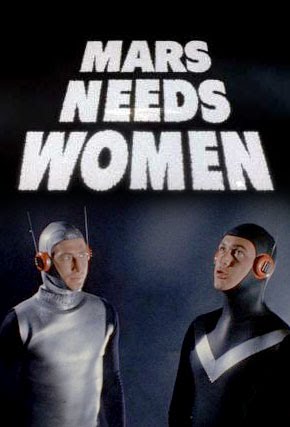
Mars Needs Women
This study looks at sci-fi movies which had a theatrical release, even if very small. It seems that Mars Needs Women (MNW) was made for television only. It's included here, "granfathered" in, on the coat tails of Larry Buchanan's work remaking 50s B sci-fi for television. Where his other projects were 50s sci-fi remade for the 60s, MNW was NOT a remake, but a new product by Buchanan himself. He wrote and directed it. Yet, MNW is very much a kindred spirit of 50s cheapy sci-fi in many ways -- complete with "aliens" who are exactly like us, but wearing hooded body suits.Quick Plot Synopsis
Several young women disappear (via cheap camera stop). Messages are received coming from outer space. Once decoded, they say "Mars Needs Women." The martians contact the Air Force to say that remotely snatching women didn't work out, so they're coming to earth in person. The leader martian (looking like a 40s 'martian' in hooded unitard) tells Colonel Page that due to genetic decay, few women are born on Mars. The male-female ratio is now 100;1. They want to ask for volunteer earth women. Colonel Page refuses. Dop says they'll just steal them then, and pops out. The world is placed on high alert. Page scrambles fighters to shoot down the martian ship. The "Cheetah-15" (X-15) is kept at bay with force beam. The early F-111 is also kept at bay. The martians land near an abandoned ice factory in Houston. The leader (Fellow 1) says they'll need some chemicals, earth money, earth clothes and a car. Fellow 3 robs a Phillips 66 station, so they have money and a map. Fellow 4 steals a Buick from a parking lot. Fellow 5 steals some suits from a men's store. To complete Operation Sleep Freeze, each of the Martians is to go find a suitable earth woman and bring her back. Fellow 5 settles on a stripper. Another Martian sets his sights on a college "co-ed." Yet another scopes out an airline stewardess. Meanwhile, Fellow 1 has decided to go for Dr. Marjorie Bolen, (Yvonne Craig) a young, sexy, space geneticist (?) in town as an advisor for the Martian Hunt alert. Fellow 1 hypnotizes a reporter to hand over his identity papers, then drive back to Seattle and forget the whole thing. Fellow 1 then pretends to be the reporter so he can get close to Bolen. Fellow 1 charms Bolen, so they do some quasi-romantic walks and talks. Bolen starts to like the Martian-fake-reporter. Meanwhile, Fellow 3 has homed in on a homecoming queen as his target. Fellow 4 gets his co-ed. With four women reported missing, authorities know there will be one more victim. All the abductions are centered on the abandoned ice plant. Bolen points out the chemicals there could be used to "freeze" people for long space flights. The army plans to attack. At supper, Bolen lets slip the army's plans, so Fellow 1 rushes to the ice plant. He implores his fellows to abort the mission and flee. They argue. Fellow 1 admits to rediscovering "love". Hug. Kiss. The army arrives and starts shooting. The Martian ship flies away. Women not stolen after all. Bolen all weepy. Text as final frame: "Earth is the cradle of man, but he cannot live in the cradle forever." -- Konstantin Tsiolkousky. The End
Why is this movie fun?
From the 40s-style martian outfits, to the 50s-style aliens-want-our-women plot, MNW is a throwback to the golden age of B sci-fi. It's not quality cinema, but it is amusing as nostalgia.
Cold War Angle
More as a side-effect of using 50s motifs, MNW rehashes the metaphors of enemy infiltrators. Spy-phobia abounds.
Notes
They're After Our Women! -- One of the old traditional tropes for sci-fi was to play on the primal (male) angst that outsiders wanted to steal OUR women. (How DARE they?) This played out as metaphor with the likes of Ro-Man carrying off pretty Alice, or the Gill Man absconding with Julie Adams. In other movies, the angst played out less subtly, such as the Mysterians demanding five earth women for breeding purposes. MNW is one of the blatant stories. Very clearly, they state that they (the Martians) want our best babes for breeding. Like the Mysterians, at first, they ask politely. When that fails, they steal them. The basic plot line of MNW would still work if it had been a Trojan raiding party that captured some prime Greek girls, but were chased off by Athenian warriors, or if Apache raiders had captured some pretty settler women, but the raiders were chased off by squad of cavalry, etc. etc. For MNW, the raiders just happen to have come from the tribe of Mars, so it's sci-fi..
Choice Women -- The Martians select five women, who apparently meet their stated criteria of being "young, healthy and with good reproductive capabilities." By this, they don't mean healthy ovaries and wide-set hips. No, they want sexy single babes. These also happen to be American teen archetypes of "available" females. What a coincidence!
1. The Stripper = sensual, voluptuous and blatantly available (on display)
2. The Stewardess = pretty, sophisticated, unattached.
3. The Co-Ed = Young, independent, away from home.
4. The Homecoming Queen = pretty, popular, "The ideal young woman."
If the Martians had demanded five plain, but sturdily-built farm girls with wide hip bones, would the men of earth have fought so hard?
Mars Got Morals -- It's interesting that the Martians wanted only single, unattached young women. Perhaps Buchanan felt strongly that married women ought to be off limits to such abductions. Perhaps he figured his audiences felt this way, so he wrote it in. Either way, the morality of the 50s and early 60s was still in place. The "sexual revolution" of the later 60s had not yet eroded the sanctity of marriage. Buchanan's moral Martians are an example of the 'before' times.
Second Wave? -- Curiously, Tommy Kirk, who plays Fellow 1 in MNW, also played a Martian in the 1964 comedy, Pajama Party. He was supposed be an advanced scout for an invasion. After Go Go reported all the young ladies in bikinis, the Martian authorities apparently decided that staying home with a batch of new earth babes was a better plan.
Stock Footage Stars -- A bit less common, but figuring into MNW, are shots of the X-15 and the early F-111. Lest viewers scoff at the X-15 portrayed as a fighter, recall that X-15s were cast in the role of space fighters in Toho's Battle in Outer Space ('60)
Bottom line? You can't take MNW too seriously. It's an old plot, performed by lack-luster actors (except for Yvonne Craig, of course), with stock footage and ultra-cheap effects. Yet, if watched in the spirit of the Commando Cody serials, it can be entertaining -- in a "lite" sort of way. Forbidden Planet, it's not.
Wednesday, August 18, 2010
Frankenstein Meets the Space Monster
The drive-in cinema market was lucrative enough, and comprised enough smaller, independent operators, that indie films were still viable drive-in fodder. Frankenstein Meets the Space Monster (FMSM) is a perfect example of a low, low-budget indie production aimed at the drive-in demographic, young adults. FMSM was actually the "A" feature. Futurama Entertainment also released Curse of the Voodoo as the "B". The title of FMSM alone was probably the big draw. Living up to audience expectations was secondary. FMSM appears to have been too obscure to make people's "worst movie ever" lists, but it shares most the usual features that get a film on such lists. Weak or hammy acting, cheap sets, poor effects and abundant stock footage. Nonetheless, it's not without its merits.Quick Plot Synopsis
A alien ship approaches earth. The bald-headed, pointy-eared Dr. Nadir tells Princess Macuzan that they've picked up signals from the planet, indicating it might have intelligent life. As they approach, NASA launches a rocket. The aliens think it's a missile attack on them, so they destroy the rocket. Two more such incidents are implied. NASA thinks the failures were for lack of onboard control, so prepare to send a Colonel Frank Saunders. Frank is actually an android. His rocket is similarly shot down by the aliens, but his capsule escapes. Frank lands in Puero Rico. The aliens, certain that he's seen them, land nearby to hunt him down. One alien shoots at Frank with his ray gun, narrowly missing, but melting the left side of Frank's head. Malfunctioning, Frank goes into basic survival mode. He kills a couple men who threaten him, but leaves women alone. Frank's creators, Dr. Steele and Karen, and the usual army general, fly down to San Juan to get Frank. The aliens, meanwhile, decide to implement Phase 2 of their plan, which is to abduct earth babes for "breeding purposes." An atomic war on their planet has left them no women. The aliens round up roughly a dozen young women (not all in bikinis). She and Steele found Frank in a cave. The aliens nab Karen as she was on her way to get help. She refuses to tell them about Frank's remote control unit (found in her purse), so they chain her near their monster named Mull. Steele and Frank follow Karen's trail to the alien ship. Steele goes for help, leaving Frank to observe. The aliens nab Frank too. By this time, the military have spotted the alien ship and start blasting it ineffectually. It has shields, but they won't hold if the military use nukes, so Nadir says they must leave. Karen awaken Frank. She tells him to free the caged babes. He does, and Karen too, just before the ship takes off. Nadir releases Mull to fight Frank. They fight, but Frank gets away long enough to blast Nadir, the Princess and the controls with a ray gun. The alien ship blows up in the air. Steele and Karen look happy as they ride a scooter through the streets of San Juan. The End.
Why is this movie fun?
There is a distinctly 50s flavor to the production and story of FMSM which a fan of 50s B sci-fi can appreciate. The over-the-top acting is fun. "And now...Maximum Energy...bwahahaha..."
Cold War Angle
A traditional sci-fi Cold War theme is provided as back story. It is there more out of tradition than an earnest bit of messaging.
Notes
Neo-stein -- The average viewer might feel gipped with FMSM. The "Frankenstein" of the title has almost nothing to do with Victor Frankenstein's famous monster. Instead, the android, Frank, is described by Steele in a sort of Frankenstein idiom of being "assembled of parts". (more of an electronic age's version of Shelley's idea) Later, when Steele talks of damaged Frank on the island, he muses that he might go violent. Karen says to herself, "He would turn into...a Frankenstein." The connection is thin, barely enough to justify the title. Clearly, the producers were coattailing on the more famous monster for some ticket sales.
They're After Our Women -- This primal trope was fairly common in Golden Age sci-fi. Usually, it was hinted at or subtle. In FMSM, this deeply visceral theme is inescapable. The tribal elements are blatant. A raiding party of "them" run around capturing our prime females -- quite clearly stated as being for "breeding purposes." The abduction theme isn't couched in visual analogies (e.g. a monster carrying a swooned babe). Instead, we get a raiding party attacking one of our "villages" (the pool party scene). A virile young man (one of our "warriors") is killed. The raiders hold everyone at gunpoint while they cull the best of the babes, then run off with their captives. The lewd leering of Nadir as he oogles our babes, completes the theme that our stolen women were not going to a better life. All this sets the tone for the also-quirky film Mars Needs Women ('67?)
Roomy Quarters -- Like many a sci-fi space ship, the alien craft in FMSM is a small thing, but seems to have in infinite amount of room inside. A control room, corridors, holding cells, the purification lab, and even room for storing a monster. The ship itself appears to be made from a geodesic radar dome, painted silver. The interior sets (shot in studios on Long Island, NY) tried to carry on the geodesic look in painted wood and plywood. The usual array of dials and switches make up the control panels.
Budget Bad Guys -- The make-up for the alien men is amusingly basic. Their bald-wig skull caps have marginally hidden seams. The clay pointy ear extensions look lumpy and obvious. Add some overall white face paint, and viola, you've got aliens. Interestingly, Princess Marcuzon doesn't have white face paint. The egyptian-esque head dress spared her from the ear extensions.
From Playmate to Princess -- Marilyn Hanold plays Princess Marcuzan. This was the big starring role of her acting career. She had a bit part (as Peggy) in The Brain That Wouldn't Die ('62). She was Playmate of the Month in June 1959. Her costume was surprisingly modest, given her assets and the exploitation theme of the film.
Vespa, The Star -- An unintended star in the cast was a little motor scooter. Dr. Adam Steele rents the scooter to go check out Frank sightings inland. Karen rides on the back, arms around him, while the music track plays a romantic 60s rock tune: "To Have and to Hold," by the Distant Cousins. Karen is rushing for help on the scooter when she's abducted. Adam rushes for help on the scooter after she's abducted. The chainsaw-like whine of the scooter's little two-cycle engine makes for a decidedly unheroic noise while he's riding to the rescue. At the end of the film, beneath the end credits, Adam and Karen ride the scooter around the streets of San Juan (behind the camera truck) while romantic rock tune plays.
Odds at Ends -- The writer or director gave FMSM an odd ending. Adam and Karen's hi-tech project was just destroyed in a fire ball. They just learned there are hostile aliens with interplanetary travel. The just learned there are hideous monsters out there in space. But, what the heck, we've got the scooter for another couple hours, so let's go sight seeing "like lovers dooooo" (say the lyrics). This bit of tourism travelogue is reminiscent of touristy sightseeing around Copenhagen in Reptilicus ('63)
Bottom line? FMSM is a low-grade B film (even though it was the headliner) whose cheap costumes, sets and effects will probably annoy viewers who demand quality. The story line isn't particularly deep either. Yet, for fans of cheap 50s sci-fi, those who liked the old serials, or fans of "so bad it's good," will find a little gym in FMSM.
Thursday, May 27, 2010
Invasion of the Star Creatures
Sci-fi from the Golden era (the 50s) was sufficiently established as part of American culture that it was a candidate for parody. This wasn't new in 1963, of course. Abbott and Costello Go To Mars had done this ten years earlier. Invasion of the Star Creatures (ISC) is a rather amateurish effort at comedy and parody in the Abbott and Costello style. ISC was written by a second-teir B actor, Jonathan Haze, and directed by a third-teir B actor, Bruno VeSota, Like A & C, their story is about a couple of bumbling earth men and some leggy space babes. The poster suggests something more serious. This notion is quickly dispelled.Quick Plot Synopsis
The opening credit is "An R. I. Diculous Production," so you know a farce awaits. Private Philbrick and Private Penn are two bumbling soldiers on a fictional Nike missile base in the southwest. They are sent with (some only slightly less bumbling) other soldiers to investigate a cave discovered in a nuclear test's blast crater. Philbrick and Penn, as human pack mules, are left outside while the other four investigate the cave. These four are chased by Vegemen, and disappear from the story line. Philbrick and Penn asleep outside, are captured by the Vegemen. They are monologued at by two tall and leggy beauties: Professor Tanga and Dr. Puna. Their planet is small and over-crowded, so they are scouting for suitable planets to conquer. Philbrick and Penn escape when Philbrick discovers that the amazons are rendered helpless by kissing. They flee the cave, but are pursued by Vegemen. The Vegemen almost succeed, but are called (telepathically) back to the cave. Tanga and Puna plan to depart in their rocket. Philbrick and Penn get their commanding officer and some random (un-PC) "indians" to help stop the rocket. The helpers get uselessly drunk on moonshine, so Philbrick and Penn must go it alone. They bumblingly launch the empty rocket, stranding Tanga and Puna. These two decide to make the best of being marooned by becoming Philbrick and Penn's wives. Philbrick and Penn are awarded a medal for saving the planet and then drive off with their 7' tall brides. The End.
Why is this movie fun?
This is tough, as ISC is almost painfully lame. Yet, some of the parody references can bring a small smile to fans of 50s sci-fi. Of course, Puna and Tanga aren't hard on the eyes, and may actually be the best part of the movie.
Cold War Angle
As a spoof, no serious messages exist in ICS.
Notes
Amateur Hour -- The two big forces that shape a movie, the writer and director, were both novice efforts. Jonathan Haze usually played bit parts in low-level B movies. For example, he played the contaminated man who dies pretty early into Day the World Ended ('55). Haze is more famous for his role in Little Shop of Horrors. He was not particularly adept at writing comedy. ISC was his sole effort at writing a movie screenplay. Bruno VeSota was another bit-part actor in B films. His lasting fame was as the fat shop owner in Attack of the Giant Leeches ('59), whose unfaithful wife got everyone out in the infested swamps. To his credit, VeSota had enough technical experience to get the job completed. Comedy/parody takes a skillful hand, which Haze & VeSota were just too green to have. The overall effect of ISC is sophomoric (especially the stereotype indian gags). ISC was VeSota's third and last film as a director.
Ro-Man Reunion -- Fans of 50s sci-fi will recognize the cave as the one at Bronson Canyon. This, ten years earlier, was the lair of the infamous Ro-Man of Robot Monster, and several other aliens too. Little wonder that Tanga and Puna set up their digs there too.
Budget Bud and Lou -- Bob Bell and Frankie Ray were cast as a low-rent version of Abbott and Costello. A budget pair Stooges might be more fitting. Penn functions as the "straight man" only because he's only slightly less idiotic than Philbrick. To their credit, they do try to act in stooge-esque fashion with many bits of slapstick. The script, however, contains only lame jokes. For instance, at one point, a Vegeman pushes Philbrick to the floor (for refusing to leave when commanded). Philbrick says, "That's the first time a salad ever tossed me! " Now and then, Ball occasionally lapses into a vague Jimmy Cagney impersonation for no particular reason.
Space Babes -- Even though parodied, ICS does manage to pay homage to the 50s tradition that outer space is populated with tall, leggy beauties in their mid-twenties. Part of that tradition is that said space babes are always man-hungry for earth men. While nothing new, this trope was at least amusing to see (again).
Space Rangers -- A running gag throughout ICS is a spoof of the 50s phenomenon of Space Rangers, those pseudo-clubs built around TV shows or movies which appealed to young boys. First Philbrick, then his commanding officer, Colonel Awol, the indian leader and even General Brass at the end, are all revealed to be members of the Space Commander Conners Club, which supersedes all other allegiances. Also, quick-eyed viewers will spot that Puna and Tanga's rocket is Rocky Jones, Space Ranger's "Orbit Jet."
A Thing For You -- The Vegemen are a mildly amusing nod to The Thing. They're plant men, grown in little flower pots, reminiscent of the famous '51 thriller.
Bottom line? ISC is a film which only devoted sci-fi collectors might endure. It may have played better to the drive-in crowd in 1963, who were children raised on 50s sci-fi. ISC has some archeological value as a time-capsule of base humor in the early 60s. To modern viewers, however, the jokes are lame or tedious.
Thursday, August 20, 2009
The Leech Woman
Universal's B unit cranked out a second-feature film to package with Brides of Dracula. The resulting movie, Leech Woman (LW) was only peripherally a sci-fi story with stronger horror tone. Yet, despite its low budget secondary nature, LW manages to be cut above the average B movie. The premise isn't entirely new. It is a mash-up of Dr. Jekyll & Mr. Hyde ('31), Wasp Woman, ('59) She-Demons, ('58) and Womaneater ('59). The search for eternal youth has Faustian consequences.Quick Plot Synopsis
Endochrinologist, Dr. Paul Talbot anticipates glory from his work on aging. He disdains his past-peak wife June. She longs for his love and is furious at his rejections. A shriveled old woman named Malla comes to Dr. Talbot. She is 152 years old. A mysterious powder from central Africa extends her life. It can restore youth. Paul decides to take June to Africa to see (and maybe get a hot wife to boot). Paul, June and Bertram their guide, are captured by the Nandos tribesman. Malla shows them the secret, though they'll never leave to tell anyone. The powder is mixed with the juice from the pineal gland of a young man victim. Malla becomes a lush young babe. She offers to let June try it. Paul hints at deserting June to save himself, so June selects Paul as her sacrificial pineal donor. June becomes a lush young babe. She and Bertram escape with a dynamite diversion. June discovers that babedom was temporary. Horrified and desperate for youth, she kills Bertram for his pineal juice. She returns to the States pretending to be June's niece, Terry. When age returns again, she kills a two-bit hoodlum for his pineal. Terry tries to seduce Neil. His finacee Sally intervenes and gets killed for it. The police come snooping around looking for June. They find dead Sally. Age returns to Terry/June. Sally's female hormone didn't do the trick. Terry/June jumps from a balcony and dies, her body that of a haggard old woman. The End.
Why is this movie fun?
The premise isn't entirely new, but neither is it worn out (yet). Even if things are fairly predictable, there is enough food for thought in the script to make it rewarding. While the directing and cinematography are not remarkable, the pace seldom bogs down (other than some trudging through the jungle scenes).
Cold War Angle
This is a science-gone-wrong tale of vanity and hubris. There are no Cold War motives in play.
Notes
Pineal Power -- Nevermind that the pineal gland is several inches inside the brain, so a hooked ring could never get there. The pineal gland had some mystique about it. Decartes fancied it was the seat of the soul. In the late 50s, the pineal hormone melatonin was studied as a possible cure for some skin diseases. Melatonin does play a role in sexuality. Prepubescent youth had higher quantities of melatonin. As such, having pineal hormone tagged as youth secret was not so far fetched.
Encore Encore -- A couple 50s B sci-fi faces return. Grant Williams plays the young lawyer, Neil. Williams is more famous as the Incredible Shrinking Man. Gloria Talbot plays his fiancee, Sally. She starred the unfortunate bride, Marge, in I Married A Monster From Outer Space ('58).
Jekyll's Daughter -- The trope of body-changing drugs is not new. Here, instead of the Jekyll/Hyde duality of civilized vs. bestial, the dualism is youth-beauty vs. age-ugliness. As in Wasp Woman, ('59) the presumption is that only pretty, young, vivacious women are of value. June, not quite the innocent victim, becomes so obsessed with being "worshipped by men" that she easily becomes a serial killer.
Malla's Monologue -- Old Malla gives the rationale for the story in a monologue before undergoing her transformation. "For a man, old age has rewards. His gray hairs bring dignity. He is treated with honor and respect. But, for the aged woman, there is nothing. At best, she is pitied. Contempt and neglect." The nypee drug gives them one last fling at youthful lust before they die.
What's In A Name? -- Low-budget productions avoided retakes to keep costs down and schedules tight. Unless a scene went noticeably wrong, it was kept. When young-June and Bertram were running from the Nandos village, she called him John at one point (the actor's actual name). A short while later, she calls him David. The credits list him as Bertram. Oh well. He dies of a neck jab either way.
Bottom line? LW is actually a better movie than its title suggests. It is thin on the science in its fiction, but makes up for it as a commentary on obsession with youth. LW would make a fun triple feature with Wasp Woman and She-Demons. The deadly quest for youth and beauty.
Tuesday, May 5, 2009
The Womaneater
This is an obscure British sci-fi/horror film that is thin on "science" but also light on the horror too. What it does have is an eclectic blend of Frankenstein and Faust and Jack the Ripper. Womaneater is still a low budget B-film, but does rather well within those confines. There is a little bit of stock footage, but not much. The sets are simple, but sufficient. There is a strong sense of film-noir throughout, as almost none of the characters seem noble or heroic. It ran as the "other" feature to The H-Man.Quick Plot Synopsis
A London doctor travels to the upper Amazon because he had heard of a tribe of natives who have a "juju" which can restore the dead to life. He's suffering from "jungle fever" and his cohort is killed by a spear as they come across a native ceremony sacrificing a young woman to an odd "tree" with little wiggling arms.
Five years later, Dr. Moran has the tree (or one like it) in the basement of his manor house back in England. He also has one of the tribesmen, who is repeating the drum ceremony. They sacrifice a young red-head to the tree. Later, Moran extracts an inky serum from the tree and injects it into a heart in big beaker. The heart beats awhile, then stops. The police are trying to solve the disappearance of the red-head. Meanwhile, at a local traveling carnival, a young mechanic takes a fancy to a blonde "attraction" at a hawker's stand. He objects to how her boss talks to her. He punches out the boss. The blonde gets fired. The next day she walks to the mechanic's garage. He suggests Moran's house as a possible housekeeper job. She gets a job there, over the objections of the middle-aged housekeeper, Margaret. Moran stalks the streets of London looking for another victim for the tree. He follows and picks up Judy. He takes Judy to his manor. He and Tanga sacrifice her to the tree. Margaret threatens to leave. She and Moran argue. She tries to stab him with decorative dagger. He chokes her and kills her. Sally tries to leave, but Moran (who's fallen in "love" with her) tricks her and locks her in. He takes her his lab to see his triumph. More serum drained from the tree and injected into a body under a sheet. The heart beats, the lungs breath. The body sits up. It's Margaret. She's an unresponsive zombie, not really alive. Moran furious with Tanga (and his people) for cheating him by sharing only half of the secret. Zombie Margaret drops to the floor before getting to Sally. The police and the mechanic arrive in time to rescue Sally. Moran throws flammables on the tree. Tanga throws a dagger into Moran's back, then kneels before the burning tree. The End.
Why is this movie fun?
The pacing is pretty good for a low budget movie, with several interwoven threads. George Coulouris plays Dr. Moran rather well, keeping the character teetering on the edge of rationality. Joyce Gregg does a good job with the tormented housekeeper. Vera Day, who did Quatermass II the year before, plays the carnival exotic dancer, but does about the worst hula seen on film. The shot over her shoulder, between her pointy bra peaks, of Jack trying to concentrate on the car's wiring, is hilarious. It probably wasn't supposed to be, but it's so completely unsubtle that you can't help but laugh.
Cold War Angle
There's nothing of commies or nukes in Womaneater, whether actual or analogous. This is much more of a faustian tale of science being misused by an arrogant scientist.
Notes
Generic Brownies -- A peek at 50s race-insensitive thinking can be seen in "the natives." They're supposed to be descended from the Aztecs, even though the Aztecs were in Mexico, not the Amazon basin. The natives are of various shades, and include Africans. The feathered garb of the medicine man is aztecish but the ritual chants sound decidedly African. There's no one that looks credibly like an Amazonian native. Instead, they're a mishmash of native peoples. This is pretty typical for 40s and 50s jungle films. All them brownies look alike anyhow, ya know. Who'll notice? In the 50s, they didn't.
Bad Girls -- A surprise, is how misogynist Womeneater is. There are no good women in this story. The beautiful victims are rendered mindless by the hypnotizing drums. Even when the effect wears off just prior to being fed to the tree, they can only scream in fear. They are powerless victims. Margaret is the abused former flame who hangs around, taking the abuse on the presumption that she could have no life apart from Moran. Judy, the bar tramp, is a cheap floosie easily picked up by Moran.
As he feeds Judy to the tree he says, "What's a few worthless lives compared to what I'm giving the world. It's turning death into life." Women are cheap tree food. Even the "good" girl, Sally is abused. She's helping Jack work on a car. Just after Jack asks her to marry him, he begins to berate her for not holding the light right and other little blunders (she's no mechanic). Okay, so Jack is a jerk. That's not so odd. The odd part is that Sally accepts all this bad manners between them as representing a normal married life. The subtle message in Womaneater is that all women are low-value creatures who foster dysfunctional relationships.Faust -- Unlike the archetypal naive scientist who unwittingly creates a monster, Dr. Moran fits the mad scientist mold. He's bent on controlling the amazonian's "juju" which can bring the dead back to life. He's doing it more for his own glory than any sort of altruism. In fact, he's quite willing to sacrifice young women's lives for the "gift" he's planning to give mankind. Not much of a gift at that price. There's nothing redeeming about Moran.
What's in it for Tanga? -- An obscure question is why the native, Tanga, agreed to come to England with the woman-eating tree when he knew all along that his people only shared half the secret of restoring life. He knew Moran's experiments would come to nothing, but played along like a good minion. His angle? He apparently just wanted the tree to be fed young women. This was his religion. The more sacrifices he tree-god received, the better.
Echo of Prohibition -- There's a curious little exchange between Moran and the bartender when Moran is stalking Judy. Moran asks for a whiskey. The bartender asks if he's a member. Moran scoffs and puts some money on the bar. The bartender smiles and pours his whiskey. What was that all about? It's a hint of earlier British culture. In the early 1900s, when the Prohibition movement was sweeping the USA, similar sentiments were astir in England. The British could not come right out and ban alcohol, as the Americans tried. Instead, they banned pubs serving drinks to just anyone. Private clubs, however, could serve drinks, but only to members. London gentlemen did like their clubs. By the 50s, the official private-club laws were a faint formality, largely ignored by both bars and patrons. The little exchange between Moran and the bartender captures that. This is a trivial little nugget as far as the movie goes, but it's a fun little snip of history.
Bottom line? Woman Eater is an oddly noir sort of film. It's a little thin on the "science" for a sci-fi, but no less than other sci-fi/horror hybrids in circulation in the late 50s. It ran as the B film to the American release of The H-Man -- making for a people-eater double feature. Woman Eater isn't a top priority film to see, but has some entertainment value.
Sunday, March 15, 2009
She Demons
Here is yet another example from the gray area between horror films and sci-fi. As a low-B picture, it's not an especially strong example of either. It double billed with Giant From The Unknown, the only other film produced by Screencraft Productions. It's claim to membership in the sci-fi sphere is thin. Dr. Osler is conducting some vague medical processes and does spew some techno-blather about hormones. He also rambles about extracting electrical energy from the lava beneath the island. That, however, is about as far as the "science" of the fiction goes. True, She Demons has many of the shortcomings which befall most low budget B productions. It is clearly aimed at the young male audience. It stars Irish McCalla (famed for her "Barbie" physique) and the poster's promise of many more babes in short skirts. Yet, She Demons' quirky mixture of tropes and themes has a charm to it. This may explain why it has developed a cult following as one of those "so bad they're good" movies.Quick Plot Synopsis
A hurricane shipwrecks a spoiled heiress and three men who work for her father. Their uncharted island is used for US Navy bombing exercises, but turns out to be inhabited. One of the men is killed by spears. The others find the island inhabited by both deformed-faced women, and a group of beautiful scantily clad 20-somethings who like to preform interpretive dance. These are all rounded up by some Nazi soldiers and returned to their bamboo cages. Dr. Osler is extracting the beauty from the young women, to try to restore his wife Mona's badly burned face. The process makes the young woman have a 'demon' face for a few days. Fred, Sammy and Jerrie sneak into the lab later, but are caught by Osler's sergeant. Fred and Igor fight, with Igor eventually getting locked into the cage full of she-demons who kill him. The three escape, but are captured by more SS soldiers. In custody, Olser tells all the back story of concentration camp days, Mona and his experiments, etc. Fred and Sammy are locked up. Osler puts the moves on Jerrie as a replacement for poor Mona. Jerrie whacks Olser with a champaign bottle and escapes with the help of Mona. Eventually, all three are recaptured by Osler. Since Jerrie continues to spurn Osler, he has her on the transfer table. Just then, Mona objects and the Navy starts bombing. The explosions free Fred and Sammy. Cracks in the walls cause "lava" to engulf Osler. Mona opts to stay and die with her husband. SS soldiers chase the fleeing three, but they escape. The soldiers do not. At the beach, Jerrie and Fred proclaim their long suppressed love for each other. Confident that the Navy will come to examine the island for all the new lava flows, they row out into the sea for safety. The End.
Why is this movie fun?
Some have moaned about how 'bad' this movie is, but it is chock full of classic trope remakes. More on those below. She Demons is pure B movie, and can be enjoyed as such.
Cold War Angle
This movie is much more of the "mad scientist" genre than anything related to the Cold War.
Notes
Remade Moreau -- There is a strong homage to the 1932 film, Island of Lost Souls. The protagonist(s) arrive on an uncharted island via shipwreck. On the island is a mad doctor and a population of people suffering disfigurement from his experiments. Where Charles Laughton's Dr. Moreau was somewhat ingratiating and smarmy, Rudolph Anders' Moreau-like Dr. Osler pushed ingratiation to extremes. We also get a recast of the '32 manimals mobbing Moreau scene, with the she-demons mobbing cruel sergeant Igor.
From Villain to Henchman -- A small side note is the actor Gene Roth who plays Dr. Osler's chief thug, an SS Oberscharführer (sergeant). In the early 50s, Roth was the chief interplanetary villain -- Vultura -- in the Video Ranger serials. Despite his added age, and fall in rank, Roth manages to still give a suitably villainous performance.
Farming Babes -- Another bit of trope recycling is Osler using the young women to make his wife beautiful again. He's farming the young ladies, as it were, to harvest their beauty. This was the trope within The Corpse Vanishes (1942) in which Bela Lugosi is using extracts from dead brides to keep his old wife looking young. The notion of the young being sacrificed to maintain the old, has deep roots.
Lost Women -- She Demons has several of the distinguishing characteristics of the "Lost Women" sub-genre. There have been several of these already in this tour of '50s sci-fi. Catwomen of the Moon ('53), Fire Maidens from Outer Space ('56) and Queen of Outer Space ('58), to name but a few. There were many others outside the sci-fi genre too. Prehistoric Women ('50), Bowanga Bowanga ('51) and Wild Women of Wongo ('58) as just a few of them. They share in common, an isolated or 'lost' group of beautiful 20-somethings who are discovered/found by some outsiders. The lost ladies have a penchant for group dance and are usually endangered by something. She Demons is clearly a member of the Lost Women sub-genre.
Logical Leap? -- To the inattentive, it may seem like a huge hole in the logic of the film (not that B films were famous for tight plot logic), that Fred, Sammy and Jerrie first see the pretty prisoner women doing their sensual group dance before getting rounded up by the SS troops. If the girls escaped their cages, why on earth were they just cavorting around a fire to drums? What kind of escape is that? Later in the film, Dr. Osler explains to Jerrie that the the "character X" transfer removes all memory from the victim. Even though their beauty returns in a few days, their memory never does. As such, all these escaped young beauties have nothing in their heads but the wild sensual inner woman. As Don Henley's song said it, "all she wants to do is dance, dance, dance." Surely, this is a young male fantasy. A bevy of perfect beauties with no past -- no fathers, no boyfriends, no plans. Only their nubile libido remains.
Liberated Über-Nazis -- One of the intriguing bits of She Demons is seeing Nazis liberated from the confines of WWII history and used as generic villains. Nazis had much screen time as villains in tons of war films. They also feature as shadowy villains in many non-war films too, but the stories were almost always set sometime between 1933-1945 (e.g. Casablanca ('42), Sound of Music ("1938"), The Hindenberg ('1937"), Raiders of the Lost Ark ("1936"), etc. etc. In She Demons we get to see generic (almost exaggeratedly stereotypic) Nazis who have broken free from the orbit of the war period -- free to ply their mythic menace anywhere, anytime. They wear pristine SS uniforms (despite being isolated on the island for over 12 years), and spout the usual generic movie-nazi lines like "Raus", "Schnell", "Schweinhund," and "Dumkopf" while doing only evil deeds (such as whipping a pretty young blonde) This freedom from history, by itself, is an intriguing feature.
Bottom line? She Demons will never impress anyone with its acting, sets or for having any deep social meaning. Horror fans and sci-fi fans will need to scale back their expectations, as it's tamely marginal in both genres. It is, however, a fun bit of entertainment if you let it be what it is, a B-movie.
Wednesday, March 11, 2009
Missile to the Moon
This little B-movie is obviously a remake of Catwomen of the Moon. One wonders why the producers thought this was a good idea. Perhaps their marketing folks said there was some quick/easy money to be made with a film that features a bunch of beauty pageant winners in dance leotards, high heels and tall hair. In that case, the Catwomen script provided a means. The script of Missile to the Moon (MTTM) follows the story of Catwomen pretty closely, but with just enough differences to provide a little interest to B-film fans.Quick Plot Synopsis
Dirk Green has privately built a rocket for traveling to the moon. The government plans to commandeer the project, because only governments can do space travel. Dirk blasts off that night. Inside the rocket are two escaped convicts, whom Dirk hijacks into being his crew. Dirk's assistant Steve and his fiance June happen to get aboard too. During a meteor storm, a big battery falls on Dirk. Mortally injured, he gives Steve a medallion then dies. When they get to the moon, the four find rock monsters. They escape into a cave only to become prisoners of and the all-female remnant of a civilization living underground in ever-shrinking air pockets. They mistake Steve for Dirk because of the medallion. Dirk came from the moon. The queen plans to take her subjects to earth. Alpha, the second-ranking moon woman rebels and kills the queen. She plans to kill the other earthlings, marry Steve (even though he isn't Dirk) and take her moon girls to a different planet. Moon-babe Lambda falls for the convict named Gary. He's only interested in the cave full of diamonds. Lambda is killed by the cave-dwelling spider monster. Zema, falls in love with the other convict, Lon. During the belly-dancing wedding ceremony, Lon and Gary save June from execution by the spider monster. Alpha, angry at their escape, orders Zema to flood the caves with poison gas. Zema instead tosses a grenade which breaks up their last pocket of air. The moon women dramatically expire. On the surface, Gary is laden down with bags of diamonds. The rock creatures force him into the deadly full sun. He burns up. June, Lon and Steve get to the ship. June asks Steve if she's prettier than Alpha. Only good ol' mother earth is prettier. Har har. The end.
Why is this movie fun?
MTTM is a remake of Catwomen of the Moon, but cranked up a notch or two. It's fun to see how much MTTM matches Catwomen and where it deviates.
Cold War Angle
There aren't really any Cold War metaphors or references in MTTM.
Notes
Catwomen Redux -- Yes, MTTM is a recasting of the story Catwomen of the Moon. Check that link for a recap. In some ways, MTTM is a cheaper copy (most notably in the props). In other ways, MTTM goes further than Catwomen did. MTTM has two loving traitors. Lambda falls for Gary and dies. Zema falls for Lon and dies. A twist in the Zema duplicate is that she causes the end of the moon women. MTTM has a repeat of the greedy-man (Walt with gold, Gary with diamonds). MTTM has the same spider puppet as Catwomen but made more menacing with big toothy mandibles. MTTM adds the laughably slow, but intriguing rock creatures. Like Catwomen, there is a very odd preoccupation with romantic pairings and whether someone loves them or not (or is pretty enough). An alien civilization and bizarre creatures are not important enough. Boy-girl attractions. Now that's important.
Telltale Budget -- MTTM is a typical low-budget production, so it's fun to spot the usual shortcuts. You'll see some V2 footage used many times, and an astoundingly cheap flat prop "rocket" for the on-the-moon shots. The rock creatures are actually kind of fun. A toddler could out run them, yet the actors respond as if they were tigers.
Rare Air -- The moon women supposedly have the last pocket of air, but it's interesting to see that only Air Force jumpsuits, pilot's helmets and oxygen masks are needed on the moon's surface. And, when Gary strays into the sun, he bursts into flames. The lit torch in the cave was 'proof' that there was oxygen earlier in the story.
Green Cheesecake -- One could imagine Producer Marc Frederic starting with the idea of a quick-buck movie whose "hook" was a cast of a dozen beauty pageant winners.

But what to have them do?. The plot of Catwomen provided a venue, so remake it was. Instead of the catwomen's artsy full black leotards, MTTM has the pageant winners in high heels, dance leotards and bangeled up like budget Las Vegas showgirls. Such an obvious pandering to teen male audience tastes is amusing. Watch how all the pageant babes are always striking glamor poses.
Bottom line? MTTM is more fun if you've seen Catwomen already. Compare and contrast, as the professors say. Beyond that, look past the extreme cheapness of the production and take in another (somewhat wacky) installment in the "lost women" sub-genre.
Saturday, January 24, 2009
Queen of Outer Space
Here is a movie that is difficult to categorize. Queen of Outer Space (QOS) is clearly in the sub-genre of planet-of-beautiful-women. Yet, it is as if there were two screenwriters, or two directors, each with a distinctly different vision of the movie. One "vision" is of a typical 50s space adventure. The other vision borders on campy parody of the sci-fi genre. QOS manages to be both, co-mingled but not blended. The final result is a peculiar, but intriguing film. The fact that Allied Artists hired and promoted Zsa Zsa Gabor as the star, and a supporting cast of starletts, suggests outright exploitation. Having Ed Bernds direct (of Three Stooges fame) suggests parody. Yet, the actors deliver their lines seriously. There is no winking at the camera as Lou Costello often did. Even though QOS is shot in CinemaScope wide screen and lavish Color by DeLuxe, it doesn't play like a true big-budget "A" movie. It's "B" movie soul is unmistakable. Call it an A of the Bs.Quick Plot Synopsis
A rocket is sent to bring Dr. Conrad to Space Station A. Before they arrive, laser-like beams zip around. One finally hits the station, destroying it. Another beam hits the rocket, sending it speeding out of control. The rocket crashes in snowy mountains. The air is breathable, so the four astronauts hike down to the tropical forest below. While dozing around their campfire, they're captured by several ray-gun toting beautiful young women in short skirts. Venus is a planet of young women. They're brought before the masked queen of the planet who accuses them of being spies. The lead venusian scientist, Talleah (Zsa Zsa Gabor), believes the men are not spies and asks their aid in overthrowing the evil queen. The queen summons the Captain, half to interrogate him more and half for male companionship. She tells of the beam weapon and plans to use it on Earth. He plays up to her, impertinently pulling off her mask. Her face is disfigured from radiation burns. He and others are sentenced to die. Talleah and two other women help the men escape the city. They hole up in a cave, where Larry is attacked by a giant spider. He's saved, but patrolling guards are too near. The Captain has Talleah and the others pretend to have captured them. In the city, the four men and three women stage a coup in the queen's chamber. Talleah disguised as queen and the other two women sent ahead to the beam weapon to round up collaborators. The queen disguise fails. Everyone is taken to the beam to witness Earth's demise. The queen pushes the button, but the beam fails. She goes inside to fuss with it. Outside, the loyal babes and the underground babes all fight. The weapon explodes and the queen burned to death. Talleah is made the new queen. She's keen on the Captain. The men planned to return to Earth in their repaired ship, but receive orders from Earth to stay (for a year) to await a relief mission. They happily agree. The women are happy too. The End.
Why is this movie fun?
Another installment of planet-of-beautiful-women is amusing enough on its own. Seeing the screenplay, acting and directing vacillate between camp-parody and earnest sci-fi adventure is fun too -- like a "tween" who can't decide if he's still a boy or a young man, so acts like both. Seeing old prop friends is fun. Zsa Zsa Gabor's thick Hungarian accent is too fun to pass up.
Cold War Angle
Amid the abundant gender role sparring, is the cautionary tale of nuclear war gone bad. Venus won her war with planet Mordo, but the ruin was great. Evil queen Yilana began her reign of hate. Her Beta-Disintegrator is a world destroying super weapon. Cold War audiences needed no convincing of such things.
Notes
Planet of Women -- QOS uses the trope of the isolated civilization of only women, as have several movies before this. Sticking to the sci-fi group, there was Catwomen of the Moon ('53), Abbott and Costello Go to Mars ('53) and Fire Maidens From Outer Space ('56). Later in 1958 there will a remake of Catwomen, Missile to the Moon. They all share the quirky notion that somewhere "out there" is a group of 20-something beautiful women who have no men but want men badly. The hapless male protagonists just happen to wind up in their midst.
Good Girl / Bad Girl -- Another feature QOS shares with other all-girl-culture movies, is "bad" girl character who hates men and her "good" girl counterpart who wants men. In this, there is a repeat of the anti-feminist message that man-haters only make for a sad world. Zsa Zsa sums up the counter message when she tells the queen, "Vimmen cannot be happy visout men." For all her vitriol at men for causing the war that disfigured her, Queen Yilana is just as eager to make war on Earth without real provocation. Moral? A woman leader would be the same as men. Good girls don't want power. They just want men to kiss them.
Plot Medley -- QOS starts out as an almost routine space adventure, but then parallels World Without End with the loss of control, crash in snow, descent to temperate woods. It then attempts a semi-serious remake of Abbott & Costello Go to Mars with the society of young love-starved beauties and a man-hating queen. There's also a bit of Flight to Mars in the earthlings finding themselves between an oppressive regime and a revolutionary underground.
Damn the Science. Full Speed Ahead -- Even the characters bemuse over how the movie's earth-like climate of Venus is contradictory to what was known. They don't explain the disparity, they just get on with the story. How handy.
Prop Watch -- QOS re-uses the star cruiser uniforms from Forbidden Planet ('56). Also look for Altaira's short gold-studded dress on Motiya. For the turbulent ride to Venus, QOS recycles the cave spider puppet and the jostled ship footage from World Without End ('56). As a reminder, WwoE used the rocket ship from Flight To Mars ('51). Recycled recycling. Some interior shots were also re-used from WwoE, as was the crashing in the snow scene (although reversed left-right).
Blatant Gender Roles -- Despite the flashy show of "strong" women, QOS positively oozes 50s male chauvinism. For one, even the guards are buxom long legged babes in miniskirts and heels. When the queen talks tough, Larry says, "Why don't you girls knock off this gestapo stuff and be a little friendly." Later, discussing the Beta-Disintegrator, they quip, "How could a bunch of women invent a gizmo like that?" says Mike. "How could they aim it?" adds Larry. "You know how women drivers are." Har har. Supporting all this chauvinism, of course, are the "good" girls who coo for male attention and just want to make out. There seems little doubt that the movie was geared to (panders to) young male ticket buyers who can think of little else beyond making out.
Bottom line? QOS is worth watching as two movies in one. Watch it for the laughably absurd sexism and sex-obsessed dialogue. Watch it as an adventure tale about hate-corrupted power and revolution. And of course, if you happen to like looking at 20-something buxom beauties "aliens" in miniskirts and heels, the producers give you plenty of that too.
Friday, December 19, 2008
The Astounding She-Monster
Released in late 1957, The Astounding She-Monster (ASM) was the second feature to an already low-budget "feature" film Viking Women and the Sea Serpent for a sort of babes-appeal double feature. ASM is nominally a sci-fi film in as much as it involves an alien coming to earth. The bulk of the movie is more film noir. At its core, ASM in the family of films of messenger-from-space, like the classic The Day The Earth Stood Still (TDESS, '51), but takes the darker tack. What if the messenger appeared to criminals instead of dignitaries? What if the messenger was only seen as a deadly 'monster'? Robert Clarke stars as the hero/geologist.Quick Plot Synopsis
The narrator tells us about other worlds which faced destructive crises. An object leaves one planet, headed for earth. A meteor lands in the woodsy mountains of southern California. Emerging from the crater is the svelt she-monster. In the city, a band of three low-grade criminal types kidnap Margaret, a young rich woman, expecting a hefty ransom from Daddy. After a flat tire, they end up at the remote cabin of a geologist named Dick. They cannot flee further, so hole up in the cabin for the night. Brad, the thug driver, goes outside to investigate a noise. He encounters the she-monster. He shoots at her to no avail. She touches him. He dies. The she-monster confronts the rest of them outside the cabin, touching Esther. She dies. Nat dodges a lunge by the she-monster, who rolls down a cliff, apparently dead. Nat makes the three of them drive out in a lightless jeep at night. The she-monster revives and stops them. She touches Nat and he dies. Back at the cabin, Dick theorizes that the she-monster has a thin metal protective coating. He mixes up a flask of acid. She-monster jumps in through the window. He tosses the flask and she-monster dies. Only her locket remains. Inside is a message from "The Master of Planets" offering to help Earth out of its current crisis. Will another messenger come with a repeat of the offer, or for revenge? The End.
Why is this movie fun?The dark reworking of TDESS is interesting in itself. Having the (presumed) "monster" be a curvaceous young woman is rare enough to be interesting. The hybrid of sci-fi and film noir is intriguing as well.
Cold War Angle
Between the narrator's comments and the message from "The Master of Planets" there is the understanding that the people of Earth stand at the brink of nuclear destruction. ASM is another tale of warning.
Notes
TDESS Sibling -- After all the crime and horror drama, at the end, the message is similar. Earth is in trouble and aliens want to help us. Here is the message the she-monster had in her locket: "People of earth, you have been under our surveillance for a number of decades. We now feel your civilization has progressed far enough to make you eligible for membership in the council of planets. This council, for your information, is a universal governing body dedicated to the advancement of planetary progress. It is an agency which Earth seriously needs in this period of crisis and chaos which Earth now finds itself. Many of our member plants have experienced the same disturbing problems which confront earth today. We feel that a meeting with the heads of these planets would definitely benefit Earth in the solution of its own global difficulties. If you would like a meeting, so arranged. Relate your wishes to the bearer of this message and she will return with word of your decision."
Scifi Noir -- Much of ASM is film noir. Crime and criminals dominate. Even the criminals themselves are derelicts. There is a femme fatale in the she-monster. A constant note of hopelessness pervades. Even the erstwhile band of criminals are dysfunctional and inept (symbolic of society itself in noir-view). Like many film noir, life is seen as fairly cheap and society somewhat dystopic. The narrator's tone has a snide edge to it. Margaret (the rich kidnapee) is described as spoiled and shallow. The kidnappers, too, are painted as losers. "You're all being taken on a rendevous with fate," the narrator says with a smug and oily voice. "The best laid plans will go astray, this day..."
Wardrobe Malfunction? -- One of the rumors surrounding ASM is that Shirley Kilpatrick's sparkly full-body leotard was so tight that it split a seam (or bust the zipper) up the back and that budgets didn't permit it to be fixed. Circumstantial evidence cited for this, is that Shirley "always" faces the camera, backing away instead of turning to walk away. There is, however, one brief scene nearer the end, where the she-monster is 'attacking' the group of four outside the cabin, and we do see Shirley from the back. Maybe this scene was shot early, out of sequence, but maybe not. What you do see is that the zipper is fairly wide and inelegant-looking. The notion of a tightly conformal metallic coating didn't square well with a fat zipper. It's just as likely that the director kept Shirley facing the camera to avoid seeing the clunky looking zipper. Besides, Shirley's front was better for viewing anyway.
A Dash of Science -- Besides the presence of an alien (albeit a very human looking one), the claim to "science" fiction comes near the end. Dick, the geologist, deduces that the she-monster has a thin coating of radium and platinum covering her (the radium is why her touch is deadly). Dick has on hand several acids he uses for his geology work. He mixes up a batch designed to dissolve the platinum, thereby breaking the she-monster's shell. It works. He throws the bottle of acids at her. She doubles over and dies (without any visible damage). Chemistry triumphs again!
Bottom line? ASM is a typical low-B movie -- The 'star' is a second-tier actor, the rest third-tier. The sets are minimal and the effects aren't all that special. Despite all this, there is an intriguing tone of dystopia, almost as if the hope of The Day the Earth Stood Still was turned on its head. For sci-fi and film noir fans, this is reason enough to give ASM a watch.
Thursday, August 21, 2008
Fire Maidens of Outer Space
This movie is sometimes called a British remake of Catwomen of the Moon -- with an even lower budget. There are several similarities between the two, which support the notion, but there some deviations too. The deviations are usually bits borrowed from other movies. Fire Maidens of Outer Space (FMOS) is occasionally cited as a "worst movie ever made," and not, perhaps, undeservedly. FMOS is one of those films written, produced and directed all by the same person. This seldom spells success. Cy Roth had very limited prior experience as either a screen writer, a producer or a director. As such, his big solo venture has an awkward amateurism to it. He may have just been trying to crank out as cheap a film as possible to make a few bucks. On the other hand, like other one-man-productions, he may have also been including a some personal artistic message. Low-B as it is, FMOS is still a 50s sci-fi, so it's part of the group.Quick Plot Synopsis
A five man crew of British astronauts are sent to check out Jupiter's 13th moon because it was discovered to have an earth-like atmosphere. They land amid trees and meadows. They rescue a young blonde beauty from a black beast-man, then follow her to a hidden passage in a tall stone wall amid the forest. Two of the men go inside, three wait outside. Inside, an old man named Prasus tells them that he and all the 20-something beauties in short skirts are all that's left of the people of Atlantis who fled earth 3000 years ago. The creature keeps them holed up inside their walls. Prasus wants the earhtmen to kill the creature and be husbands for the love-starved ladies. In gratitude for saving the girl, Hestia, Prasus gives her to the leader: Luther. There is much quasi-ballet dancing. A rival brunette is upset that a younger girl got a husband before she (the eldest) did. So, she incites the other girls to capture Hestia and offer her on an altar (with fire, hence the title) to appease the sun god for the infraction of the eldest marries first rule. Much more dancing ensues. The three outside men are captured and taken to the altar room. The other two men escape their confinement too. The black creature finds his way inside the wall. First, he kills Prasus, then comes to the altar room, disrupting the sacrifice ceremony. Luther and Larson arrive and, with a gas grenade, cause the creature to fall into the flames. All is forgiven and the earth men promise to send back another mission to bring them all to earth to find husbands. The rocket takes off. The end.
Why is this movie fun?
Tracking the many similarities to Catwomen can be amusing. Puzzling over what Cy Roth was thinking with his obvious changes from Catwomen can be amusing too.
Cold War Angle
None. This story is motivated by libido, not nuclear angst.
Notes
Checkers, Rock(et) Star -- Many B-grade sci-fi films have used the same stock footage of the launch of the captured V2 with the checkerboard paint on its fins. Cy Roth goes one better and recycles the Checkers footage used in an obscure B movie, King Dinosaur ('55). That movie used the Checkers launch footage, reversed, superimposed over a pine woods to look like a landing. Roth simply reused it. To his credit, however, Roth had a model V2 Checkers for the "space" shots, and had the aft-with-fins mockup for the disembarking shots made to look like Checkers. At least he was consistent.
Planet of Babes -- An obscure sub-genre (all-women societies) grows just a bit with FMOS. In the sci-fi flavor, it's preceded by Cat Women of the Moon ('53) and Abbott and Costello Go to Mars ('53). It has similarities to both. There are other all-women movies in the sub-genre too, such as Tarzan and the Amazons ('45), Prehistoric Women ('50), Wild Women (aka Bowanga, Bowanga) ('51) and Mesa of Lost Women ('53). All these deal with a group of young pretty women in their prime, who lack men. This odd little sub-genre is worth exploring on its own, but not here. There will be others to come in this sub-genre in the sci-fi flavor too.
Quota Quickie? -- FMOS is sometimes referred to as a "Quota Quickie." This disparaging term stemmed from the British 1927 Cinematograph Films Act, which mandated that at least 20% of films shown in British cinemas were British productions. Many low-budget (and low quality) films which would lose money, were still worth doing because it allowed American distributors to then also market American films which were high profit. They were like loss leaders in the retail market. Cy Roth, an American producer, would certainly appear to have created a low-budget British film with this in mind.
Juvenile Motivation -- Much of FMOS is built upon the juvenile (male) fantasy of there being many available and eager young women starved for male attention. The behavior of the men in FMOS only reinforces this, as they're all (but one) slobbering to be "lost" among the babes. There's nothing deeper or nobler in play -- simply boy wants girl who wants boy. The many low camera angles looking up the girls' long legs, with glimpses of panties, appeals to the voyeur. It was certain that offering audiences dozens of pretty women in short skirts would sell some tickets. Cheesecake sells.
Amateur Art? -- Cheesecake aside, Cy Roth seemed to be trying to make at least a modest artistic statement as a writer. Roth repeatedly used Borodin's Polovtsian Dance #17, popularized in 1953 as the song "Strangers in Paradise." He seemed to be trying to make the 13th moon into something more than a love-starved sorority house planet. Then there is the Prasus character. He stands as a symbolic father figure, protector and provider for his "daughters." It is he, in father-role, who "gives" Hestia to Luther. Prasus, like most fathers, wants his daughters to marry "good" men. He frets about the black beast-man outside the walls of the happy home -- symbolic of the bad boys "out there" who simply want the girls brutishly. (The fact that we're never told anythig about the Creature -- why he exists, what he wants, etc. -- makes him more symbolic than anything) The climactic scene has the "good" man saving the daughter from the "bad" man. Roth may have been an amateur writer, but he seemed to be trying to do more than a simple exploitation film. A morality play lurks within.
Padding O'Plenty -- One inescapable conclusion in FMOS, is that Roth did not have 80 minutes of script. Tightly edited for a modestly brisk pace, FMOS might run less than 60 minutes. A "feature" film had to be longer than that. You can't help but notice how many scenes are padded with long looks at not much going on.
This Is My Good Side -- The very many close ups of the actors and actresses, in which they look dreamily, or heroically, into the camera, suggests that Roth may have sold many of the "lead" actors and actresses on the idea that the movie (lame as it was) offered them a chance to get their faces on the big screen. All the close ups look like publicity snips, particularly since they do nothing to advance the plot.
Bottom line? FMOS is worth watching only as a representative of the planet-o-women sub-genre, a remake hybrid of two obscure movies, but somehow still trying to have some legitimate artistic reason to exist. If you're impatient with low-quality, slow moving films, it would be best to skip FMOS.
Subscribe to:
Posts (Atom)