1910s & 20s * 30s * 40s * Pre-50s * Frankenstein * Atomic Angst * 1950 * 1951 * 1952 * 1953 * 1954 * 1955 * 1956 * 1957 * 1958 * 1959 *
1960 * 1961 * 1962 * 1963 * 1964 * 1965 * 1966 * 1967 * 1968 * 1969 * 1970 * 1971 * 1972 * 1973 * 1974 * 1975 * 1976 * 1977 * 1978 * 1979
Showing posts with label dinosaurs. Show all posts

Friday, July 20, 2012

When Dinosaurs Ruled The Earth

Following up on Hammer Film's hit, One Million Years B.C., ('66) which starred Rachel Welch, When Dinosaurs Ruled the Earth (WDRE) was a worthy sequel. For some reason, dinosaur and caveman movies are tagged as sci-fi, when they are really just fantasy films. But, since they show up on sci-fi movie lists, they are included here too. Victoria Veltri stars as the leading cave girl, Sanna. Robin Hawdon stars as the leading cave guy, Tara. Despite the title, the story is more about cavemen not getting along too well with each other. Val Guest, writer of the Quatermass stories, wrote and directed.

Quick Plot Synopsis
The narrator tells us that this is a time of beginnings, of darkness and light. The beginnings of man living with man, of love and fear of the unknown. The Rock tribe is gathered on a high cliff at dawn, to sacrifice three blond women to their sun (god). Just as the sun comes up, a fuzzy partially-formed moon appears in the sky, causing great wind. Many are blown over the cliff, but one of the sacrificial women, Sanna (Vetri) falls in the sea and lives. She is picked up by a raft of fishermen from the nearby Beach tribe. Having their human sacrifice survive is bad magic (apparently), so Kingsor and some Rock men come to fetch her. At the beach village, blonde Sanna is a curiosity. Tara (Hawdon) takes a shine to Sanna, much to the jealous displeasure of his already-girlfriend, Ayak. She stirs up the other women to declare Sanna to be "Neecro" (bad magic). Sanna escapes into the desert. The delegation of Rock men arrive looking for Sanna. They search but are attacked by a chasmosaurus. Sanna hides in the woods and sleeps in an open dinosaur eggshell. Mamma dinosaur arrives and assumes Sanna to be one of her babies. Tara is carried off by a pterosaur to it's pinnacle nest. He kills it, but also sees Sanna and Mamma dinosaur. He tries to save her, but Sanna's in charge. She takes him to her cave. Caveman style romance ensues. A Rock tribe man saw where they were. More men come. They see the smoke from Sanna's fire and have the two surrounded. They escape by swimming out into the surf. Tara is captured. Sanna is saved by Momma dinosaur. Tara is to be killed for being Neecro, but the execution is interrupted by a tsunami. Everyone runs in circles screaming. Giant crabs appear and attack people. Sanna appears, frees Tara and they take to a raft. Kingsor tries to halt the incoming wave with authoritative arm raising. It fails. Tara, Sanna and a couple from the Rock tribe survived on the raft. The fuzzy moon becomes the solid moon. They watch a very fast lunar eclipse. Ramp up triumphal music, roll credits. The End.

Why is this movie fun?
Aside from all the shapely cave girls in skimpy costumes, the dinosaur and live-action integration is pretty well done. The landscape of the Canary Islands lends visual appeal too. It is interesting to see how modern tastes and socio-political cause d'jour write (or re-write) history.

Cultural Connection
Movies about primitive man battling dinosaurs have been around since silent films. The Lost World 1925 is the best known. Despite the lecturing of evolution pedants, the populist mind has no problem with caveman vs. dinosaur. Some argue that this popular comfort with the idea suggests a lingering "race memory" -- that maybe early man did have to deal with dinosaurs.

Notes
Going, Going, Gone -- Comparing caveman movies over the previous 50 years, one can see how cave clothing got skimpier and skimpier. In 1923 cavewomen in Buster Keaton's Three Ages wore ragged-edged leopard skin dresses with one strapless shoulder!. In 1940, cave-babe of One Million B.C., Carol Landis, wore a ragged-edged leather miniskirt dress. In 1966, cave-hottie Rachel Welch wore an even more ragged leather one-piece swimsuit with many cutaways. In 1971's WDRE, cave-vixen Victoria Vetri (playmate of the year, 1968) wore essentially a bandeau bikini. There wasn't really enough of it to make ragged. In the uncut version of the film, she wore even less than that, appearing nude in the "love" scene and the skinny dipping scene.

Tough Love -- Notable in WDRE are depictions of tough caveman "love." One Rock tribe man carries off a screaming Rock woman to his cave. She fights (sort of) and screams a lot. He tosses her onto his pile of hay and rips off her top. She kinda likes things rough, apparently, as she smiles and makes "love me" eyes at him. In another scene, Tara feels romantic for Sanna in their cave hideaway. So, in suave caveman style, he grabs her by the hair and rips off her cave-ini. (Good thing cave-girl-wear fastened with easy snaps.) He tosses her nude form onto a pile of furs. She kinda likes it and makes "love me" eyes. Modern male story writers liked to assume that primitive women were turned on with some roughness.

Fading Idealism -- In1940's One Million B.C. and the 1966 remake, One Million Years B.C., the story features a mean tribe, the Rock men, and a nicey-nice tribe, the Shell men. In OMBC and OMYBC, the Rock tribe are projected "capitalist" (selfish) while the Shell tribe is spun as "socialist" (sharing). WDRE alters that dualism a bit such that the Rock tribe are ritualistic and authoritarian. The Shell tribe are still nice and communal, but not as clearly cast as the purely nice ones. The pessimism of the 70s was seeping into cinematic caveman culture.

New Moon -- An odd feature in WDRE is that it purports to depict when the moon was formed. The vague glowing mass just arrives all of a sudden -- interrupting the Rock tribe's (wasteful) sacrifice of three pretty blondes. The fuzzy moon creeps out the Shell tribe too, so they also blame Sanna for it. (Can't a blonde get a break?) Near the end of the story, the cloudy mass suddenly coalesces into the moon we all know and love. This causes the fateful tsunami that wipes out the old authoritarian establishment, making the world anew for the lovers. If evolutionists have trouble with dinosaurs and cavemen, astronomers will have seizures over this fanciful story of the moon's creation.

Pre-Leet -- A minor point is the name of the Rock tribe leader -- Kingsor. This is so Leet, but more than ten years before Leet appeared. Could this indicate that the seeds of Leet were lying dormant in mankind, just waiting for the 80s BBS environment to make it sprout?

Bottom line? There's really nothing science about the fiction in WDRE. It's a fantasy story. Fans of sci-fi with aliens, saucers, rockets or nukes, will find their cup empty. Fans of dinosaur films get some action. Fans of films with glistening young women in bikinis will find their cup overflowing.

Thursday, September 29, 2011

The Valley of Gwangi

Warner Brothers / Seven Arts produced an A-grade film that defies easy categorization. The Valley of Gwangi (TVG) proved that cowboys are a versatile story component. You can mix them almost anything: dinosaurs, aliens, whatever. The stop-motion animation of the various critters, great and small, was done by the great Ray Harryhausen. While not his last animation, it was his last go at dinosaurs. James Franciscus and Gila Golan star, but Harryhausen's work dominates the movie. The story, originally written by King Kong effects master, Willis O'Brien, was itself an adaptation of the basic Kong story. A giant creature is captured from his native Eden, hauled into civilization to be exhibited, breaks loose, rampages, and dies. But, instead of a giant gorilla, the beast is an allosaurus.

  Quick Plot Synopsis A battered and bloody gypsy man staggers and dies just as his family find him. In a burlap bag is the miniature horse he took from the Forbidden Valley. The old woman of the clan warns that it will bring a curse on them. Carlos gets the miniature horse for T.J. Breckenridge (Golan) who is running a traveling wild-west show cum circus that travels around Mexico. The tiny horse is to be the star act that makes her show profitable again. Enter Tuck Kirby (Franciscus) who was once TJ's boyfriend, but he left her. The gypsies sneak in and steal back the eohippus. Carols blames Tuck, but it was actually Professor Bromley who tipped off the gypsies. He wanted to follow them to find the source. They find a narrow passage cave through the ring of mountains. In the forbidden valley, a pterodactyl almost carries off Lope. Carlos wrestles it and kills it. They chase an Ornithomimus, thinking to capture it for TJ's circus. However, a big blue allosaurus, named Gwangi, catches and eats it first. They all flee Gwangi, while a Styracosaurus intimidates him. They find a cave to hide in. Tuck asks TJ to settle down with him in Wyoming. She agrees. Eventually, Gwangi finds their hideout cave, but the Styracosaurus arrives again. While they do battle, everyone rides away, like the wind. Gwangi gives chase, catching and eating Carlos. Everyone else gets out through the cave. Gwnagi is too big, so gets stuck. In freeing himself, he causes a rock slide which knocks him out. Tuck, Champ and the others tie up Gwangi and take him back for TJ's circus. TJ fancies a world tour with Gwangi over settling down in Wyoming. Tuck is hurt. Meanwhile, the gypsies conspire to free Gwangi before he is exhibited. The dwarf gypsy loosens the bolts on Gwangi's cage, but gets caught and eaten anyhow. Gwangi breaks out of his cage, causing the stadium crowd to stampede for all exits. Many people flee to an old cathedral under renovation. Gwangi follows them in, so they trap him inside. His big tail knocks over conveniently placed pots of open fire. This catches the drapes on fire. Soon the whole place is engulfed. Gwangi screams in pain and takes a long time to die. Outside, the crowd watch in stunned silence as the cathedral crumbles amid the flames and plaintive roars. The End.

  Why is this movie fun?
That's easy. Cowboys AND dinosaurs. What's not to love? Harryhausen's work is excellent and usually well integrated into the live-action.

  Cold War Angle
Since the story is a recast of the classic Kong theme, and Kong was pre-Cold War, TVG has no Cold War to it. Just good ol' monster rampaging.

  Notes
Cowboy-Dino Redux -- As unusual a mix as it is, TVG is not the first time cowboys and dinosaurs have been together. In 1956, the indie film Beast of Hollow Mountain had a group of cowboys, also in Mexico, discover a T-Rex. They don't want to capture it for exhibition, just to stop it from eating their cattle. Instead of the beast burning in a church, they lure it into some quicksand in the swamp. TVG is a far superior film, just not the first. Before all of that, and even before King Kong, there was the silent film version of Conan Doyle's "Lost World" which also featured some dinosaurs brought back from a hidden valley, for exhibition, who also break free, rampage and die.

  Gila Revoiced -- Actress Gila Golan is obviously dubbed with some other woman's voice, but why? The dubbing job is only passable at times, suggesting that it was a last-minute decision. Watch Our Man Flint ('66) to hear her real voice. She is clear and articulate enough, but does have something of a latent eastern European accent, like a mild Gabor sister. The original producers and director must have been okay with Golan's accent when they cast her. She was hardly the only well-built beauty available at the time. It may be that some late-to-the-table producer at WB/7A, who viewed the final cut and didn't like the sound of her. Perhaps he thought it was too close to the Green Acres scenario of an eastern european accented beauty amid American rustics. So, he ordered all of Golan's lines dubbed with a blandly American-sounding voice.

  Harryhausen's Last Dino -- Ray would continue to do stop motion animation after TVG, but this was his last dinosaur movie. Dinosaur films were falling out of favor at the box office and would remain so until CGI-animated ones made a comeback in Jurassic Park in the 80s. Some scenes in TVG look like inspiration for scenes in Jurassic Park.

  Great Score -- One of the highlights of TVG is the rousing musical score by Jerome Moross. The motif is pure western, full of galloping cadence and manly brass. It ranks right up there with the themes from The Magnificent Seven and The Good, The Bad, and The Ugly and How The West Was Won.

 Bottom line? TVG is often listed as a sci-fi movie, but has little science to it, beyond a backwater paleontologist spewing some blather about evolution and wanting to study the dinosaurs (which by their very existence seem to disprove his blind faith in evolution). Beyond that, it's essentially a ramping monster film. As a film, TVG is rollicking and fun, provided one does not take it too seriously. Harryhausen's work is worth watching, regardless.

Wednesday, May 18, 2011

Voyage to the Planet of the Prehistoric Women

A curiosity, as a derivative work of prior derivative works, Voyage to the Planet of Prehistoric Women (VPPW) is yet another story cobbled out of cuttings from two earlier films, themselves created out of prior Russian films. Details on that in the Notes section. Added to all the recycled footage was new footage of Mamie van Doren and a bevy of young beauties, playing the women of Venus.This expounds on things hinted at in the original. Peter Bogdonovich directed the new footage and provided the voice of "Andre" as narrator. VPPW was likely aimed the small screen only, (hence the DVD cover art in lieu of a proper poster) but is included here because of its theatrical roots.

Quick Plot Synopsis
The main body of the story comes from the english-dubbed version of Planeta Bur: Voyage to the Prehistoric Planet ('65). A synopsis of the original base story can be read here. VPPW is told as a narrated flashback of V2PP by the astronaut Andre. Instead of there being three Venus-bound ships traveling together, they travel one at a time. Cappella is lost to a meteorite. Kern and Sherman (and robot John) follow, but crash-land in the Vega. Lockhart, Hans and Andre are the third rocket as rescue mission. They land and explore, looking for Kern and Sherman. Interspersed with the PB footage is new footage of the venusian women alluded to in the original. Roughly a dozen platinum blondes with seashell bras live the life of harbor seals. They bask on coastal rocks, swim to catch and eat raw fish. Unlike harbor seals, they communicate telepathically, and worship a pterosaur they've named Tera. The astronauts and the babes never really meet, though two babes see the astronauts. Angry that the men killed their pterosaur, the queen blonde (Van Doren) invokes the god of fire mountain to erupt and kill the invaders. This doesn't work. She then invokes the sky god to rain and flood them. This almost works, but the astronauts depart anyhow. This second failure of local gods prompts the ladies to knock down their old pterosaur idol and prop up the lava-scorched hulk of the robot John as their newer "stronger god." Astronaut Andre voiceovers his desire to return and find "her." The End.

Why is this movie fun?
A third appearance of original footage could be as dull as recycled cardboard, but the new footage actually fits. Sure, it's campy and exploitive, but for all that, not so badly done for a B-grade made-for-late-night-TV movie. The additional footage from Nebo Zovyot was fun to see too.

Cold War Angle
There is none. VPPW is mostly an example of the Space Women sub-genre.

Notes
Copy of Copies -- Roger Corman (the uncredited real producer of the work) cobbled together footage from two of his prior adaptations of soviet sci-fi. Corman used footage of the rocket launches, spaceflight and space stations from his Battle Beyond the Sun ('63). BBS was Nebo Zovyot ('59) dubbed into english, telling a roughly similar story but without the soviet gloating over foolish capitalists. He used footage from his Voyage to the Prehistoric Planet ('65) for the astronauts in their rockets and on Venus. VPP was his english dubbed version of Planeta Bur ('62). The premise of VPPW is VPP retold as flashback, but revealing the unseen women.

Space Got Babes -- VPPW keeps alive the old mythos of there being out in space somewhere, a society of pretty young women (with no men). Like several others in the sub-genre, there is no explanation for why there are no men. There just aren't. These particular space babes are all 20-something platinum blondes (except for one redhead), led by Mamie Van Doren (who fit the role of buxom kitten better 10 years earlier). They live the primitive life of harbor seals in a semi-mermaid idiom. Only one of the venusian babes (beside Van Doren) had any acting experience, or did anything afterward.

Telling the Untold Story -- What the original movie (Planeta Bur) left as teasingly unexplored, with the haunting presence of at least one pretty venusian woman with some telepathic powers. She "sings" unseen. She rescues Andre with calls for help. She warns them of danger with her songs. Eventually, Andre finds her likeness carved in ivory. Her reflection is seen in a puddle at the end -- arms raised, beckoning. Writer Henry Ney filled in the untold story. He created a bevy of beauties, not just one. He played up the telepathy part. Ney also had the women be the cause of the two "natural" disasters in the original film -- the volcano erupting and the torrential rains. As campy as it was, Ney managed to fill in the implied story in the original.

Fading Marsha -- An interesting detail to watch for is the fading of Marsha. She goes from a Russian cosmonaut to a fairly useless American astronaut to a mere acronym. In the original film, Masha (no R) was a fellow female cosmonaut (and love interest for Ivan). She stayed in orbit in the Sirius while the three men go down looking for Kern and Ivan. In Corman's 1965 dub, Voyage to the Prehistoric Planet, most of the scenes plain looking Masha are replaced with new footage by not-quite-hot-anymore Faith Domergue as Marsha (with the R) but in a less useful role. In VPPW, we're told that "Marsha" is the acronym for earth mission control. That seems thin, but plausible enough, if it weren't for lines like "Marsha says she saw something on radar." Or, when Sherman/Ivan is despairing in the cave and moans about "Marsha, O Marsha." (A bit too attached mission control, are we?)

Fond of Older Women -- Audiences seemed to like prehistoric (or primative) women. VPPW is another member of the primitive women sub-genre. A partial list includes: One Million B.C., ('40), Prehistoric Women ('50), Bowanga Bowanga ('51), Viking Women and the Sea Serpent ('57), Wild Women of Wongo ('58), Women of the Prehistoric Planet ('67), Prehistoric Women ('67) and Rachel Welch in the remake One Million Years B.C. ('66). Perhaps primitive/prehistoric women (all young, pretty, shapely and scantily clad) were appealing on the presumption that civilization hadn't (yet) curbed their wilder "appetites". For whatever reason, the sub-genre proved popular. Corman knew some prehistoric girls could spice up his old soviet sci-fi footage.

Bottom line? VPPW is passably viewable as a B-grade sci-fi on its own. It has some archeological value. A tribe-of-women tale it has some value. For the average viewer, however, VPPW will likely seem too obtuse, or dated. (After all, most of the source footage was from 1959 and '62)

Sunday, November 14, 2010

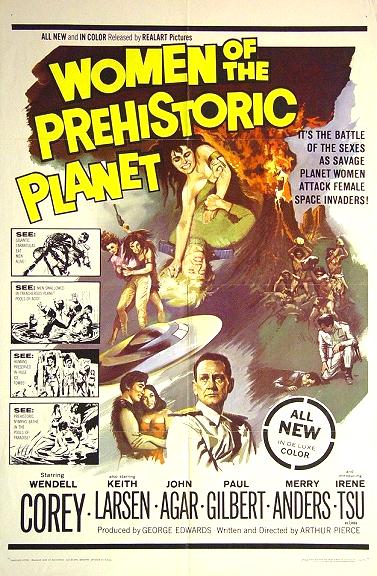
Women of the Prehistoric Planet

Somewhat mis-titled, Women of the Prehistoric Planet (WPP) is an indie production very much in the Star Trek morality play ehtos. By its title, WPP could easily be confused with Voyage to the Planet of Prehistoric Women, ('68) but that is a completely different film. WWP is not another derivative of Planeta Bur, but a new work written and directed by Arthur C. Pierce, who brought us The Human Duplicators ('65) and Mutiny in Outer Space ('65). Partially a social commentary on racism, partially a love story and partially a jungle flick, WWP struggles to be many things. It was mostly shot on a sound stage, so it has a small-scrreen feel to it.

Quick Plot Synopsis
Three space ships of some unnamed advanced civilization (of humans) are traveling back home from some far flung mission. The commander of the mini-fleet, Admiral King, hears that there is trouble aboard one of the ship, the Cosmos 3. The trouble is a mutiny by some of the Centaurian crew/passengers. The backstory is that Centaurians (played by asian actors) are a race whose once-great civilization collapsed (war?), leaving them poor. The mutiny on Cosmos 3 caused it to crash land on a steamy prehistoric planet. King's superiors do not approve a rescue, but King turns the Cosmos 1 around anyway. Traveling at near-light speed, their three month trip meant that 18 months elapsed for the survivors of the Cosmos 3. When the Cosmos 1 lands, they find the crashed ship but no survivors. A young man, Tang, is the son of two survivors -- a white officer and a centaurian woman. Aboard the Cosmos 3, a centaurian woman named Linda runs away. (yearns for freedom). She meets Tang and the two fall in love. Scout parties from the Cosmos 1 go through several jungle movie adventures, including losing an expendable crewman in a "pool of acid", attack by a dinosaur, and attack by a giant spider. Tang and Linda are attacked by a band of generic cavemen. King's men rescue Linda, but shoot Tang (a manly flesh wound). Volcanic instability forces the Cosmos 3 to leave. Linda runs away again, just before launch. She finds Tang and they live happily ever after. Departing, Admiral King remarks to his log, that the previously uncharted planet should hereafter be called: Earth. The End.

Why is this movie fun?
The Star Trek flavor of WPP has nostalgia value. Seeing veteran 50s B sci-fi star John Agar (now with a touch of gray) adds more nostalgia value. The lovely Irene Tsu adds eye candy value. Seeing TV actors of the 70s in early bit parts is fun too. Stuart Margolin, who later plays "Angel" on Rockford Files, is an expendable comic relief crewman (who gets killed by the cat-sized "giant" spider).

Cold War Angle
WPP is a morality play about racism. The only hint of a Cold War theme is the subtly implied disaster which befell the Centaurians.

Notes
Women? -- While the title and poster suggest that viewers will get to see multiple women on the prehistoric planet, there seems to be only one, and she's not even of the planet. She's an alien. Linda falls in love with Tang, She leaves the civilized confines of the Cosmos 1, trading her pink jumpsuit for a racy silk wrap. None of the other women of the Cosmos stay on the planet.

Race Relations -- WPP is blatantly a social commentary on race relations (from a mid-60s point of view). Even though the screenplay tries to preach fairness, some of the subtle signals send contradictory messages. The crew members of the Cosmos are portrayed as superior. The Centaurians as inferior. The crew are clearly all-white. They dress in tidy white uniforms with snappy cravats. They are in control, follow orders, and are concerned for others. The Centaurians are "rustic," (and all played by asians) Their outfits are sleeveless. Their men are hotheads and trouble makers. (their women are nice, though). Even the "progressive" notion of Tang being the mixed-race son of a "white" and a Centaurian, is undermined by his apparent comfort at being a cave man. Subtle signal: "They" are savages at heart. Star Trek (TOS) would dabble in the race topic too, with similar, but more exaggerated "others": the Klingons.

Enduring Dino-Caveman World -- Evolutionists say that cavemen and dinosaurs never shared the same soil. The more popular view, that they did, is seen again in WPP. We have a token dinosaur (enlarged iguana) and a cameo of savage cavemen near the end.

Color Me Expendable -- The soon-to-be tradition of having an expendable crewmen on your "away team" was not confined to Star Trek. Those familiar with TOS can spot his expendability well in advance of his fate. Watch the short-sleeved member of the search party. He's not quite bright enough to understand time paradoxes associated with travel near the speed of light. He is also wearing a red cravat. Dead giveaway. (pun intended) The others wear yellow. Sure enough, when they're crossing the wobbly log over the pit of acid, who falls in? Surprise! (not)

What's the Matter With Wet? -- Poor Linda falls into the little pond, fainted at the sight of the big mean snake (which Tang shoots with his metal crossbow). Tang takes her back to his cave. She wakes up with only an animal print sheet on. He took her clothes off because they were wet. Why is this always accepted by screenwriters? Of course, it was Irene Tsu. I suspect that if Tang had fished out Chief Bradley, he would have let him dry off in his clothes.

Odds and Ends -- Note that the space ship, resembling a chrome football, is sometimes silver, and other times gold. Note that giant lizards on prehistoric earth are highly flammable -- shoot them, and they burst into flames. Note that earthquakes are bad enough to force a ship to take off, but will subside shortly after it does.  Gavin MacLeod is sometimes cited as playing the helmsman. We mostly just see the back of his head and that is a full head of dark hair. The credits, however, do not list MacLeod.

Bottom line? WPP is a low-budget indie production with unimpressive effects. Fans of 50s B movies will see much similarity. By the mid-60s, the bar was higher than that. Yet, there is a 60s flavor to it, as a sci-fi space opera making social commentary. Viewed with a charitable attitude, WPP has its moments.

Thursday, October 21, 2010

The Land Unknown

To start off this Digression Week, we return to 1957. Universal's B-wing produced a rather major effort (for a B movie), with The Land Unknown (LU). It was yet another iteration of the "lost world" sub-genre. While not the best of the lot, it was not the worst either. As with the others, some undiscovered spot on the earth contains a sampler of primeval earth, into which a small band of 20th century must survive. More on that in the Notes section. Second-teir actors, stock footage and less-expensive effects mark LU as a B movie. Yet, more elaborate sets, models, props and matte art, give LU a larger-budget "A" feel.

Quick Plot Synopsis
Some navy brass in Washington brief men who will embark on a survey mission to Antarctica. A pretty lady reporter will accompany them. They are told of, and show films of the 1946-47 Admiral Byrd expedition, whose work they will expand upon. The goal is to find more natural resources. Coal. Minerals. Uranium. After stock footage of steaming ships, Commander Roberts, the pretty reporter, Maggie, pilot Jack and mechanic Steve, take off in a helicopter for a first photo survey. A storm brews up. Jack's only option is to fly through it. Amid the foggy clouds, something swoops at them, hitting and damaging the chopper. They descend and keep descending, finally landing 3000' below sea level. Outside, it is warm, humid and tropical. They rest for the night. Next morning, the air is clear and they see the primeval tropical landscape. They see "dinosaurs" too, a couple of death-roll fighting monitor lizards, the dead pteranodon that hit their chopper. They find a cute little tarsier and Alan blathers evolution talk about it becoming a Mozart in 50 million years. A carnivorous plant eats the tarsier. A T-rex chases them back into the chopper, whose whirling blades save them. They find their camp ransacked. A "caveman" abducts Maggie. The boys give chase. Cavey says Maggie is his. The boys interrupt him in mid-maul. Foiled (at gunpoint) he says he is Dr. Carl Hunter, sole survivor of a crash 10 years ago. Carl says his old wreck has a part they can fix the chopper with, but will only trade it for Maggie. No, say the boys, and all leave. Later, Maggie gets separated from Alan, and the carnivorous plant almost gets her. Carl saves her. She faints. He disappears. The boys look in vain for Carl's wreck. Maggie decides to give herself to Carl to save the others. En route, a plesiosaur almost gets her, but Carl saves the day with fire. He carries the (again) fainted Maggie up to his cave. Steve fights Carl without much success until Alan and Jack arrive. Carl falls and hits his head on a stone table. He surrenders and gives them a map to his wreck. Maggie dabs Carl's wound. The boys get the chopper fixed. The plesiosaur, angry about Carl's fire in its mouth, scares Maggie into a faint again. Carl puts her in his canoe to take her to Alan. The chopper takes off just as Rex shows up again. They see the canoe and hoist Maggie up. The vengeful plesiosaur attacks Carl and knocks him out, then goes for the chopper. Steve fires a flare into its mouth. They hoist up limp Carl and fly away. Back at the convoy, they run out of gas and have to ditch near the ship. All aboard safely, Maggie and Alan exchange oblique talk of marriage. Kiss. The End.

Why is this movie fun?
As lost-world dinosaur movies go, LU is pretty well paced. The sets are impressive, as is the matte art. The interweaving of actual history makes the script somewhat clever. The stock footage actually has some interesting moments, like DC-3s taking off from a carrier with rocket assist! A rare stock footage treat!

Cold War Angle
There's not much mention of Cold War themes, beyond the hint that if Antarctica had uranium deposits, it was important for America to get there first.

Notes
B, for Lack of Harryhausen -- The "dinosaurs" are all that keep LU from being an A-grade movie. They used a couple of monitor lizards, fighting amid miniature landscape, but this effect was old-stuff in the 1940s. There is an almost-embarrassing T-Rex, which is clearly a man inside a poorly formed rubber-suit. The head is okay, but from the neck down, he looks like a geriatric Rex hobbling down a nursing home hallway. The plesiosaur is better, but so clearly a large mechanical prop that there's no magic. The badly done dinos let much of the wind out of LU's sails.

Lost Plane -- A clever bit of history weaving was to have Carl say he was the survivor of a plane lost in the Antarctic 10 years earlier. The other three were dead. There was a plane lost in the Byrd expedition in 1946. The PBM went down in a snow storm. 3 men died. One wonders if audiences in 1957 would have had just enough of a vague memory of a lone lost antarctic plane in '47 to have connected those dots. In the real history, six other men survived and were rescued 13 days later.

The Castaways -- Jock Mahoney stars as Commander Harold Roberts, (Although, Maggie calls him "Alan" on numerous occasions). He is a fairly 2-dimensional heroic leader character. Shirley Patterson plays the lady reporter Maggie. Aside from being the usual eye candy / damsel-in-distress. Her character is the 2-dimensional female match for Alan. She gets rescued a lot, faints a lot, and men fight over the rights to possess her. Pilot Jack and mechanic Steve are a bit less flat. The Dr. Hunter character is more interesting. As the 20th century civilized man of science -- turned into a brutish (and lusty) savage, he actually serves as an interesting antidote to all of Alan's pollyanna science blather about evolution producing Mozarts and Shakespears.

Star Chopper -- The sixth castaway is the helicopter itself. The horsey-looking Sikorsky S-51 (or H-5, if your prefer) was the first real US military chopper. The Byrd Expedition had two S-51s. The producers used one in LU, (even though they were obsolete by the mid 50s), to take advantage of stock footage. The writers even had the castaway's chopper run out of fuel at the last minute and have to ditch. This was pointless for the plot, but let them include footage of the ditching of one of Byrd's S-51s. Actually, the real S-51 crashed on take-off, not landing. The pilot veered off the deck before gaining enough height. Without the cushion effect of the deck, he just dropped into the sea off the port side. Rare footage.

Nazis and Saucers and Secrets, Oh My! -- An intriguing bit of back story to the original Byrd Expedition, provides a very sci-fi connection. Why, conspiracy theorists asked, was such a huge military 'scientific' expedition so hastily mounted just a year after the war ended? The conspiracy theory runs like this: Before the war, the Nazis explored part of the antarctic coast, naming it New Swabia. There, they constructed some underground bases. Nazi scientists were working on a flying saucer, based on a crashed UFO found in Bavaria in 1938. As the war was going badly, U-boats ferried Nazi scientists and big-wigs to the hidden bases in New Swabia to continue work on the über-weapon saucers. Admiral Byrd was sent to find those saucers, root out those Nazis. Supposedly, Byrd himself met with some aliens (who looked perfectly human, not Roswell "grays") during a "missing" three hours of a flight. Shortly afterward, the Byrd Expedition was called off early, without much explanation. Now, there is a prime sci-fi movie story line in need of a producer.

Bottom line? LU is a worthy member of the "lost world" sub-genre. It is visually well done, except for the dinosaurs, and well paced. Knowing some of the history of the Byrd Expedition enhances the story.

Friday, August 13, 2010

Voyage to the Prehistoric Planet

Roger Corman was again working behind the scenes to create another example of the dub/edit sub-genre. His dub/edit Battle Beyond the Sun brought the soviet film Nebo Zovyot to American audiences. This time, he brought the 1962 Soviet film Planeta Bur to American viewers as Voyage to the Prehistoric Planet (V2PP). The title is actually a fair (if uninspired) descriptor for the film and the writing/dubbing follows the original story pretty closely. Corman added some bits of new footage with a couple stars that would have box office value in America, but otherwise left the story unchanged. The dubbing gives V2PP an inevitably B quality, but the sets and costumes still look big budget. The lack of a theater poster for V2PP suggests that American International Pictures may have aimed it at the direct-to-TV market. (hence the DVD cover art in lieu of a poster)

Quick Plot Synopsis
After a bit of new footage of some moon colony models and narrated intro about colonizing the moon, the Planeta Bur footage begins. Read the original synopsis for the overall story. Planeta Bur. Basically, a three-ship mission to Venus becomes a two-ship mission. The men land anyhow and explore, finding dinosaurs and hints of a hidden ancient civilization. The one woman crew member stays in orbit. They all eventually regroup and blast off, just as one of them finds proof of humanoids on Venus. The End.

Why is this movie fun?
The original movie was fun, (hover car, robot, etc.) so this version maintains some of that fun. The edits do tighten up the pacing a bit.

Cold War Angle
As with the original, there is less of the usual Cold War analogies. There is no mention of nukes or some shadowy "other side".

Notes
Fading Stars -- Corman shot some new footage, using two English speaking "stars", Basil Rathbone and Faith Domergue. Both had some marquee value, but more so for fans of 50s movies.They didn't get new roles, but replace existing roles in the original. Basil plays Professor Harding on the moon base, as a sort of mission control voice. He replaces the disembodied speaker voice of mission control from the original. His function in the story is the same. Faith replaces the somewhat plain looking Russian actress who played Masha in the original. All the footage with Masha is cut. Some of the vital ones were reshot with Faith as Marsha (note the added R in the name). Ostensibly, she is supposed to have been a crew member with Kern and Sherman, but they are (naturally) never seen together. Both Faith and Basil are a looking a bit long in the tooth and really add little life over what the soviet actors had. In fact, without the romantic angle that Ivan & Masha had, Faith's Marsha becomes rather flat. Do, however, note her very 60s sculpted hair.

Cheap Inserts -- Viewers will note how the sets used for Faith and Basil's parts look noticeably cheap compared to the soviet originals. These cheap sets and rudimentary props give the dub/edit a distinctly 50s B-grade feel -- almost a 50s TV sets feel, ala Rocky Jones: Space Ranger.

Bottom line? If the original Plenta Bur (with subtitles) is unavailable, V2PP is a passable way to get the film. The original is a bit longer, slower, and prone to talky scenes, but plays more sincerely. For a study in film recycling, it can interesting to watch the original, then V2PP, then its "sequel" Voyage to the Planet of Prehistoric Women ('68) This latter film also merges in some of Nebo Zovyot footage too.

Monday, December 28, 2009

Valley of the Dragons

I closed out 1961 just a bit too quickly. There was one more "sci-fi" film of '61, though like many B-grade sci-fi, it only just barely qualified.
Columbia Studios' B-wing put out a low-budget film based on lesser known Jules Verne story: "Career of a Comet." Edward Bernds directed and wrote the screenplay. Bernds made a mark for himself in 50s sci-fi with such films as World Without End ('56) and Spacemaster X-7 ('58) and others. Valley of the Dragons (VoD) is part Robinson Crusoe, part caveman/dinosaur flick, and only marginally a sci-fi tale. In all this, it is throughly a "50's" era style of film.

Quick Plot Synopsis
It is 1881, outside of Tangiers. An Irishman named Michael Denning and a French Captain Servadac are about to fight a duel with pistols over some fracas involving a woman. The duel is interrupted when a comet rushes in, narrowly missing, or perhaps grazing the earth. Everyone but Denning and Servadac are swept away in a windstorm. The two duelists find themselves alone in a changed landscape. The sahara had become a lush jungle. They are attacked by brutish Neanderthals. They watch "dinosaurs" fight. They find a tribe of cave-dwelling people (Cro-magnon?). When a "mammoth" attacks, the two are separated. Servadac fell over a cliff and is swept far down river. A pretty blonde cave-babe finds him and takes him home to her tribal camp as "hers". While recovering from his injuries, Servadac teaches her english. Meanwhile, Denning helps the cave people's leader after a failed ox hunt. Denning is taken to the cave where he becomes the fancy of a pretty brunette cave-babe. Both Denning and Servadac go through similar exploits as modern men in cave society. While exploring a cave with Servadac, the blonde Deena is captured by Morlock-like cavemen. She escapes but is lost. Men from the cave tribe find her. Denning hears her broken english and knows Servadac is alive. While en route to restore Deena to Servadac, the volcano erupts and causes an earthquake. The rest of the cave tribe are trapped in their cave by dinosaurs displaced by the lava. The part of cave tribesmen and hut tribesmen must work together to save them. Servadac finds the ingredients to make gunpowder and his men set charges on the ridge above the cave. The ensuing landslide buries or frightens off the dinosaurs. The two tribes learn to be friends. Servadac figures the comet will pass by earth again in seven years. In the meantime, they'll enjoy their pretty mates. The End.

Why is this movie fun?
Several of the tried-and-true plot devices and tropes are trotted out once again, with predictable results. There is something familiar and comfortable (to a 50s fan) about them.

Cold War Angle
As an adaptation of a Verne story, there is little of the usual Cold War symbolism. Only the two rivals setting aside their difference for a common defense, might be seen as a soft Cold War message.

Notes
Semi-Verne -- As with most film adaptations of Verne novels, Hollywood tweaked things heavily. In Verne's novel, many people were taken by the comet, not just two. Like other disaster film plots, the band of castaways must survive both the elements and interpersonal friction. Verne's novel was more of a spotlight on Anglo-French tension, with a dash of anti-semitism. Bernds cast the story in more traditional Hollywood tones of boy-meets-babe.

Ancient Recycling -- VoD contains a good deal of footage recycled from One Million B.C., a 1940 dinosaur-caveman film by Hal Roach. Aside from the oft-reused scene of the alligator (with fins) battling a large lizard, the earthquake and lava footage was reused too. Bernds even reused the basic plot elements: a member one tribe is lost and taken in by rival tribe. The lost man and beautiful blonde girl of the other tribe fall in love. This romance becomes the key to intertribal peace.

Fanciful "Science" -- At one point, Servadac theorizes what happened to them. They are riding on a "comet" which periodically has visited earth over the millennia, each time, it snatched off some hunk of earth bringing with it some flora, fauna and atmosphere. This handily explains the co-existence of dinosaurs and cave men, as well as themselves. Servadacguesses that evolution would be 'frozen' with such isolated samples. Therefore both dinos and cavefolk did not advance during the thousands of years. Handy.

Cave Brutes, Cave Babes -- It is interesting that in the film, cave men (not the Neanderthals) are brutish and not too bright. Cave women, on the other hand, are exactly as we idealize them today -- beautiful, shapely, and hungry for love. Oh, and they can learn english pretty quickly, while the men are stuck with grunting and pointing. Much food for musing in all this stereotyping.

Morlock Ancestors -- One intriguing short scene is when the Morlock-like subterranean men try to capture Deena. Clearly not just more Neanderthals, these white-haired brutes were some other form of humanoid. Did the comet take them off the earth at some point too? Did they come off some other planet? No explanation is given, so the pre-Morlocks are just a fun tangent in VoD.

Bottom line? VoD amounts to a semi-remake of One Million B.C. with some help from Jules Verne. In that, it is yet another caveman & dinosaur movie with little "science". A fan of saucers and aliens will not find much to like. Yet, there are some minor points of interest for the hard core sci-fi fan.

Wednesday, October 21, 2009

Lost World

Intended as a grand sci-fi/fantasy epic remake of Arthur Conan Doyle's classic novel. The first film adaptation, shot in 1925, was a milestone in many ways, but movie making and special effects had come a long way in 35 years. Irwin Allen's Lost World (LW) & 20th Century Fox version was derailed on the way to greatness, but managed to still be a respectable, (if more modest) A-film. Allen's screenplay followed the book fairly well, telling of Professor Challenger's expedition to a remote plateau in the Amazon upon which dinosaurs still lived. Aside from the paleontological presumptions in the premise, there is little "science" in The Lost World. Nonetheless, dinosaur movies have traditionally been lumped into the sci-fi genre.

Quick Plot Synopsis
Professor Challenger proposes as new expedition to the amazon to prove him right or wrong about seeing dinosaurs. A publisher agrees to bankroll the trip, if his reporter can come along. The party includes Challenger, Professor Summerlee, Sir John Roxton, and Ed Malone, the reporter. In Brazil, they are joined by Gomez, the helicopter pilot, Costa, a local and Jennifer Holmes, daughter of Malone's publisher and keen to marry Roxton. The group land on the remote plateau and make camp. At night, a dinosaur scares them and wrecks the helicopter. After a bit of exploring, the group encounter (capture) a native girl. After encountering some dinosaurs and a giant green spider, the group are captured by native warriors. They're held in a cave pending sacrifice. The native girl helps them escape. In doing so, they come across old blind Burton White, lost from an earlier expedition. White tells them the way out is through several perils. The group press on with warriors close behind. They pass one lake of lave. Gomez pulls a gun on Roxton, revenge for death of his brother in first expedition. Malone throws a bag of diamonds at Gomez. His gun goes off, awakening a dinosaur which eats Costa. Malone and Gomez dislodge a lava flow that kills the dinosaur, but Gomez dies too. The rest make it out a passage to the jungle. Roxton still has some diamonds in his pockets. He gives one to Malone so he can marry Jenny. Challenger has a baby dinosaur to take to London. The End.

Why is this movie fun?
The 50s had seen several examples of the dinosaur sub-genre. LW is one of the more lavish ones, owing to color by DeLuxe and CinemaScope. The A-level actors help too. Claude Rains plays the flamboyant Challenger. Michael Rennie plays Roxton, perhaps a bit too cooly. Jill St. John and Vitina Marcus do well as the customary eye candy. David Hedison as Malone and Fernando Lamas as Gomez round out the bill.

Cold War Angle
Unlike what usually befell adaptations of Jules Verne's novels, the writers avoided any grafting in of Cold War elements into Doyle's pre-WWI novel. LW is pure dino-romp.

Notes
Remake -- The first film version of LW was a silent movie shot in 1925: screenplay by Marion Fairfax. The film featured stop-motion animated dinosaurs by a young Willis O'Brien. Fairfax followed Doyle's text, but Fairfax added a young woman to the team, Paula White. Ostensibly trying to find her father from the first failed expedition, she provided the love triangle interest between Malone and Roxton.

Variations -- Allen's screenplay tried to stick to Doyle's text as much as Hollywood would allow. It carried on Fairfax's invention of the young woman member of the group as triangle fodder. Fairfax had Doyle's ape men (ape man) but omitted the native humans. Allen had the natives, but no ape men. Allen revived the Gomez/revenge subplot, which Fairfax skipped. Doyle's story had Challenger bringing back a pterodactyl. Fairfax made it a brontosaur who rampaged through London streets (spawning a popular trope). Allen suggested the baby dinosaur traveling to London.

All For the Queen -- Willis O'Brien pitched 20th Century Fox in the late 50s, to do a quality remake of LW. He had gained much experience in the intervening 35 years, so his stop-motion dinosaurs were to be the real stars. Fox bass liked the idea, but by the time the ball started rolling, there was trouble in studioland. Fox's grand epic Cleopatra was underway, but was already 5 million dollars over budget. Cleo would nearly sink 20th Century Fox when it was finally released in 1963. To stay afloat, all other Fox films' budgets were slashed. Allen could no longer afford the grand O'Brien stop-motion.

Fake-osaurus -- Allen's production is often criticized for its "cheap" dinosaurs, which were live monitor lizards and alligators with fins and plates and horns glue onto them. (more on that below) These were already a bit cheesy when used in the 1940 film One Million B.C.. O'Brien is still listed on the credits as "Effects Technician," but all Allen could afford was lizards with glued on extras. Somewhat amusingly, the script still refers to them as brontosaurs and T-Rexes.

Typical Female -- The character of Jennifer Holmes starts out promising. She's a self-assured to the edges of pushy, and is said to be able to out shoot and out ride any man. Yet, when she gets to the Amazon jungle, she's little more than Jungle Barbie, dressed in girlie clothes and screaming frequently. She even does the typical Hollywood trip-and-fall when chased by the dinosaur, so that a man must save her.

Bottom line? FW is a finer example of the not-quite-sci-fi dinosaur sub-genre. The actors are top drawer, even if some of their acting is a bit flat. Nonetheless, FW is a fair adaptation of Doyle's classic adventure novel, given the constraints of Hollywood culture.

Wednesday, October 7, 2009

Dinosaurus

Movies about dinosaurs in the modern world have traditionally been classified as sci-fi, though the science part has typically been thin. In Dinosaurus, the science is completely lacking. They're just there. No techno-babble is offered to explain them. But, since it's listed as a sci-fi movie, it's reviewed here. Dinosaurus was brought to you by the same team that gave you The Blob and 4D Man. This movie was crafted more as amusement and entertainment for a younger demographic, than any sort of statement or social commentary. The stereotype characters fit this task by being predictable. There's a brave hero, a pretty woman to be in peril (many times), a trusting boy, a cowardly villain (complete with bumbling sidekicks), drunk Irish guy, etc. etc.

Quick Plot Synopsis
A construction crew is blasting offshore on a caribbean island to deepen the harbor. The blasting uncovers two "frozen" dinosaurs, a T-Rex and a brontosaur. The workers haul them up on the beach. Lightning from a thunderstorm awakens them. A local villain also finds a "frozen" neaderthal in the seaweed. He too, is awakened by the storm. This same storm knocks out all power and communications on the island. A tangled mass of subplots consumes the middle of the movie. The villain wants the neaderthal so he can sell him. The hero and heroine search for a lost orphan (whom the villain abuses). The construction crew try to evacuate the islanders to the ruins of an old fort for protection from the T-Rex. There are comic scenes of the caveman discovering modern life, like wax fruit and mirrors, etc. The boy, caveman and brontosaur become friends. When Rex causes a cave-in of the abandoned mine everyone hiding in, caveman sacrifices himself holding up a timber so everyone else can escape. Eventually, Rex fights bronto and wins. Bronto staggers into quicksand, denying Rex his meal. Everyone has run to the fort. Rex turns on the fort, which cannot hold out. The hero duels with Rex with a steam shovel. Our hero delivers the roundhouse knockout punch with the big bucket and Rex falls off the cliff into the sea. The End. (?)

Why is this movie fun?
Fans of stop-motion dinosaur movies will be amused. The fact that the cast are relative unknowns provides some freshness (even if the characters are flatly predictable.)

Cold War Angle
There are no cautions about nuclear testing or commie spies or world domination. Dinosaurus is just good clean rampaging-dinosaur fun. Nothing deeper than that.

Notes
Big Budget B -- Color filming and CinemaScope were becoming a bit less expensive by the late 50s. This allowed some bolder independent teams, such as Harris', to dabble in what was once A-only territory. Harris saved on actors' pay, employing second and third tier talent. The stop motion, while not Harryhausen, got a fair amount of screen time. For a B-film, Dinosaurus was fairly plush.

Popular Anachronism -- Sober-faced science types pooh-pooh the mixing of "cavemen" and dinosaurs, on the assumption that they lived millions of years apart. The popular mind, however, has no such trouble. Cavemen and dinosaurs were natural neighbors. Q.v. Johnny Hart's "B.C." comic strip and "The Flintstones" cartoon.

Ahead Of His Time -- Harris and his writers included some comic scenes of the "Neaderthal" man encountering the modern home: glass windows, plastic fruit you can't eat, paintings, mirrors and flush toilets, etc. The scenes did not advance the plot at all, but were entertaining -- a sort of vignette skit-within-a-story.

Questionable Ending -- Producer Jack Harris seemed eager to keep his options open for sequels. Both The Blob and now Dinosaurus ended with the words "The End" morphing into a question mark. Sadly, Harris and his friends never followed up with "Return of the Blob" or "Rex's Revenge."

Rock 'Em, Sock 'Em -- The climax of the movie is worth the wait. The battle of T-Rex vs. Steam Shovel is fascinating for its quirkiness. Bart delivers several good boxer-style punches to Rex's jaw with the big steel bucket. The whole scene seemed based on the toy Rock 'Em-Sock 'Em Robots.

Bottom line? Dinosaurus is not deep in any way, but does manage to entertain. Don't look for any science amid the fiction. Fans of stop-motion dinosaur movies should find something to like.