1910s & 20s * 30s * 40s * Pre-50s * Frankenstein * Atomic Angst * 1950 * 1951 * 1952 * 1953 * 1954 * 1955 * 1956 * 1957 * 1958 * 1959 *
1960 * 1961 * 1962 * 1963 * 1964 * 1965 * 1966 * 1967 * 1968 * 1969 * 1970 * 1971 * 1972 * 1973 * 1974 * 1975 * 1976 * 1977 * 1978 * 1979
Showing posts with label saucer. Show all posts

Tuesday, December 10, 2013

The UFO Incident

Released amid the mid-70s renewed fascination with flying saucers, The UFO Incident (TUI) is a made-for-TV movie dramatizes the famous “Hill Abduction” of the 60s. (Hence the DVD jacket in lieu of a theater poster.) James Earl Jones stars as Barney Hill. Estelle Parsons stars as Betty Hill. This is a television movie, but it is included here for its legacy connections to the Golden Era of sci-fi: the 50s. (more on that below). TUI, as the film version of the 1966 book about the event, becomes the seed for many movies to come, from Close Encounters to Altered to Fire in the Sky, etc.

Quick Plot Synopsis
Note: The screenplay interweaves the therapy and remembering with flashbacks of what was remembered. This synopsis does not interweave.
Betty and Barney Hill return from a vacation in Montreal. As night falls, they are crossing into northern New Hampshire’s White Mountain area, en route to their home on the coast in Portsmouth. They make small talk until they notice a strange light in the sky. It gets larger and appears to follow them. Barney is worried and dismissive. Betty is curious. Eventually, they are stopped by several aliens in the road. The aliens take Betty and Barney into their saucer. They take tissue samples and poke a long needle in Betty’s navel. The aliens seem mild and dispassionate, but not hostile. The Hills are allowed to leave, but told they will not remember any of their experiences. Per the aliens’ word, the Hills arrive home two hours later than they should have, and have no memory of traveling a long stretch of road. Both are bothered by their hole in time. The stress prompts them to seek therapy. Dr. Simon uses hypnosis to explore their repressed memories. Both Barney and Betty describe the abduction event in very similar accounts. Once they listen to the tapes of their sessions, the Hills find some peace at having filled in their missing memories. The movie concludes that the Hills remembered what they believe happened to them. The Dr. Simon character is not convinced there were real aliens, but thinks they’ve shared a common fantasy. They express their individual concerns — him with being persecuted, her with being in control. But Dr. Simon not out to burst their happy bubbles. The Hills go on to fairly normal lives, a triumph for hypnotherapy. The End.

Why is this movie fun?
Knowing how many alien abduction movies will be made after TUI, it is like looking at photos of great-grandparents and seeing family resemblances. What makes TUI interesting as a film, is the lack of sensationalism. The matter-of-fact-ness has a humble charm.

Cultural Connectiions
Alien Abductions — While not the first occurrence of the trope, the Hill Abductions are the first to get mainstream traction. The 1966 book about their experiences, by John G. Fuller, and the 1975 movie (TUI) were more documentary in form than speculative fiction. This helped legitimize the account in the popular mind. The various elements of the Hill Abduction became the model by which many others would be patterned. Though, as noted below, those various elements were not created by the Hills, but pre-existed in the culture via sci-fi.

Notes
Primal Aduction, or Sci-fi Legacy? — The Hill Abduction became the model many subsequent reports. Author Thomas Bullard wrote “UFO Abductions: Measure of a Mystery” in 1987. In that book Bullard suggests that the Hill’s story is authentic because they were “entirely unpredisposed,” to a culture of UFO lore. That is, they weren't UFO 'nuts' before the event, so not inclined towards that sort of thing. Or were they?
A 1990 article by Martin Kottmeyer titled “Entirely Unpredisposed” outlined how much of the classic abduction story already existed in American culture, even if one were not a “UFO nut”. Kottmeyer cites 1930s’ Buck Rogers comics in which Wilma is abducted by the Tiger Men of Mars, taken aboard their saucer and given a medical examination. He also notes how people in a culture pick up and repeat tropes. As an example, he cites how the term “flying saucer” was not the shape Kenneth Arnold said he saw in 1947, but that was a term a reporter used (with no drawings of what Arnold saw.) “People started looking for flying saucers and that is exactly what they found.”

Some examples of the abduction story from sci-fi of the 50s (and early 60s) include:
-- The Day The Earth Stood Still (’51) has a scene in which Patricia Neal is picked up and carried aboard Klaatu’s flying saucer by the alien's robot (abduction trope). Aboard the saucer, the robot (Gort) performs medical procedures on the wounded Klaatu. Granted, this is alien-on-alien medicals, but the motifs are there -- getting carried aboard a saucer in which medical procedures are performed.
-- Invaders From Mars (’53) has the woman carried aboard the martian saucer (abduction trope). Once inside, she is laid on an operating table and about to be injected with a very large needle.
-- Killers From Space (’54) features Peter Graves as a man abducted by aliens (though not aboard their ship, per se), subjected to invasive medical procedures (leaving scars) AND amnesia of the event. Graves is also haunted by images of the aliens’ eyes, which float disembodied in his nightmares. Note Barney Hill’s words while under hypnosis (repeated in TUI) “All I see are these eyes... I'm not even afraid that they're not connected to a body. They're just there. They're just up close to me…”
-- Posters Galore The abduction trope was published dozens of times in the 50s via movie poster art. Even if the story did not feature aliens abducting earthlings, the posters often depicted an alien or robot carrying off a swooning woman. Someone did not even have to watch the movie. The posters themselves transmitted the message: Aliens want to capture you. Kottmeyer also cites an episode of -Outer Limits entitled “The Ballero Shield” which featured an alien with big slanted almond-shaped eyes. This was also the look of the aliens in Earth vs. The Flying Saucers (’56)
Could the Hills have unwittingly adopted the tropes of 50s sci-fi to flesh out their vision? Once the Hills’ story went mainstream, it followed the pattern of Arnold’s flying saucers. Once people were familiar with alien abductions, missing memories, etc., that is exactly what they found more of.

Bottom line? TUI is rather well done for a made-for-TV movie. While it has many of the usual budget constraints, the production doesn’t feel cheap. The quick intercutting of therapy sessions with flashbacks keeps the pace brisk -- a good thing, given the very talky nature of the script. Jones and Parsons do a good job portraying their characters with depth and subtlety. For someone unfamiliar with the famous Hill Abduction story, TUI is a good introduction (though not “the last word”). For fans of 50s sci-fi, it is fun to look for the movie precedents and familiar tropes. Also of interest is seeing the ancestor that spawned so many later movies. The Hills did “abduction” before abduction was cool. TUI is worth seeking out to watch. —

Wednesday, September 25, 2013

UFO: Target Earth

This is another of those films written, produced and directed by the same man. Michael A. DeGaetano's UFO: Target Earth (UTE) is a very low budget affair that suffers from the traditional pitfalls of the one-man-band films. The cast is mostly unknowns who never acted in another film. UTE is also slow paced, as was the film before it, The Terminal Man. The premise of a man searching for a lost UFO was not new. Others, with more money and talent, would make similar stories, but with more memorable results.

Quick Plot Synopsis
A television reporter interviews several people about some recent UFO sightings. This preamble sets the stage for opening with college staffer Alan Grimes trying to make a phone call. Instead, he gets patched into a call between to military officers discussing scrambling some jets to check out a UFO sighting. Alan senses there's something to it. He asks professor Whitman about the possibility of UFOs and extraterrestrials. He gets a rambling answer that amounts to "science doesn't believe in such stuff." Alan next asks colleague Dr. Mansfield if he could talk to Vivian -- a young woman with strong ESP. Vivian has felt a disturbance in the force. The army deny any reports or communications about UFOs. Positive that military denial amounts to reverse proof, Alan asks permission to go hunt for the "felt" UFO. He and Vivian go interview some rural folk and to a lake to set up some sensors. While he's on the far side of the lake, Vivian gets some creepy voices calling her name. She runs off into the woods. When Alan returns, he finds Dr. Mansfield and associate Dan there with more equipment to unofficially probe for hidden saucers. They find Vivian channeling the aliens temporarily. All go back to the camp. Once the equipment is set up, the TVs display colorful glimpses of faces. Alan hears the alien talking New Age blather. They are pure energy beings who have been in the lake for a thousand years. They need Alan's imagination to refuel their ship. Alan, in a trance and apparently aging quickly, walks into the lake to join with the aliens. Dan tries to stop him, but rescues a skeleton. After a very long colorful geometric display, the saucer forms and wooshes out into the stars. The End.

Why is this movie fun?
On the so-bad-its-good level, UTC is such a low-production-value film that it really makes you appreciate all that mediocre film makers actually accomplish. For fun during the slow parts, watch for the mic boom.

Cultural Connection
The early 70s saw a resurgence of UFO sightings. The most sensational was the October 10, 1973 sighting by a dozen or more witnesses, culminating with the "abduction" of two men fishing on the Pascagoula River in Mississippi. The UFO craze of the 70s was not the Cold War expression of the 50s craze. It was a melding of Eastern Mysticism and New Age assumptions with extraterrestrials. Erich von Däneken's book "Chariots of the Gods?" (1970) was in popular circulation. UFOs and, in fact, all things mysterious, became the work of aliens with ESP and other paranormal powers. Aliens and saucers were becoming "contacts" with advanced beings that were vaguely benevolent and friendly, rather than hostile invaders. Spielberg's vasty superior Close Encounters of the Third Kind ('77) will be a benchmark in this 70s version of the UFO / aliens crazes.

Notes
Ambitious Auteur -- While Michael DeGaetano might not have had a lot of skill as a director, he did not lack for ambition as a writer. Even though he fails to communicate via his screenplay the deep "truths" he had in his heart, one can tell he was trying very hard to say something. Some samples of the dialogue illustrate this: Dr. Mansfield points out to Alan that he's planning to use science and technology to seek and find a metaphysical phenomenon. Alan replies, "When the circle is drawn, they're joined." This is a handy retort for any contradiction, but DeGaetano was surely aiming at some notion of the paranormal actually being more physical than metaphysical. Then, towards the end, the alien voice says: " We are beyond the jaws of darkness, where the light springs from the consciousness of your mind, and bends upon itself to become the truth." Again with the circular thinking. DeGaetano was trying hard to say something deep, but for most people, it just came off as New Age gibberish. DeGaetano would try his hand at Film Art twice more, writing, producing and directing Haunted in 1977 and Scoring in 1979. Both were equally obscure.

Fuel The Imagination -- DeGaetano's ambitious overreach left his screenplay with peculiar holes and leaps of logic that tend to befuddle viewers. A crucial bit of dialogue (easily missed) comes between Dr. Mansfield and Alan as they talk about the mysterious sightings. Her: "For instance, how much do we really know about electricity?" Him: "We know it's a power source." Her: "Exactly, just like the imagination." (Huh?) Even though this leap of logic is never fleshed out, it explains why the aliens "want" Alan. His imagination will be the fuel for their space craft. Now, why beings that are pure energy need a space craft in the first place is also not explained. Another unexplained bit is that Alan is somehow the fourth "chosen one" by the aliens. Since they're still stuck in the lake, did the first three not have enough imagination? Was each person only a quarter tank of saucer fuel? This imagination-draining somehow ages Alan to baldness, then to bones. Loss of imagination ages people?

Alien Sales Technique -- The alien gives Alan a peculiar sales pitch for help fixing their saucer. Help them, but die doing so, or don't help them and die anyhow (of old age after a long life, etc.) Seems an odd appeal. It works, though. Alan opts to give up his life to top up the saucer's tank rather than face ordinary mortality.

Conrad Retread -- There is a noteworthy similarity between UTE and MIkel Conrad's 1950 film The Flying Saucer. Both were one-man-band productions, written, produced and directed by the same man. Both featured some plucky lone wolf guy who looks for a hidden flying saucer. Both have a guy and a girl involved in the search. In both, the saucer is gone at the end. Like Conrad, DeGaetano seems to have tried to capitalize on their respective UFO crazes to sell some tickets. Both films suffer from the writer/director being too enamored with his own writing and directing such that long boring scenes escaped editing and poorly explained non-sequetors arise. UTC is proof that Conrad's style of "art" was not unique.

Long and Short -- There are longer and shorter versions of UTE. The theatrical release, the VHS release and DVD release all seem to have differing run times. There may even be shorter versions that were run on television. UTE has many scenes which would benefit from some editing. The final "light show" scene alone goes on and on and on for many long minutes. Clearly, DeGaetano was fascinated with computer-generated spirograph images and could watch them for hours. As such, the shorter versions may not be missing anything, plot-wise.

Bottom line? UTE is a poorly made amateurish film with cheap sets, flat acting, stale camera work and a talky screenplay that tries waaay too hard. For those who enjoy "bad movies", there are many of the things that are usually "liked." Anyone prone to being annoyed by weak movies would be advised to give UTE a miss.

Monday, July 30, 2012

Alien Terror

The second of Boris Karloff's "last" sci-fi films was Alien Terror (AT) It was shot mostly in Mexico as one of four Columbia cheapies, AT's Mexican title was "Invasion Siniestra". This was the weaker of the two. It still had Juan Ibanez as one of the writers, and Jack Hill as one of the directors, but new collaborators did not improve the team. Set sometime in the late 1800s, the story is a patchwork of alien-takeovers, sabotage and a psychopathic woman-killer. The killer is played by Yerye Beirute, who also played Karloff's dim assistant in the sister film, The Fear Chamber

Quick Plot Synopsis
Dr. John Mayer (Karloff) and his assistant, Dr. Isabel Reed conduct their experiment but the chamber produces an explosive " beam" straight up through the roof and out into space. This attracts the attention of some aliens in a saucer. They land and decide to destroy the beam machine for the safety of the universe.They need a human to "inhabit" and control to carry out the sabotage. They select Thomas, a psychopathic killer of women, because he has a weak, (controllable) mind. Mayer performs his ray demonstration successfully for a group of dignitaries and generals. Possessed-Thomas enters later, giving a "gift" to Mayer. In the box is a glowing blob alien that inhabits Mayer too. The two of them then set about changing the machine to be a spectacular failure, so mankind will never try it again. Isabel and Mayer's pretty blonde niece, Laura, are suspicious of the creepy Thomas. Isabel sneaks off with some of the alien's advanced math. Thomas keeps being creepy and kills a couple more women. He kills Isabel too. Laura confronts Thomas too, so he starts strangling her. Paul (handsome hero who likes Laura) comes in, saves Laura and fights Thomas. Mayer, whose mind struggles against his alien controller, turns on the ray machine and zaps Thomas in the face. Badly hurt, Thomas goes outside to moan, wail and get killed by the mob of angry villagers. The glowing blob alien leaves Mayer and inhabits Laura. She tries to get to the machine, but Mayer knocks her out. Mayer has her lying on a table, about to kill her with his ray (and the alien). This bluffs the glowing alien blob to come out of her and sit (handily) in the focusing ring of the ray machine. Mayer sets the machine to overload and all three leave. Boom, explosion, sparks and fire. The house is in flames. Mayer muses that he learned a lot of things from his alien "guest" that will help mankind, but they must never mess with "the ray" again or the aliens will return. The aliens leave in their saucer vowing that mankind shall never get nuclear technology. Roll credits. The End.

Why is this movie fun?
Almost all the fun of AT is in Boris Karloff. Despite the absurd script and his failing health, he delivers his lines with sober sincerity. Some of the tropes are of nostalgic value too. A lone genius working in a remote mansion, using bailing wire and bricks, creates a nuclear energy beam -- ah, but aliens from a saucer, inhabit human bodies to try and destroy his machine. All very 50s.

Cold War Angle
Once you clear away the psycho-killer fluff in the story, the remainder is classic 50s cautionary tale about the dangers of nuclear power. Aliens arrive (like Klaatu) because mankind is not responsible enough to handle such power. The aliens succeed in stopping Mayer's ray from becoming a weapon, but apparently did not return to mess with The Manhattan Project.

Notes
Klaatu As Pod Person -- AT is a curious hybrid of The Day the Earth Stood Still ('51) and Invasion of the Body Snatchers ('56). Instead of the benign Klaatu, we get "sinister" aliens who inhabit humans to prevent mankind from developing nuclear power. The energy-beings taking over human bodies is also reminiscent of the Diaphinoids from the Gamma One film, War of the Planets ('66) and Mario Bava's Planet of the Vampires ('65)

Plot Conflict -- It's almost painfully apparent that the writers, (Juan Ibanez, Karl Schanzer and Luis Vergara) were telling two different stories. One is the sci-fi story of aliens, take-overs and ray weapons. The other was a twisted tale of a psychopath who compulsively killed young women. AT's runtime would have been far too short for a feature film with only the sci-fi parts. Instead of developing the usual other subplots (romance, professional betrayal, international spies, etc.) the writers opted for gruesome killings. Odd and unnecessary plot elements include: Isabel being scarred from some earlier experiment, yet "hot", cleavage-y and lonely; Thomas having a limping girlfriend who knows he's a killer but loves him anyway (?) but he kills her at the aliens' urgings (why?), catacombs as meeting social place, pretty blonde adult daughters of villagers who wander around alone in the woods even though many women have been killed already -- yet after several are killed, the villagers still haven't called in the police.

Don't Need No Body -- A plot quirk which was poorly explained (or not thought out) suggests that the aliens could not directly affect things on earth because they were "pure thought." This is why they needed to inhabit Thomas and Mayer. That doesn't quite explain the silver-suit pretty-boy alien. He had a body. It's almost suggested that the silver alien might be visible only to Thomas, so he doesn't really have a body, just a projected vision of one. The trouble with that theory is that Silver Boy hands Thomas a box. He could affect matter then. Perhaps Silver Boy is an inhabited other-alien-race body needed to pilot the ship full of thought beings. (because they couldn't reach the pedals).

Sounds Wrong -- Listen for an odd bit of dubbing when Mayer finishes his demonstration for the generals. Still with his welding helmet on, a voice -- very much NOT Boris Karloff -- says, "This is our gift to the future, gentlemen. A way to destroy obstacles in the path of progress." Then Boris takes off the helmet and it's his voice again. What was all THAT about? A sound edit that needed fixing after Boris had died? Surely someone could have been found with a voice closer to Karloff's. A continuity error where the alien was supposed to be inhibiting Mayer? (this happens later). It's just odd.

Bottom line? AT is a very strange movie, almost more determined to be about Thomas and his compulsion to kill young women, than it was about aliens. The alien take-over part is of some interest, even if most of that story is told by Boris giving exposition. Viewers not fond of murder movies will probably want to skip AT. Fans of alien take-over films might find some redeeming value. Fans of Karloff get a rare glimpse of the man in his final year. Obviously weak and frail, he still had great stage presence.

Tuesday, September 13, 2011

The Body Stealers

Tigon Pictures sought to produce a more general-audience film than its usual exploitation and horror fare. The Body Snatchers (TBS) was certainly a milder project, though perhaps too mild. Patterned, in part, along the traditional sci-fi trope of alien abductions and substitutions, that plot line itself is abducted by low-budget James-Bond-esque elements. An uneasy alliance of government, military and scientists try to uncover the mystery of 14 men who disappeared in "Thin Air" (an alternate title). The film features a couple familiar (if not that big) names, such as George Sanders and Maurice Evans, but is mostly filled out with lesser or obscure actors.

  Quick Plot Synopsis
Three men skydive to test out a Jim's new parachute design. While they're floating down, they disappear. Only their chutes come to earth. At an air show, exhibition skydivers also disappear without a trace. Jim (Niel Connery, yes, Sean's brother) and General Armstrong (Sanders) want all parachute jumps cancelled while they investigate. Mr. Hindsmith, a Minister's aide, blusters pompously. Jim and Armstrong are told to investigate quietly to avoid publicity. Jim calls on Bob Megan (Patrick Allen), who has an overactive libido. Cynical Bob doesn't really care, but takes the job for $25,000. Bob finds a parachute pack buckle on the airfield. Later that night, Bob comes across a tall leggy blond on the beach. He quickly puts the moves on Lorna, who kisses back, but runs away and disappears. Later, Jim tells Bob to "lay off the dames." They meet Dr. Julie Slade who is not charmed by Bob. Word comes in that they found one of the missing men, but he dies. Later still, Bob is killing time on the beach. Lorna reappears, apologizes for running off. They kiss some more. It's implied that they go far beyond that. Next morning, Jim comes upon them, taking photos. Lorna runs away again. At the hotel, Julie calls with news. Before she can tell Bob, she's knocked out. Bob rushes to the lab. She's sore, but okay. Dr. Matthews thinks it might all be something extraterrestrial, but Bob scoffs. Julie explains that the fiber of the parachutes and even dead Harry's tissues were changed. Radiation? Maybe something more. The parachutes are gone. Bob fetches his buckle. It tests radioactive too. Jim's photos showed only Bob. Lorna did not photograph. Bob plans to do a skydive himself, in a radiation-proof suit, to investigate. Lorna tries to talk him out of it. He goes on up. Jim chases Lorna into the woods. Sees something. Screams, and is later found dead. Bob parachutes, feels the same pain, sound and disappears for a short while. He reappears, but remembers nothing. Bob goes to talk to Armstrong. Julie goes to find the now-missing Matthews. At Matthew's dark and spooky house, Julie looks down in the creepy basement. She finds Matthews (dead) and under glass. She turns and delivers two really serious screams, then faints. Bob finds Lorna at the beach again. Hug, kiss. Meanwhile, Armstrong finds out that Matthews signed the test papers saying the chute's were fine. Bob follows Lorna to Matthews house, where he finds the fainted Julie. One of the aliens. named Martis, appears, looking like Matthews. Exposits about how their planet, Mygon, is dying of a plague and they needed these kidnapped men to help them. Martis plans to kills Bob and Julie for knowing too much, but lurking Lorna stuns Martis with her ray gun. Bob persuades Lorna to leave the kidnapped men. He'll drum up a squad of volunteers when she comes back in a year. The men start to wake up. Jim walks Lorna to her ship. They hug and kiss some more, then she disappears, as does the ship. No one will believe the whole incident, so Hindsmith says to lose the files and just pretend it never happened. The military men smile and agree. Julie flies off with Bob in his private plane. The End.

  Why is this movie fun?
Another iteration of the venerable body-snatcher trope has a level of fun, even if done poorly. The aerial footage adds some visual fun. Aviation fans get a few more visual treats too.

  Cold War Angle
With the mixture of traditional themes and tropes, it is doubtful that the writers or producer were crafting anything related to the Cold War.

  Notes
Snatchers -- The premise plays on the old body-snatchers trope of Golden Era sci-fi. The aliens in TBS are both simple kidnappers, but also the traditional form-takers. They do all this, not to invade, but because they need humans to help them with their plague problem. Though one wonders what earthling parachutists would have had to offer this Mygonian civilization that builds interplanetary space cruisers and has ray weapons.

  Ol' Fashioned Abduction? -- The original story had perhaps come from late 50s, or early 60s when alien-takeover was still cool). Even the title is obviously close to the 1956 classic. By 1967, when They Came From Beyond Space was produced, the trope was already tired. There are some small hints that the original script may have been intended for an American production that wasn't especially forthcoming. Note that Jim refers to women as "dames" (not a british-ism) and also promises to pay Bob 20,000 dollars (not pounds).

  Too Much Plot? -- The traditional plot of aliens abducting humans and taking on human form, was itself abducted and took on the form of a "free love" spy "thriller." The newer writers were much more interested in Bob's rapid sexual conquests than aliens abducting people. What was the point of Jim discovering that aliens can be photographed? If poor Harry's body was transformed into something "else", what about all those men in the basement waking up? Aren't they something "else" too? What about the plague on planet Mygon? If the Minister wants it all to have "never happened", will there be any volunteers like Bob said? Ministerial denial is tidy, but Lorna is coming back in a year. What then? The writers had far too many ideas to ever get resolved in one low-budget movie.

  Cheap Dames -- A curious feature to TBS is how women are portrayed. Except for Dr. Julie, they're little more than objects for sexual conquest -- even if they're aliens. In that vein, the alien-of-interest is a tall blond with long legs and fond of short short short skirts, though she never appears in the two-piece shown in the poster. Hindsmith's secretaries smilingly accept that their job is to "please" the boss. The poor hotel keeper, Mrs. Thatcher (a past-prime woman fond of deep-cut necklines) blatantly wishes she could "please" like the young girls, but gets no offers. Yes, movies are short, but Bob's character is written such that serious necking, (and more, if time allows) routinely follows "Hi, what's your name?"


Good Alien / Bad Alien -- We only get two aliens: Lorna and Martis. She is "good", while he is "bad." She is enjoying the sensuality of the human form (skinny dipping, sex, etc.). She develops compassion for us lowly humans. Martis is heartless and goes about his kidnapping mission with no remorse. Good triumphs over evil. This duality is also an old trope. The Brain From Planet Arous ('57) being a flagrant example. Teenagers From Outer Space ('59) also featured the alien who gets a soft spot for earthlings because of "love."

  Talk is Cheap -- The producers and director followed the B film solution to having too much story for their budget. Quite often, the characters sit in plain rooms talking about events off camera rather than those events being filmed. Talk is much cheaper than special effects or stunts. Some missing elements suggest that the aerial footage might have eaten most of the meager budget, forcing the cheap talk. Jim sees something behind the tree, screams and dies. Julie sees what we must assume is the alien Martis in his horrible native form. She screams and faints. This would have been the logical spot for the director to show the hideous alien (model, mask, makeup, post-production optical effects…something) even if only briefly. But we see nothing, making her scream pretty pointless. Perhaps there was no budget left for it. The omission leaves an odd hole.

  Prop Watch -- You have to wait until the final few minutes of the movie, but you get to find out that Lorna and Martis are (or must be) Dalek's. Her ship is clearly the saucer-cruiser featured in Dalek's Invasion Earth 2150 A.D. ('66). Tigon must have paid some licensing fee for the use of the model from Amicus Productions. Perhaps they paid by the minute, as the appearance is very brief.

  Plane Crazy -- A visual treat for aviation buffs is the multiple appearances of the De Havilland DH89 "Dragon Rapide" twin-engine biplane. First built in 1934, the DH89s were a mainstay of pre-war local passenger service. It's an unusual plane for American audiences. Also of minor interest is Bob's personal plane, a Beagle Pup. The Beagle company was on hard times and hoped the Pup would be a popular private aviation machine. It wasn't popular enough. Beagle made it for only two years, 68-70) then went into receivership.

 Bottom line? Viewers with a low tolerance for very cheaply done films might want to give TBS a miss. Fans of cheap Bond knock-offs will get to see Bob try to jump anything with two X chromosomes. TBS is definitely a weak member of the alien-takeover genre, but fans of that flavor will find a little bit to like. The airfield settings and occasional skydiving are different, but perhaps not enough for most folks.

Monday, July 25, 2011

The Bamboo Saucer

Classic sci-fi was getting more rare in the late 60s, but it was not dead yet. The Bamboo Saucer (TBS) is solid 50s B sci-fi in many ways. It has a flying saucer, dashing hero, beautiful lady scientist, stock footage of military jets and even a close-call with a meteorite in space. The first half (after the saucer buzzing), amounts to an average spy story with the mysterious saucer as MacGuffin. After that, the sci-fi adventure takes over. The product of various small-time producers, TBS appears aimed at the television market, but apparently had at least a modest theatrical release too. (note the extra-cheap poster) As a minor trivia note, John Ericson stars. He played the fallen hero "Dutch" in another of 1968's indie sci-fi: The Destructors.

Quick Plot Synopsis
Fred Norwood (Ericson) is a crack test pilot, flying the experimental X-109 (actually footage of the F-104 Starfighter). He is buzzed and chased by a glowing blue flying saucer. His radical maneuvering gets him in hot water with his bosses on the ground. No one saw his flying saucer. No radar blip either. He is scrubbed from the X-109 program as unstable. Fred convinces his brother in law to let him use the laser radar gizmo he's been working on to look for blips invisible to regular radar. Eventually, one is found, but Joe goes up to check it out while Fred sleeps. Joe's plane is broken up in the air. Fred tells FAA investigators about his saucer. This gets him an appointment with Hank Peters (Dan Duryea) in Washington. The NIA has a sketch by a chinese peasant of a flying saucer. Fred says it's his! The saucer landed in Communist China, in an abandoned church. The peasants kept it secret because they disliked the Reds. Hank wants Fred to join his recon team, along with Jack the electrician and Dave the metallurgist. They parachute inside China, aided by Sam (a chinese) and other natives. They stumble upon a Russian team on the exact same mission. One of their scientists just happens to be a beautiful blonde: Anna. They all agree to an uneasy alliance to find the saucer, but keep the Chinese Communists from finding it. The two teams do find the saucer inside the church. They explore it and discover some things. The Russians try to steal it for Moscow, but their pilot dies of mismanaged stresses inside. Dubovsky tries to force Fred to be the new pilot. A fight breaks out. Hank and the Americans prevail. Red Chinese patrols are coming. Fred, Anna and Jack try to figure out the controls. Dave, Zagorsky, Dubovsky and Hank hold them off with guns and grenades. Eventually, the Chinese prevail, killing the four in gun battles. Fred and Anna figure out how to take off, and do so, escaping the Chinese. However, the autopilot engages and zips them deep into space. They have a close call with a meteorite and are on a collision course with Saturn. At the last minute, they figure out how to disengage the autopilot. Fred flies the saucer back to earth. He plans to land it in Geneva, Switzerland, so both nations can claim credit. He gives a little speech about world peace. The End.

Why is this movie fun?
For a fan of 50s sci-fi, there is so much to love. An actual alien saucer, international intrigue, fights, a beautiful blonde scientist, etc. The pace is pretty good and the techno-blather is nice and thick.

Cold War Angle
The moral of the story in TBS, is that the Americans and the Soviets should learn to get along -- ending the Cold War. TBS is a blatant appeal to reconciliation, instead of the more customary metaphors for things going wrong.

Notes
UFOs Got Legs -- By the late 60s, the UFO craze (hysteria?) had begun to be absorbed into American culture. Once an object fear and suspicion, the flying saucer had become familiar enough (and banal enough) to made into kids' toys, night lights, table lamps, and used in local marketing gimmicks. But, the venerable flying saucer had not quite gone completely kitsch yet. TBS captured some of the mystique and cache it still had. The preamble to the movie even suggests that it's dedicated to all those misunderstood souls who've seen flying saucers but are not believed. Even this late in the game, UFOs still had "legs."

50s Roots -- Some of the strength TBS's cache may be due to its original story writer, Rip Van Ronkel, who was very much a 50s guy. He wrote for Destination Moon ('50) and the '59 TV series, Destination Space. Ronkel died in 1965, so did not get to see his story become a film in '68.

Mikel Conrad Redux -- The scenario in TBS is curiously close to that in the 1950 film, The Flying Saucer by Mikel Conrad. In TFS, an American intelligence team (Conrad and his "nurse") explore a remote area (Alaska, in this case) looking for a hidden flying saucer which appeared briefly in public earlier. While searching, the American team become aware of a Soviet team also looking for the same saucer. In the end, they find it. Familiar? A notable difference between the two films is that Conrad's saucer was an earth scientist's invention and was destroyed in the end. No one got it. TBS's machine was alien and all of mankind got it.

Pretty Speeches -- Evidently, the impetus for the story, and perhaps its moral too, was that the traditional Cold War way of thinking -- extreme Us vs. Them patriotism -- was wrong. This was clear in an argument between Fred and Hank after the Americans foil Dubovsky's attempt to capture them.
Hank: "... take them prisoners."
Fred: "You're beginning to sound like Dubovsky."
Hank: "You mean because he's loyal to his side, and I'm loyal to my side?"
Fred: "I mean you keep wanting to blow each other up."
Hank: "Whose side are you on?"
Fred: "i'm on the side of survival. Whose to gain if we kill each other?"

Watch The Skies! -- Fred's little epilogue echoes the messages of many sci-fi movies from the 50s. We have to stop our petty squabbling and stand together to face the aliens. As Fred flies the saucer to Geneva, he says: "You know, when the world sees this ship, they'll realize there are other intelligent beings out there in the universe. And that we'll have to meet them one day. All the nations of this earth better be ready to stand together" Amen, says jack.

Bottom line? TBS is actually a pretty entertaining tale, and one solidly in the classic sci-fi orbit. Fans of 50s B movies about flying saucers will feel right at home. The special effects are modest, but adequate. The saucer set was also modest, but workable. At least there wasn't any WWII surplus electronics in there. TBS is a bit obscure, but worth checking out.

Saturday, March 26, 2011

The Ambushers

The mid 60s saw many spy movie spoofs. The Ambushers (TA) was Columbia Picturers' contribution. TA was the third in their series of four Matt Helm films, starring Dean Martin. All four were based (very loosely) on novels by Donald Hamilton. TA only barely qualifies as a sci-fi movie, and even then, only because it features a flying saucer as the MacGuffin. As a Bond parody, the Matt Helm movies pushed the boozing, womanizing, innuendo and crazy gadgets to absurd degrees. Such parodies are the foundations for later parodies, such as "Austin Powers." Senta Berger and Janice Rule star as the lead females.

Quick Plot Synopsis
I.C.E (Intelligence Counter Espionage) launches their experimental flying saucer, which uses electromagnetic levitation which is fatal to men. It flies off successfully, but is hijacked by a controlling ray from deep in the Mexican jungle. The pilot, Sheila Sommers, wanders out of the jungle in a catatonic state of shock. She was abused by the evil Leopold Caselius, pretending to be a beer company owner. He plans to sell the saucer to the highest bidder. Back at I.C.E. Sheila suddenly comes to, but thinks she's married to Matt. (they were in the dim past). Mac sends Matt and Sheila, posing as honeymooners, to Acupulco to investigate Ortega and his beer company. Amid much scenery and shots of scantily clad women, Matt eventually gets a tour of the beer factory. Caselius is onto Matt. A fez-wearing baddie named Nassim and a pretty foreign agent named Francesca, are also following Matt. Through plot twists and turns, Matt finally learns that the saucer is hidden in one of Caselius' remote haciendas. Matt sends Francesca in first, to play the loyal buyer. Matt lets himself get captured and brought in. Nassim captures Sheila and brings her in. Both Nassim and Francesca put in bids for the saucer, but it's already sold. Caselius orders Matt shot by firing squad. He escapes this by blowing laughing gas from a specially tainted cigarette. Nassim and Francesca each escape murder too. Francesca finds the saucer first, but Nassim kills her. He goes inside to steal it, but the radiation it emits kills men. He emerges screaming. Sheila escapes being ravaged by Caselius via drugged lipstick. She gets to the saucer, but Caselius recovered and traps her inside, again attempting a ravage. Sheila kicks the power on and Caselius is radiated. Scream and die. The brakes on the railway flat car are released, so the saucer begins a long careen through the jungle. Matt chases it on a motorcycle. He catches up, lifts Sheila off the speeding flatcar with a levitation ray gun, and places her on the back of the motorcycle. The flatcar flies off the end of the obligatory cliff moments later. The saucer explodes, obligingly, at the bottom. Everyone returns stateside. Matt resumes his boozy playboy spy role. The End.

Why is this movie fun?
It's a comedy. It's supposed to be fun. Granted, most of the humor is fairly low, but some jokes are okay. The saucer itself is classic 50s stuff.

Cold War Angle
Most spy movies involve infiltrator and evil despots, but not necessarily in the Cold War angst category.

Notes
Based on the Book? -- David Hamilton's Matt Helm novels were not high literature, but were at least serious spy fiction. Hamilton must have been embarrassed at Columbia's action-comedy "spoof" adaptations. Imagine Ian Fleming's Bond stories set as a Muppet Movie, with Kermit playing James Bond. It would be hard to follow the book very closely. The 1963 novel, "The Ambushers," did feature his super spy Matt Helm, and was set in Central America (Mexico is close enough, I suppose). There were a few characters borrowed, such as Sheila and Mac, but there is little affinity beyond that. In lieu of a stolen Soviet missile, the movie has a stolen flying saucer. Beyond that, the movie is packed with innuendos and boob jokes.

Got Boots? -- Note the very 60s costuming of the ladies. Tall boots and very short skirts are aplenty. Sheila goes through several outfits with tall matching boots. The white outfit is for the beer factory shoot out only. The orange outfit is for getting captured. Francesca (Berger) has her own tall boots outfits, as do many of the "Slaygirls".

1950 Dejavu -- The plot of TA is reminiscent of the 1950 film The Flying Saucer, written, directed and produced by Mikel Conrad. TFS had a secret government saucer which was stolen by enemy agents. They planned to sell it to the highest bidder. A hard-drinking secret agent and his female sidekick (who pretends to be a non-agent), track down the stolen saucer in a remote location. Multiple bad guys emerge and almost succeed. The saucer is destroyed in the end. Sound familiar? Hamilton's novel wasn't this close to TFS. It's Herbert Baker's screenplay that was.

Wasted Mod-Mustang -- Nassim, the vaguely
arabic sinister agent, drives a modified '65 Mustang fastback. It has some winged antennae thing and a taller roof, open in the back. Other than getting Nassim from A to B, this special Mustang does nothing special. Perhaps there were car gizmo scenes or a gimmick-charged chase scene that showed off what the car could do, but they were cut. A pity. The car looks like it had potential.

Joke Samples -- The humor and sex references in TA are, for the most part, aimed at a pretty low common denominator. Typical example: (Sheila wants to 'carry on' with Matt while they watch Caselius' hacienda). Matt: "In broad daylight?" Sheila: "What's wrong with a broad in daylight?" Example of the better ones: (Matt faces the firing squad. His requests for a last meal or a blindfold were turned down with a simple "no".) Matt: "Can't I have a last cigarette?" Quintana: "No, they're bad for you."

Rat Pack Inside Joke -- The "Rat Pack" of the 60s included Dean Martin, Sammy Davis Jr., Frank Sinatra, Joey Bishop and a few peripherals. They regularly spoofed each other. At the end of TA, Matt is instructing a new recruit on how to make out. He puts on music -- his own "Everybody loves somebody sometime..." tune. This puts the recruit out of the mood. He then plays Sinatra's "Strangers in the night..." and the recruit turns nympho. Matt says: "I had no idea you were such a Perry Como fan." (barrroom ching) (For those not familiar with 60s culture, Perry Como was the clean-cut, good-taste crooner counterpart to the booze-n-women Rat Pack crooner, Sinatra.)

Bottom line? TA is a comedy spoof of the Bond-style action spy thriller movie genre. As such, there is little sci-fi in it. It does have a flying saucer. If Bond parodies, with lots of cleavage and innuendo, are not what you're after, but you do like flying saucer movies, you could watch the first 10 minutes and the last 10 minutes. That is all that has the saucer.

Sunday, February 13, 2011

Mars Needs Women

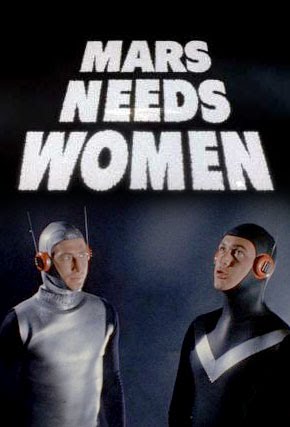
This study looks at sci-fi movies which had a theatrical release, even if very small. It seems that Mars Needs Women (MNW) was made for television only. It's included here, "granfathered" in, on the coat tails of Larry Buchanan's work remaking 50s B sci-fi for television. Where his other projects were 50s sci-fi remade for the 60s, MNW was NOT a remake, but a new product by Buchanan himself. He wrote and directed it. Yet, MNW is very much a kindred spirit of 50s cheapy sci-fi in many ways -- complete with "aliens" who are exactly like us, but wearing hooded body suits.

Quick Plot Synopsis
Several young women disappear (via cheap camera stop). Messages are received coming from outer space. Once decoded, they say "Mars Needs Women." The martians contact the Air Force to say that remotely snatching women didn't work out, so they're coming to earth in person. The leader martian (looking like a 40s 'martian' in hooded unitard) tells Colonel Page that due to genetic decay, few women are born on Mars. The male-female ratio is now 100;1. They want to ask for volunteer earth women. Colonel Page refuses. Dop says they'll just steal them then, and pops out. The world is placed on high alert. Page scrambles fighters to shoot down the martian ship. The "Cheetah-15" (X-15) is kept at bay with force beam. The early F-111 is also kept at bay. The martians land near an abandoned ice factory in Houston. The leader (Fellow 1) says they'll need some chemicals, earth money, earth clothes and a car. Fellow 3 robs a Phillips 66 station, so they have money and a map. Fellow 4 steals a Buick from a parking lot. Fellow 5 steals some suits from a men's store. To complete Operation Sleep Freeze, each of the Martians is to go find a suitable earth woman and bring her back. Fellow 5 settles on a stripper. Another Martian sets his sights on a college "co-ed." Yet another scopes out an airline stewardess. Meanwhile, Fellow 1 has decided to go for Dr. Marjorie Bolen, (Yvonne Craig) a young, sexy, space geneticist (?) in town as an advisor for the Martian Hunt alert. Fellow 1 hypnotizes a reporter to hand over his identity papers, then drive back to Seattle and forget the whole thing. Fellow 1 then pretends to be the reporter so he can get close to Bolen. Fellow 1 charms Bolen, so they do some quasi-romantic walks and talks. Bolen starts to like the Martian-fake-reporter. Meanwhile, Fellow 3 has homed in on a homecoming queen as his target. Fellow 4 gets his co-ed. With four women reported missing, authorities know there will be one more victim. All the abductions are centered on the abandoned ice plant. Bolen points out the chemicals there could be used to "freeze" people for long space flights. The army plans to attack. At supper, Bolen lets slip the army's plans, so Fellow 1 rushes to the ice plant. He implores his fellows to abort the mission and flee. They argue. Fellow 1 admits to rediscovering "love". Hug. Kiss. The army arrives and starts shooting. The Martian ship flies away. Women not stolen after all. Bolen all weepy. Text as final frame: "Earth is the cradle of man, but he cannot live in the cradle forever." -- Konstantin Tsiolkousky. The End

Why is this movie fun?
From the 40s-style martian outfits, to the 50s-style aliens-want-our-women plot, MNW is a throwback to the golden age of B sci-fi. It's not quality cinema, but it is amusing as nostalgia.

Cold War Angle
More as a side-effect of using 50s motifs, MNW rehashes the metaphors of enemy infiltrators. Spy-phobia abounds.

Notes
They're After Our Women! -- One of the old traditional tropes for sci-fi was to play on the primal (male) angst that outsiders wanted to steal OUR women. (How DARE they?) This played out as metaphor with the likes of Ro-Man carrying off pretty Alice, or the Gill Man absconding with Julie Adams. In other movies, the angst played out less subtly, such as the Mysterians demanding five earth women for breeding purposes. MNW is one of the blatant stories. Very clearly, they state that they (the Martians) want our best babes for breeding. Like the Mysterians, at first, they ask politely. When that fails, they steal them. The basic plot line of MNW would still work if it had been a Trojan raiding party that captured some prime Greek girls, but were chased off by Athenian warriors, or if Apache raiders had captured some pretty settler women, but the raiders were chased off by squad of cavalry, etc. etc. For MNW, the raiders just happen to have come from the tribe of Mars, so it's sci-fi..

Choice Women -- The Martians select five women, who apparently meet their stated criteria of being "young, healthy and with good reproductive capabilities." By this, they don't mean healthy ovaries and wide-set hips. No, they want sexy single babes. These also happen to be American teen archetypes of "available" females. What a coincidence!
1. The Stripper = sensual, voluptuous and blatantly available (on display)
2. The Stewardess = pretty, sophisticated, unattached.
3. The Co-Ed = Young, independent, away from home.
4. The Homecoming Queen = pretty, popular, "The ideal young woman."
If the Martians had demanded five plain, but sturdily-built farm girls with wide hip bones, would the men of earth have fought so hard?

Mars Got Morals -- It's interesting that the Martians wanted only single, unattached young women. Perhaps Buchanan felt strongly that married women ought to be off limits to such abductions. Perhaps he figured his audiences felt this way, so he wrote it in. Either way, the morality of the 50s and early 60s was still in place. The "sexual revolution" of the later 60s had not yet eroded the sanctity of marriage. Buchanan's moral Martians are an example of the 'before' times.

Second Wave? -- Curiously, Tommy Kirk, who plays Fellow 1 in MNW, also played a Martian in the 1964 comedy, Pajama Party. He was supposed be an advanced scout for an invasion. After Go Go reported all the young ladies in bikinis, the Martian authorities apparently decided that staying home with a batch of new earth babes was a better plan.

Stock Footage Stars -- A bit less common, but figuring into MNW, are shots of the X-15 and the early F-111. Lest viewers scoff at the X-15 portrayed as a fighter, recall that X-15s were cast in the role of space fighters in Toho's Battle in Outer Space ('60)

Bottom line? You can't take MNW too seriously. It's an old plot, performed by lack-luster actors (except for Yvonne Craig, of course), with stock footage and ultra-cheap effects. Yet, if watched in the spirit of the Commando Cody serials, it can be entertaining -- in a "lite" sort of way. Forbidden Planet, it's not.

Friday, December 24, 2010

Zontar, The Thing From Venus

American International commissioned Larry Buchanan to remake several of their older movies as part of a TV movie package. The first was The Eye Creatures ('65) which was a remake of Invasion of the Saucer Men ('57). Zontar: The Thing from Venus was a similarly close remade of It Conquered the World ('56). As a purely TV movies (no theatrical posters), it would fall outside the scope of this survey, but Zontar is grandfathered in. It's like a "10th Anniversary Edition" of a 50s icon, updated to have mid-60s styles and cars.

Quick Plot Synopsis
Note: What follows is nearly identical to that for It Conquered the World, but with mostly just name changes.
A special laser communication satellite is about to be launced. Keith, a scientist who has become discredited for having too many wild theories, tries to warn the authorities not to launch a satellite. They do anyway. It is lost, but returns mysteriously. Keith reveals to his friend Curt (a rocket scientist) that he has been communicating with a being from Venus, who is coming to earth in the errant satellite. Curt does not believe him. After the satellite comes down, the venusian takes up residence in a steamy cave. It somehow manages to stop all power sources. Electricity, steam, hydro, even mechanical watches stop. It releases eight lobster-like flying creatures who 'bite' their intended target person in the back of the neck, implanting an electronic control device. The alien then directs them to do its bidding. The Army General of the rocket base is bitten, and so is the police chief of the town. They become emotionless tools of the alien. Curt's wife Ann is also bitten, but Curt eludes and kills his lobster-bat. When he realizes that his wife has been taken over by the alien, he shoots her. Keith feels much inner turmoil. He believed that the alien was coming to earth to improve mankind, but events have caused him to doubt. The alien, Zontar, orders him to kill Curt, but he can't. His doubts have grown. Keith's wife, Martha takes matters into her own hands, drives to the cave and tires to shoot the alien. Bullets are useless. The alien kills Martha, which Keith hears over his radio. This is the turning point for Keith. He drives to the cave. A squad of soldiers tried to shoot the alien, also to no avail. Keith uses a special plutonium laser wand to stab Zontar. It grabs Keith in its claws. They die together. Curt (John Agar) gives a longish epilogue speech about imperfect man needing to find his own answers. The End.

Why is this movie fun?
It is amusing to see how closely Buchanan copied the original screenplay. Sometimes it's a more general scene-for-scene copy. Other times even specific lines are copied. It is a curious thing to watch.

Cold War Angle
Whatever there is of this, was inherent in the original. The most blatant line (also in the original) comes when the possessed-general tells the lab folks that the power is out due to a "communist uprising."

Notes
Compare and Contrast -- Larry Buchanan's remake is not an exact line-for-line copy of Lou Russof's original screenplay. Buchanan and Hillman Taylor tweaked the script a bit -- in places. For instance, when Keith is letting Curt listen to a transmission from Zontar, Curt guesses that he's listening to "progressive jazz?" In ICW, Paul says, "the London Philharmonic?" Yet, many times, they kept lines completely intact, such as the general worrying about recovering the satellite, then relaxing a bit, "What am I worried about? I'm not paying for it." Even Martha's final speech is the same as Claire's. Aside from such tweaks (or not), a notable change is that in the original, Tom takes an old-tech pump style blow torch to the monster's eye to kill it. Keith stabs Zontar with his plutonium laser and turns it on, frying them both.

Monster Mash -- The original movie suffered some scorn for having its monster be too silly looking. Paul Blaisdell's foam creation would have worked better in moody dark cuts, but Roger Corman had far too exposed. Blaisdell's monster looked like a mutant carrot. Buchanan at least touched on deeper cultural iconography. His monster, Zontar, played off the more classic villain, Milton's Satan in Paradise Lost. In this one small way, Buchanan's Zontar improved on the original.

Saucer Redux -- Fans of the low-B genre will probably note that the "Laser Communication Satellite" which returns to earth is the same saucer model used in Buchanan's first A.I.P. remake, The Eye Creatures. In fact, the footage is the same. It's just recycled.

Bottom line? Zontar is almost exactly the same as its predecessor. If you liked the original, you'll be amused by the remake. If ICW annoyed you, it might be best to give Zontar a pass. John Agar fans might still want to take it in, as he is the star.

Monday, December 20, 2010

Destination Inner Space

Harold Goldman and his United Pictures team put out a third low-budget film in 1966. Destination Inner Space (DIS) was more sci-fi than Dimension 5, but not much as Cyborg 2087. Arthur C. Pierce again wrote the screenplay, but this time with more quick recycling than originality. DIS may have had a modest theatrical release, based on the poster, but has all the hallmarks of a made-for-TV movie.

Quick Plot Synopsis
Commander Wayne is called to an undersea lab to help identify some odd signals. Is it a sub? A secret Soviet sub? No. It's not an animal either. It turns out to be an aquatic flying saucer, which settles onto the sea floor 2000 yards away. Distracting sub-plots begin. Sandy likes Maddox but he can't make a commitment. Maddox hates Wayne for some misdeed in their past. Wayne likes Rene, but she's too cool for him. Inside the saucer, a triangular block of ice is pushed out of a compartment. The ice melts away from the capsule-pod inside. Wayne, Maddox and Sandy investigate the saucer. Maddox brings back the pod. Once in the heat of the sea lab, it grows to double its size, then hatches a hunch-backed creature from the black lagoon. Said creature kills an expendable crewman, then departs. Creature then kills everyone aboard the surface support ship and trashes the air pumps, winch and radio. Now trapped inside the sea lab, Wayne and Maddox have it out over who did the bad thing years ago. Turns out Maddox was the coward who froze and killed the five sailors, not Wayne being heartless. Thus stripped of pride, Maddox bristles no more. Sandy is impressed with him admitting he was a coward. Wayne plots a trap for the gill man. They rig spear guns to trip wires. Hungry creatures obligingly comes in and gets a chest full of spears. It leaves. Wayne goes after it, followed by Maddox and Ellis. The creature jumps the, but all three men manage to subdue it. They bring it aboard the sea lab, tie it up and have it sedated. Wayne and Maddox then swim up to the support ship. Everyone dead. Nothing working. They do find some dynamite, though. They return to sea lab. Wayne rigs up a timer for their bomb. Wayne, Maddox and Sandy swim to the saucer. Meanwhile, Rene dabs the poor sedated gill man with water like a good nurse, but this awakens the creature. It breaks the chains and escapes to chase Wayne and company. Inside the saucer, the three have the bomb almost ready, but the creature jumps in, interrupting. Maddox holds off the creature while Wayne and Sandy escape. He tries to keep it at bay with a flare, which is predictably knocked into the case of dynamite. Big explosion. The saucer is gone in a cloud of silt. Many days later, later, aboard the sea lab, Dr. Lassiter is morose about the lost opportunity to study the alien. Wayne says it's okay, the President wants him to head up a team to be ready for next time. Dr. L is happy. Rene drops her ice princess act and jumps Wayne with a big kiss. The End.

Why is this movie fun?
Fans of 50s sci-fi will see several of the classics mashed into this one script. While not new or novel, the screenplay is at least comfortably familiar.

Cold War Angle
Other than a brief worry that the mystery sub might be some new soviet technology, the analogies of ruthless invaders (which drove the 50s movies), lingers only as an echo of those more sincere days.

Notes
Medley of Your Favorites -- Pierce cobbled together his screenplay from tried and true 50s classics. There is the element of a crew trapped somewhere with a murderous monster on the loose: The Thing ('50) and It! Terror from Beyond Space ('58) There the alien frozen in the block of ice which thaws and rampages, also from The Thing. From The Atomic Submarine ('59), we get the underwater alien saucer. Of course, there is the inescapable link to Creature from the Black Lagoon ('54) with the amphibious gill-man costume. Similar gill men monsters have terrorized coastal towns and party beaches too. That's just what gill monsters do.

Value Monster -- Most of the special effects budget must have gone into the monster costume. It's actually not too bad, given some of the really poor ones that had gone before it. The monster gets a fair amount of screen time. Yes, the hunch on his back is where his scuba tank is. It is interesting to note that the credits call the creature: "The Thing."

Scuba Padding -- Viewers will probably note how the run time of DIS is padded out with extended -- and a few times repeated -- footage of divers swimming in scuba gear. Swimming, swimming, swimming.

Tedious Subplots -- Also filling out the run time with non-action, are the three (or four) human drama subplots. Maddox and Wayne have a hostile history. Maddox accused Wayne of killing 5 crewmen by sealing up a flooding compartment on a stricken sub. Turns out it was Maddox who killed them by locking the escape hatch. Whatever. Sandy liked Maddox before, but now that he knows that she knows he was a coward, there's no hope for them. He's still a coward. This makes his sacrifice in the end his honor-redeeming act. Wayne has the hots for older-gal Rene, but she's too world wise for some navy wolf. But, when Wayne is all heroic and even kind, she jumps his bones. Whatever.

Logic Gap -- Pierce probably did not have much time to work on his script. It was bound to have a few inconsistencies. He has the premise that the people in the sea lab were trapped and could not escape until a rescue ship comes. Yet, Wayne and Maddox were quite capable of swimming up to the supply ship for a look around, and return with some dynamite. If it was that easy, why couldn't everyone just swim up to the ship?

Bottom line? DIS is a low budget mash-up of previous stories. That gives it some nostalgia value for 50s sci-fi fans. Fans of gill man monster movies will probably like the monster. People expecting an A-quality movie will be disappointed. DIS is a B movie made of spare parts, for TV markets. It might be interesting to do a Goldman triple feature with Cyborg 2087, Dimension 5 and Destination Inner Space.

Sunday, September 19, 2010

The Eye Creatures

This made-for-TV movie would normally fall outside of the scope of this study except that it is a member of a small sub-genre of a 50s sci-fi B movies remade for 60s TV. American International Pictures commissioned director Larry Buchanan to remake its 1957 Invasion of the Saucer Men for the television market. But they gave him almost no budget -- just $16,000, according to imdb.com. The Eye Creatures (EC) featured lumpy white humanoid monsters festooned with many eyes. The extremely low budget is obvious. When Wade Williams brought the rights to the film, it got retitled Attack of the The Eye Creatures (yes, two "the" words).

Quick Plot Synopsis
The uncredited screenwriter added the opening scenes in which an Air Force General briefs a lieutenant. Top secret spy satellite footage shows a flying saucer headed for earth. It will land in the midwest. The lieutenant is assigned to check it out. Also added, are a sergeant and corporal who monitor the top secret surveillance equipment. They use the "infrared scope" to peep on teens necking at Lover's Point. They form a sort of pair-of-perverts running gag interspersed through the original script. The '57 script kicks in with the drifters in the diner. See Invasion of the Saucer Men, as it is essentially the same, but with different names. The running thread with Mr. Larkin's beer-loving bull was left out.

Why is this movie fun?
Seeing an almost word-for-word remake of a 50s B sci-fi has some amusement value. Spotting the budget shortcuts (such as un-careful use of day-for-night) provides some amusement too.

Cold War Angle
The original had little Cold War to it. This remake added none.

Notes
Comedy Gone Bad -- The original screenplay had its own odd mixture of "serious" alien invasion / monster story and a few too many attempts at comic relief. Buchanan opted to boost the comic relief aspect in his remake. Yet, he also attempted to retain the "serious" alien-monster angle. The result is even more bi-polar than the original. EC would almost qualify as parody, but Buchanan was serious. At least, seriously completing his assignment with what little he was given.

Cheap Clones -- To satisfy demand for low-cost TV movies, AIP took many of its 50s B movies and cloned them. They took the existing scripts and had them reshot (in color!) with minimal budget. This way, they had two movies about saucer men, etc. Coming up soon in this group, we'll see It Conquered the World ('56) remade as Zontar: Thing From Venus and Day the World Ended ('55) remade as In the Year 2889. These, too, will re-use the older scripts almost verbatim, but be in color and feature more "hip" 60s actors.

Clip Spotter -- Buchanan used a short clip from Invaders From Mars ('53) where the glowing saucer hovered over the rim of the sand pit, then dove in.

Scrimping Exposed -- MST3K's critique of EC included a skit at the called "They Just Didn't Care," which highlighted the flagrant budget shortcuts. The more amusing is the "extra" eye creatures being actors in black shirts and pants, wearing just an eye creature head.

Bottom line? EC is so low in production value that the average viewer will likely find it extremely annoying, or hilarious. Fans of the 1957 original might be amused at seeing the script re-acted with less talent, like a community theater's version. In a way, one can almost respect how much Buchanan accomplished with almost NO money.

Sunday, July 18, 2010

The Human Duplicators

The upper half of a sci-fi double bill aimed at the drive-in market, The Human Duplicators (THD) was still a typical B movie. It got a little more funding from its producers (director Hugh Grimaldi and writer Arthur Pierce), such as being shot in color. The lower half of the bill, Mutiny in Outer Space (produced by the same team) was done in black and white. THD has the feel and visual patina of mid-60s budget sci-fi -- in the Star Trek TOS idiom. Richard Kiel ("Jaws" of 007 fame) has his usual lack of acting finesse, but it works well enough, what with his being an alien.

Quick Plot Synopsis
A saucer hovers near earth. Inside, Kolos (Richard Kiel) is instructed by his superiors that his mission is to replace key earth personnel with duplicate androids in preparation for conquest. Kolos beams down to the country estate of Professor Dornheimer. Kolos takes over Dornheimer's work in cybernetics. Later, a Dr. Munson is caught stealing electrical supplies from a lab. The guard shoots him, but he does not die. His body is found in the morning, lying in a canyon near the Dornheimer estate. NIA man, Glenn Martin is on the case. There were other instances of trusted scientists being caught steeling materials. Martin decides to investigate Dornheimer. Other than meeting his pretty (but blind) niece, Lisa, he has no leads but a feeling something was up. Next day, he climbs down the canyon to discover a cave. Inside, he finds a ladder and hatch which leads to a room full of manikin parts. He finds replica heads of the missing scientists, Dornheimer and his aides. In another chamber, he sees the android Dornheimer and his two buxom assistants creating a copy of another scientist. Lisa urges him to leave, but Kolos captures him. Martin is duplicated. His dupe fools his boss, but not quite his Jersey girl, Gale. Later, Gail interrupts roboMartin stealing electrical supplies. He flees, but loses an arm. At the estate, Kolo's superiors chide him for not duplicating Lisa yet. Meanwhile, Lisa meets Martin in his cell and offers to help him escape. Kolos and Lisa share a minute of almost-pathos discussing trust. RoboDorneimer assumes command and the other androids ambush Kolos. The roboBabes catch Lisa at Martin's cell and take her to be duplicated. Sick real-Dornheimer tells Martin to use the Pulse Lah-Zer cannon on the androids to scramble their electronic brains. In the lab, a big fight breaks out as Kolos breaks his chains and takes on the crowd of clones. Martin arrives and shines the light on them. They go crazy. RoboDornheimer has Martin trapped, but dupe-Martin enters, confused. He and roboDornheimer wrestle to the death. Kolos tenderly brings the unconscious Lisa up from the lab. He gives a speech about how superior humans are, reveals that he too is an android, then beams up and flies away. The End.

Why is this movie fun?
THD combines several comfortably familiar themes -- the paranoia of duplicates, the basic crime/detective story, impending hostile alien invasion, and technopobia. The overall package feels like classic 1960s B film.

Cold War Angle
Actually, there are several Cold War themes in THD. One is the implied threat of enemies infiltrating "our" researchers, military and government. Two, is the "you don't know who you can trust" paranoia trope. Three is the overt musing by Martin and his boss as to whether the Red Chinese were behind it all.

Notes
Techno-Snatchers -- The trope of someone (or something) duplicating people had been around for many years. The most famous was Invasion of the Body Snatchers ('56) there were others before and after. The idea was not developed very much in THD. In fact, it was revealed fairly early, so was not allowed to take on the creepy quality Body-Snatchers achieved.

TechnoPhobia -- A theme growing more frequent during the 60s was a fear of machines -- fear that someday computers would become too smart and take over. We saw this in an early form in The Invisible Boy ('57) where the supercomputer tried to control people. It will become a fairly common trope in the later 60s and 70s. This iteration falls on the optimistic end of the scale. Machines can't be trusted, but humans are still declared (by Kolos) to be superior.

TechnoDies ex Machina -- The not-too-elegant solution to the superior androids drops in at the end, like a good Dies ex machine should. With no foreshadowing or plot incorporation, the hitherto unknown Pulse Laser Cannon is handily set up in the professor's lab, on a gimbal mount, so Martin can mow the androids down as if wielding a flex-mount 50 caliber. How handy for mankind and sloppy of roboDornheimer and Kolos to not recognize the threat just sitting over there.

Ow Moy Gwaaad -- Barbara Nicholes, who plays Martin's co-woker and girlfriend, is played with an overly thick lower-class New York (Jersey?) accent. Her character is a weird mix of cheap brassy broad, spunky career woman, and helpless female.

Love Prevails -- THD uses a common trope, in which the big mean alien (or monster) becomes softened by a new-found emotion -- love -- for a pretty earth girl. Ro-Man became conflicted over his feelings for Alice back in 1953. This is amusingly appropriate, in that cave leading to the lab was none other than Ro-Man's cave in Bronson Canyon.

Passing Pathos -- There is one scene which tries to achieve some pathos, thought not too successfully. At the end of Lisa and Kolo's talk about cloning her and trust, she touches his arm. He twitches a bit, as if thrilled by her touch. He offers her the doll she dropped, but since she's blind, she just stands there. Kolos holds out the doll as imploringly as the wooden Richard Kiel could, then slumps at her apparent rejection. He trudges away despondent. This scene wasn't much in the realm of cinema, but it was as close as THD could get to poignant drama.

Mr. Cleaver's Day Job -- Hugh Beaumont, famous as Ward Cleaver, plays a minor role as Martin's boss at the NIA, Austin Welles. Perhaps this is what Ward came home from in all those episodes. Who knew?

Bottom line? THD is fairly customary as a B-movie, so likely to annoy viewers expecting polished entertainment. Fans of impending alien invasion, copy humans and fist fights, will find enough to enjoy.

Sunday, January 3, 2010

Planets Against Us

"I Pianeti Contro Noi" was an Italian sci-fi in the 50s style that was released in Europe in 1962. A French-dubbed version was also released, entitled "Le monstre aux yeux verts" (Monster with Green Eyes). Walter Manley Enterprises, apparently dubbed the French copy into English and titled it Planets Against Us (PAU). The story fits neatly into the 50s idiom of deadly invading alien stories. It also carries on the invasion-angst tradition. Aliens sabotage earth's space programs and attempt to prepare earth for conquest, with a 5th column of cyborgs all patterned after one dead man. A pretty earth woman softens the steely heart of one of the cyborgs.

Quick Plot Synopsis
A plane crashes in the Sahara, killing all aboard, but one of the bodies is missing. Earth's various aerospace projects begin to fail. Rockets blow up. Security cameras catch sight of the same man at each disaster. It is the missing dead passenger. Authorities deduce that it must be an alien sabotaging earth's space flight efforts. A global manhunt begins. The mystery man, now named Bronco, is seeking the (adult) daughter of Dr. Borri, who is perfecting a temporary-paralysis gas. Bronco finds Marina and much alien-on-earth social play ensues. Bronco is clueless, but Bronco is attractive to the ladies, etc. Things turn dark when Bronco touches the hand of a policeman who stopped him. The man dies instantly. One of the ladies after Bronco, dies similarly, reduced to skeletal dust. Bronco is part of the vanguard, a group of cyborgs, identical copies of the dead passenger. Their job is to get earth ready for an alien invasion. Dr. Borri's paralysis gas is their key. Bronco, however, develops a soft spot the lovely Marina and becomes conflicted. Bronco is damaged by a policeman. He drives to rendezvous with the other cyborgs aboard the saucer, but turns back (to go see Marina?). The saucer zaps him with a ball of light. All that remains are metal bits and the souvenir Marina bought for him. Professor Miller warns the audience that secret invaders could be anywhere. The End.

Why is this movie fun?
The traditional hidden alien invasion line is nostalgic. Being an Italian production makes the acting (often odd) more fun to watch. The first cyborg army in movies is of historical interest.

Cold War Angle
In PAU, the invading aliens assume their traditional role as surrogates for the communists. The closing epilogue by Miller leaves no doubt that the intent of the movie is to play to spy fears. "(The invader's agents are) cleverly hidden in the throngs of various cities. They powerful, ruthless, maniacal. Yes, it is a dreadful, menacing, but silent invasion. Even at this moment, this very second, there may be one of these monsters right next to you (as he looks right into the camera) Watching, watching, about to destroy you NOW (he points a finger at the camera).

Notes
Cyber First? -- PAU appears to be the first "modern" film to feature cyborgs -- humanoid shaped robots -- if you don't count evil Maria from Metropolis (1927). Aliens inhabiting, taking-over or duplicating humans was pretty common. They remained organic, however. "Bronco" and his duplicates were mechanical copies of a Professor Landerson's dead son Robert.

Deadly Midas -- An interesting trope is that Bronco, the cyborg, kills with a touch of his hand. They said the touch imparts lethal radiation. Bronco's hands can kill in seconds, even a touch on this cold lips causes a non-lethal radiation sickness. This trope appeared in the 1936 sci-fi film, The Invisible Ray, in which a scientist (played by Boris Karloff) is exposed to "Radium X". Thus "poisoned", his touch kills by radiation overdose.

The Alien Speaks -- Cyborg Bronco delivers the somewhat muddled messages of the story. One the one hand, it is the usual superior alien talk. "You people of this puny world move swiftly towards your own destruction." On the other hand, he lapses into a reverie over how precious life is, how foolish man is, and how science is dangerous. These are probably the personal observations by the softening "heart" of an invader cyborg than the collective voice of the invaders who sent him.

Tin Man's Heart -- A curious subplot is the cyborg "Bronco" developing a fondness for pretty (human) Marina. Bronco had no qualms about killing people and setting up the earth for conquest by his masters. But like Ro-Man, feels the awakening spark of love and wants to keep the earth girl for himself. He tells her she has "a beautiful shape," and that, "With you I could bring a fresh spirit to the earth. And restore the world to a new state." Quite the pick-up line.

Glimpse of Old Europe? -- Bronco could have sought out Dr. Borri directly, in his quest for the paralysis gas, but curiously, he does not. He seeks out Borri's daughter, Marina. Bronco somehow needs her to make the introduction to her father. To modern American eyes, this seems pointless. It may, however, be a vestige of Old World etiquette. Even an invading alien should not simply barge into a highly respected person's office. Proper introductions are necessary.

Bottom line? PAU is a convoluted invasion story burdened with a few too many messages. Sorting them out takes some concentration, so PAU is not a good choice for an impatient viewer. For the patient and forgiving 50s fan, it does carry on the traditional invading aliens tradition.

Sunday, August 16, 2009

Visit To A Small Planet

Sci-fi comedy is a rare commodity. Jerry Lewis helped kick off the 60s with a fine example in Visit to a Small Planet (VtaSP). The premise is a bumbling alien (with amazing powers) comes to earth to study us. He wants to experience things as humans do, but comes to regret it. As one would expect, there are ample close-ups of Lewis making funny faces, and many physical humor gags.

Quick Plot Synopsis
Kreton (Lewis) is an errant student on planet K-19. He regularly exasperates his instructor, Mr. Delton, with his obsession with planet Earth. Mr. Delton decides to let Kreton go to Earth to teach him a lesson and get it out of his system. Kreton arrives in his saucer. He shows up at the Spielding home, dressed as a Confederate officer, expecting to watch the Civil War. His calculations were off by 99 years. Conrad (Earl Holliman) is forever trying to make out with Ellen Spielding, so Kreton decides to study human romance instead. Many sight gags hinge off of Kreton having an invisible force field that no one can penetrate. No one is permitted to tell anyone else that he's there. More gags stem from this. Ellen takes Kreton to a beatnik club. More gags flow at the expense of the beatniks. On the way home, they pass a lover's lane. Ellen coaxes Kreton to kiss her, but his forcefield stops it. He makes it go away and is swept away by passion. Mr. Delton makes it rain on them to cool Kreton off. Conrad, jealous of Kreton, convinces Ellen to elope with him that night. Mr. Delton allows Kreton to feel pain too. Conrad punches Kreton, chases him, and locks him in a barn. The state police are called in, but the tear gas blows back into the crowd. Kreton escapes in Mr. Delton's saucer. He's learned his lesson and won't visit Earth ever again. The End.

Why is this movie fun?
It's a comedy. It's supposed to be fun. Lewis still a young man, so many of the gags feature very physical humor. The pacing is brisk and the supporting cast good.

Cold War Angle
This is background material, but Mr. Mayberry as the ever vigilant Civil Defense spotter (complete with white CD helmet), always watching the skies with his binoculars, was an everyday part of Cold War culture.

Notes
Prop Watch -- Conrad comes in dressed in a Destination Moon space suit instead of an 1860 costume as everyone else was for the Civil War party. The clear spherical helmet was from somewhere else, but the old DM suit still looked good.

Adapted Play -- Writer Gore Vidal wrote the stage play upon which the screenplay was adapted. This gives VtaSP wittier writing and social satire beyond the usual B movies. The actors are veteran comedy actors, so the farce takes on a life of its own.

The Power of Love -- A familiar trope shines again. Earth women teach alien men about love. Here, it's comical, but the trope shows up in earlier 50s sci-fi in a more serious form. We earth men think our women are pretty special.

Pre-Carrey -- Modern viewers (born after 1980 or so) will see a lot of similarity between Jerry Lewis's style, facial expressions and mannerisms, with comedian Jim Carrey. But, Lewis came first. Carrey wasn't born until two years after this movie.

Pre-Hippies -- Seems each era has its mainstream and counter-culture. The 90s and 00s had their hiphop gangs, Goths and Emo. The 60s and 70s had their Hippies. The 50s had their Beatniks. The beatniks portrayed in the "Hungry Brain" scene in VtaSP are exaggerations of the stereotype, but interesting nonetheless.

Bottom line? VtaSP is a "lite" diversion for a sci-fi fan. Nothing too deep, though the writing is a cut above the usual B screenplay. If you're a Jerry Lewis fan, this is more of his usual gags and schtick.

Saturday, July 18, 2009

The Atomic Submarine

There was more to 50s science fiction than just rockets and outer space. The nuclear powered submarine was also a hot new technology. The deep sea was mysterious too. Irving Block and Jack Rabin's short story focused on the nuclear sub. The screenplay for Atomic Submarine (AS) turned out to be more of hybrid between horror, sci-fi invasion tale, and the traditional submarine movie genres. Having the effects men from Forbidden Planet, Block and Rabin, helped, but could not completely compensate for the low budget. It seems fitting that the last sci-fi movie of the 1950s was an alien invasion tale. The plot had become stereotypic. A flying saucer and monster-like alien plot the invasion of Earth (surrogates for the earthly enemy Americans already feared).

Quick Plot Synopsis
Ships are being lost, mysteriously, all around the arctic. The US Navy sends its most advanced nuclear sub, the Tigershark, to investigate. Tensions mount as an outspoken anti-war scientist is assigned to the mission. Dr. Nielson is the expert handler for the small experiment explorer sub "Lungfish," for examining seabed evidence. More ships are lost. The crew figure out that the sinkings happen within 1000 miles of the pole. They wait at a gap in the line. They get high energy readings and see a lone light moving underwater. They can see that it is a saucer craft, but are never able catch it. More ships lost. Nielson theorizes that the saucer must return to the pole after each attack to recharge its batteries from the Earth's magnetic field. They position themselves between the last sinking and the pole. when the saucer comes, they try to torpedo it, but this fails. Desperate not to have the saucer outrun them again, they ram it. The bow of Tigershark gets stuck in the saucer's hull. The saucer appears damaged, but is still able to move slowly towards the pole. Nielson thinks it will recharge and escape. With little time left, a crew of five man Lungfish to attempt to cut Tigershark free. At the saucer, they find it has air inside. In the dark and spooky interior, the two frogmen work to free the sub, but die of melting. Commander Holloway hears a voice calling him on. He comes to a dome structure with a tentacled cycloptic alien inside. The alien is studying earth for possible invasion. Holloway shoots the alien in its big eye and runs. He and Nielson return in Lungfish. The alien heals himself. Tigershark pulls free. They pursue the saucer and arm an missile. The saucer breaks free of the ice and zooms toward space. The missile follows, finally finding its target. Earth is saved. Light banter ensues. The end.

Why is this movie fun?
There is a charm in the old fashioned invading-alien-monster-in-a-saucer story. The mixture with the war-movie flavor (submarine setting) is different. Rabin and Block's models add some interest. The minimalist interior of the saucer (pitch black except for lit ramps and catwalks) has a German impressionist feel to it.

Cold War Angle
Aside from the mere presence of a nuclear powered and nuclear armed submarine billed as the "deadliest in the fleet," there is the subdued "moral" to the tale. In the end, even the anti-war advocate has his eyes opened to the very real menace "out there." In the end, it is American military weaponry that nips the threat in the bud. Even the pacifist concedes the value in having brave men with strong weapons to deal with the threat. In the 50s sci-fi tradition, the alien is a stand-in for the feared communist hoards plotting to invade our Eden. Our troops and our nukes will protect us. Rest assured.

Notes
Inspired by the Headlines -- In July 1958, America's first atomic submarine, USS Nautilus, made the first ever transit under the North Pole's arctic ice. This accomplishment was a two-edged sword. If WE could send a sub under the arctic ice, then so could THEY. While the topic was still hot, Allied Artists wanted to push out a quick atomic submarine movie. Shooting took less than two weeks.

Proto-Voyage -- Two years before Irwin Allen's Voyage to the Bottom of the Sea, AS featured a very advanced nuclear sub, equipped with a mini-sub, and scientists aboard, all engaged in the wonders (and dangers) of the deep. Toho Studios would put out Kaitei Gunkan (Undersea Warship) in 1963 as a third super-sub movie (AIP releasing it in America in 1965 under the title of Atragon). Atragon was more fantastic. Voyage had a much bigger budget and is much better remembered, but AS was the first of the super-subs.

Cargo Subs -- A fascinating detail, easily lost in the action, was the notion of cargo-carrying submarines. In the 50s, nuclear power was imagined to be so cheap as to make the idea seem economically feasible. Trade routes under the polar ice could open markets and reduce costs. The idea was new. In 1916, the Germans dabbled with cargo submarines to evade the British blockade during WWI. The Deutschland was one of two built. Since America was the big customer for German goods, the entry of the US into the war in 1917 put an end to submarine cargo runs.

Ship, Heal Thyself -- The notion of a ship as a semi-lving thing, which can heal itself, was unusual, but entirely new. The Devil Girl from Mars (1953) had a ship that could repair itself, given enough time and raw material. Still, self-healing ships were fairly rare yet.

Hawk vs. Dove -- Dr. Nielson Jr. (played by Brett Halsey) is portrayed as the anti-war idealist. Commander Holloway (Arthur Franz), a proud military man. Nielson and Holloway have running debates over the need for nukes. There was a nascent anti-nuclear sentiment, even in the 50s. AS is a sort of rebuttal.. Nielson is a straw man for the pro-nuke faction. The obvious moral to the story is that in the face of an unarguably hostile threat (the alien, and by analogy, the communists), nuclear weapons are necessary.

Bottom line? AS is a B movie in the classic pattern. It has stern narration, ample stock footage and inexpensive sets. it's unusual venue lends interest. For fans of aliens in saucers, threatening to invade Earth, it is a fun variation on the theme. That said, folks who are not fans of 50s B sci-fi, will likely be unimpressed.