1910s & 20s * 30s * 40s * Pre-50s * Frankenstein * Atomic Angst * 1950 * 1951 * 1952 * 1953 * 1954 * 1955 * 1956 * 1957 * 1958 * 1959 *
1960 * 1961 * 1962 * 1963 * 1964 * 1965 * 1966 * 1967 * 1968 * 1969 * 1970 * 1971 * 1972 * 1973 * 1974 * 1975 * 1976 * 1977 * 1978 * 1979
Showing posts with label mars. Show all posts

Saturday, July 5, 2014

Capricorn One

Peter Hyams wrote and directed Capricorn One (C1). It would be the big budget sci-fi movie for 1978. This, in stark contrast to the field of low-budget and marginal indie films that ’78 had seen thus far. The cast of C1 are recognized names in the 70s film world. James Brolin plays the lead as astronaut Charles Brubaker. Brenda Vaccaro plays his wife. Elliot Gould plays the persistent news reporter. Hal Holbrook plays the middle man between the astronauts and the sinister plot. C1 was a major studio effort, and did okay, but a bit “old school”. It became culturally overshadowed by Star Wars and the new-think of sci-fi.

Quick Plot Synopsis
With the usual techno-blather and ceremony, the three astronauts of Capricorn One are loaded into their capsule for man’s first manned mission to Mars. At T-minus-10 minutes, Flight Director Jim Kelloway ushers the men out of the capsule, and into a waiting Lear Jet. The rocket takes off without them. The three, Brubaker, Willis and Walker (OJ Simpson) are taken to an abandoned air base. They are told that the life support system for Capricorn One was faulty — the product of lowest-bid corporate corner cutting. They would have been dead in two weeks. But, if the mission was scrubbed, NASA would lose funding, so the mission will be faked. Jim shows them a sound state with a landing module on a fake Mars set. Jim asks them to cooperate for the good of the program, and hints that their families might die if they do not. They cooperate. They fake transmissions en route. Elliot, tech in Houston ,keeps noticing that the transmissions arrive too soon, like they’re only coming from 300 miles away, not millions of miles away. His observation is brushed aside by his bosses. Elliot starts to tell his reporter friend Robert about the odd vibes, but Elliot disappears without a trace. The landing is faked. Everyone applauds the success. In a homebound transmission, Brubaker gives his wife an insider hint by mistakenly saying they vacationed at Yosemite. Meanwhile, the re-entry is said to have failed and all three died instantly. Brubaker figures the new storyline out, and realizes that they will be killed to keep the secret. So, they escape in the Lear Jet. Trouble is, it had very little fuel. They belly land only a few dozen miles away, in the desert. Robert noticed Kay’s reaction to the Yosemite comment and asks her. She said they vacationed at Flat Rock — a western movie set, with comments about how ‘they’ can fake anything. Robert then realizes the mission was faked. Taking Elliot’s comment about 300 miles, he locates the only abandoned base in range. He finds evidence of the faking. Meanwhile, Brubaker, Willis and Walker have split up to go different directions. Jim sent a pair of killer helicopters to hunt them down. They find Walker first, then Willis. The helicopters locate Brubaker too, but Robert arrives in a crop-dusting plane her hired (Telly Savalas as the owner/pilot) They get Brubaker up on a wing and flee. The helicopters pursue. Through fancy flying, Telly evades the helicopters’ machine guns. He blinds them with crop dust. They crash into a cliff. At a grave-side memorial service for Brubaker, he and Robert drive up and run in slow motion as the astonished crowd turn to see. Freeze frame on happy Brubaker. The End.

Why is this movie fun?
Setting aside the tinfoil hat aspect, C1 is well written and well presented story. Hyams does an excellent job with the visuals. The aerial chase is quite captivating. The acting is quite good too — OJ being the exception.

Cultural Connection
Conspiracy Theories — Two books were published, one in 1974, another in 1976, claiming that the Apollo landings on the moon had been faked. In the wake of the failure in Vietnam and the Watergate Scandal, cultural trust in government was at an epic low. Other films in the 70s, such as The Andromeda Strain and The Resurrection of Zachary Taylor, explored the government conspiracy trope. The broad tar brush assumed that if the government lied about somethings, that everything they said was a lie too. As such, Hyam’s 1978 story about a faked mission — which looked a lot like an Apollo mission — found a willing audience and added fuel to the fake moon landing theories.

Notes
Dual Villains — The double villains in the story are the government (naturally), but also the corporate-industrial-complex that depends on government funding. The two together, in a sort of dark symbiosis, perpetuate a lie in order to keep the money flowing. The problem, as explained by Jim, is that the public (the real source of the money) loses interest in programs. Public tolerance for big budgets (and therefore big taxes) wanes. So, in a mixture of Bread and Circus and The Matrix, the industrial complex and the politicians fabricate popular lies. Sensitivity to this dual-villain-hood is alive and strong, even today — 40 years later.

Mechanical Bloodhounds — An excellent touch by Hyams is how he handles the two Hughes 500 helicopters sent to track down the three escaped astronauts. Note how Hyams has them turn to “face each other” periodically, as if they were living beings consulting each other. This makes them seem almost alive themselves, like mechanical bloodhounds, rather in the way Spielberg made the greasy tanker truck become the villain in Duel, and not so much the truck driver. In reality, the two choppers are dozens of yards apart and facing in opposite directions, but with the long lens and tight shot, they appear to be looking in each others’ eyes. It’s a very effective move.

Fake vs. Reality — Hyams’ script plays with the notion of illusion vs. truth, as the broader theme of the movie, but also in many little vignettes throughout. For example, Robert is (apparently) always using lie-stories to try to seduce Judy. She always rebuffs him as a fake. “Why don’t you just be honest?” she asks. She is more attracted when he is sincere (and not just out to seduce her). “You’re less obnoxious when you’re helpless.” Note how Robert and his editor keep seeing their reality as a reflection of old movies. Reality mimics the fake. The obvious one, is the Brubaker vacation to Flat Rock where they watched a western being filmed. “How something so fake could look so real. With that kind of technology, you could convince people of almost anything.” While this applies to C1 directly, it applies to all movies. The amusing irony being that C1 is also a movie. The faked landing conspiracy in C1 is, itself, a fake — and yet so hungrily believed (by some) to be truth.

Plane Crazy — Aircraft fans can relish the co-starring effect the two Hughes 500 helicopters get. The aerial dual with Albain’s red Stearman 75 is great fun to watch. The Learjet 24 gets good coverage too. Note how the director staged the shots for the belly landing. Lots of dust is kicked up, but the foreground sagebrush conceals that the gear is down for a regular landing. The budget would not support destroying a Learjet. For that matter, the two helicopters that crash into the cliff are models. No budget for blowing up real 500s either.

Plot Holes? — C1 has its critics, many of whom feel the plot had holes that should have been filled. These may be the sentiments of “completists” who prefer to have all details explained. Many supposed holes amount to disbelieving the sinister government could successfully keep such secrets. For example, the disappearance of Elliott. Surely someone else in the bar noticed Elliott being abducted while Robert was distracted with the poor-connection phone call? Not necessarily. A plain woman comes in and asks Elliott to help her start her car. He leaves with her. The ambush outside where no one would see. A nerd leaving with a plain woman would hardly noteworthy to other bar patrons. Robert did not ask around the bar, probably because he thought Elliott simply left on his own. Yes, a lot of people would have to be “in on” the conspiracy, but they do not all have to know everything. The woman who took over Elliott’s apartment, for instance, knows she has only been there a few days. She has been told to lie, perhaps with her family similarly threatened, but need not know why she has to lie.

Rushed Ending? — Some criticize the happy slo-mo ending as too rushed. Movie audiences like happy endings. Studios give them to them. Yes, there could have been a darker ending where the government won after all — like a sniper taking out Bru and Robert with the cover story of a terrorist look-alike intent to bring anguish to the poor widow, etc. etc. But as much as the 70s were rife with distrust of the government, the people still want to imagine that they “win” in the end. Hope is hardly a plot failing.

Bottom line? C1 is a must-see. Even people who do not care for sci-fi can appreciate the conspiracy-thriller aspect. C1 is very 70s film, oozing with 70s conspiracy mythos. The action is plentiful and the writing has wit. The acting is good (if sometimes a bit too ‘colorful’). C1 is worth hunting down.

Wednesday, October 30, 2013

Invasion From Inner Earth

We close out 1974 on a low note. Bill Rebane’s deservedly obscure Invasion From Inner Earth (IFIE) had a small theatrical release. (note the very low budget poster) IFIE is actually a neat way to close out the year as it tied in the previous made-for-tv movies. It was another survivor group story (and with five main characters too) and insidious aliens. IFIE also had the 70s’ sense of civilization-collapse doom. Listen for the theme music, a rather flagrant paraphrase of the theme from The Good, The Bad and the Ugly, (classic western from the mid 60s)

Quick Plot Synopsis
The movie opens with a montage of spinning earth in space, a crude flying saucer, some people running in the streets and a radio announcer talking of people dying of a mysterious disease. Then cut to a remote cabin in the Canadian wilderness. Jake is a young bush pilot who has ferried up three young “scientists” to study something or other. Jake’s sister Sarah tends the cabin Jake flies Stan, Eric and Andy back to civilization, but they are warned not to land due to a mysterious disease. They fly to a closed lodge to look for fuel and supplies. They find neither, but Stan and Andy experience an odd red light. All return to the cabin. Through a very slow series of scenes, it is revealed that people around the world are dying of a mysterious disease. Radio communications are sporadic or lost altogether. The five debate what to do — stay and wait out the problem, or go to a city for help. There are no animals anywhere to hunt. Supplies run low. Andy sees the red light again. Being the rich young jerk type, he decides to steal Jake’s plane and fly back. The red light is in the plane too. Andy screams and the plane blows up. The others pick up an odd alien voice asking how they’re doing, etc. Stan has a theory that the whole things is trouble caused by aliens who came from Mars thousands of years ago and hung out deep in the earth. The aliens have come up and spread disease to get rid of everyone. Jake decides to go for help on the snowmobile. He drives and drives, but the red light gets him too. He disappears all of a sudden. Stan, Sarah and Eric decide to walk out. They trudge and trudge. At a camp, while gathering firewood, Eric sees the red light and wanders off to die in the snow. Stan and Sarah are separated looking for each other, or Eric, but eventually meet up at a small empty town. They hold hands, become young almost-naked children who walk down a grassy hill towards a whitefish flying saucer parked beside the woods. The End.

Why is this movie fun?
Fans of “bad” movies may find much of what they like. Only for the very patient, and forgiving, is there some fun in seeing familiar sci-fi tropes recast into a low-budget indie production.

Cultural Connection
Worlds In Collision — Stan spins a theory of where the aliens came from, and where they’ve been, based on almost nothing the viewer is shown. Instead, he seems to be drawing his “obvious” conclusions from theories proposed by Immanuel Velikovsky. HIs 1950 book, “Worlds in Collision” sought to explain legendary stories and Biblical events as caused by near-collision encounters by Earth and Venus, and earth and Mars. Of course, the “established” scientific community dismissed Velikovsky’s theories. This outcast (by the establishment) status made Velikovsky’s work rather popular on college campuses in the mid-70s, when youth were eager (if not too critical) to accept all things anti-establishment. His theories must have made up the “obvious” pieces that Stan assembled into his whole-cloth theory.

Notes
Comet Dating — Some notes on IFIE say it was shot in 1972, but released in 1974. Some of the footage may have been shot earlier, but the Eric character makes mention of the comet Kohoutek while discussing Stan’s theories. That comet was discovered in March 1973, so clearly, most of the final quarter of the film were after that date. The comet Kohoutek is interesting for a couple reasons. One is that it was a huge hype bust. Touted as the “comet of the century” and a “once in a lifetime experience.” it turned out to be an Edsel of an astronomical wonder. It was barely visible with the naked eye. The comet was also significant as just one in a long string of doom signs. Some felt that the comet’s appearing (as weak as that was) foretold the end of the earth in January of 1974. There would be many more doomsday predictions — such as Y2K and the Mayan calendar, etc. — but those were nothing new. Kohoutek was supposed to be one too, and yielded similar results.

Rebane Returns — Director, producer, writer and bottle washer, Bill Rebane first (sort of) brought the world his puzzling sci-fi movie Monster A-Go-Go in 1965. You can read a review of it here. Nine years later, Bill manages to complete a whole movie, though his style (or lack thereof) remains evident. Long talky scenes and most action happening offstage. Bolstered by completing an entire film, Rebane went on to produce/direct three more films. None of them were all that good, but one of them was nominally a sci-fi in 1978, The Alpha Incident and 1975’s Giant Spider Invasion, which will be covered later. Bill had a technical ability as a director, but no particular artist’s skill or eye. Since he made and sold several movies, one must assume he was, at least, a talented salesman.

Rookie Writer — The story and screenplay were penned by Bill Rebane’s wife Barbara. She and Bill were a mom-and-pop team of movie makers at the low low end of the movie pecking order. They produced, directed, edited, etc. Their son even worked as a grip. Bill has his wife Barbara write the story and screenplay for IFIE. Her abilities as a writer matched her husband’s talent as a director.

Can’t Say Goodbye — Perhaps endemic to the Rebane “system”, IFIE doesn’t really have an ending. It just ends. This happens in Rebane’s first venture, Monster A-Go-Go. He had a beginning and a middle, but no ending. Another man added an ending and marketed the film. His wife’s story might have a cohesive (or at least, explained) ending, but with all the time and footage spent on the beginning and the middle of IFIE, there was no time to wrap things up. It too, just ends.

Plane Crazy — In case you were curious, and even if you’re not: Jake’s plane was a Beechcraft Baron. That particular plane was built in 1965. It was sold to Hilgy Aviation in 2006, but suffered substantial damage in May 2008 when the pilot mistakenly raised the landing gear after touchdown in Lansing, Michigan, thinking the lever he was pulling would raise the flaps. The pilot was alone and survived.

Bottom line? IFIE is a very weak film, weakly written, weakly acted and weakly directed. Bill Rebane has a reputation for creating weak films, but IFIE is said to be his weakest. Some say IFIE makes Manos or Plan 9 look good. So, fans of “bad” movies may be amused. Those not big fans of “bad” movies may want to give it a miss.

Tuesday, July 10, 2012

Just Imagine

Next up, we go back 40 years to see a sister film, of sorts, to THX 1138. But where THX was the dark and gloomy twin, Just Imagine (JI) is the bright and happy twin. In late 1930 -- in the very early days of "talkies" -- Fox Film Corporation released their wild sci-fi fantasy comedy musical. JI featured extravagant sets, lavish costumes (for the martians) and several elaborate dance numbers. It starred El Brendel, a popular vaudeville comedian. Whether JI was too over-the-top, or The Great Depression squashed the market, it would be many years before a big budget sci-fi movie was done again.

Quick Plot Synopsis
A narrator shows views of New York in 1880 with light traffic of pedestrians and carriages. 50 years later, in 1930, the streets are so full of cars that people can't cross the street. What will things be like in another 50 years? Just Imagine. In 1980, personal airplanes have replaced cars. People have numbers instead of names, and the Government regulates personal relationships. J-21 loves LN-18, but the Tribunal rejected his application for her hand, in favor of MT-3. To take his mind off it all, J-21's room mate, RT-42 and his girlfriend D-6 take him to see scientists revive a man struck by lightening in 1930. The experiment works, but the scientists have no further use for Ole Peterson. J-21 takes him in. Ole adopts the new name-number of Single-O. They show him the marvels of 1980. Food and drink in pill form, televiewers and baby vending machines. Still dejected over LN-18, J-21 is recruited by the famous scientist Z-4. He has a rocket plane to fly to Mars, but needs a pilot. J-21 needs notoriety to win his appeal over MT-3. RT-42 goes along, and Single-O stows away. Once on Mars, they find martians (mostly young women, scantily clad) and are taken to the Queen. She and her people are welcoming. Via gestures, she tries to explain that on Mars, everyone has a bad twin. Later, the boys are captured by the bad twins and imprisoned by the bad queen. They're treated to a big dance number in front of a giant idol. The good queen's aide, Boko, help the boys escape, but only after some comic confusion in the tunnels. Single-O has to help J-21 and RT-42 to the ship since they got hit with knock-out gas. Single-O has to fight Loko (Boko's evil twin). He wins and they blast off. Back on earth, D-6 and others try to stall the appeal hearing. What proof has he that he went to Mars? Single-O brings in Loko as proof. J-21 arrives just in time. His new notoriety sways the judge, so J-42 is allowed to marry LN-18. Single-O meets his son, Axel, now a silly old man. The End.

Why is this movie fun?
The fanciful expectation of what 1980 would look like is fascinating. They got so much wrong -- or else, we did. Where is my personal airplane? The sets and props are a joy to behold for classic sci-fi fans. The tradition that outer space, and Mars in particular, was populated by young women in skimpy outfits, apparently has a long history.

Cultural Connection
In the pre-atomic age, the future seemed bright. The zeal of the Art Deco age bordered on conceit. Compare JI to the "Rhythm of the Day" dance scene from Dancing Lady ('33) in which the 1930s smugly imagined themselves as the epitome of modernity and progress. Seems each era feels that way about itself, only to be branded as "old fashioned...passe..." by the next era. But from JI you can almost feel the overflowing optimism the 30s felt for what mankind could accomplish. Contrast this with the 1971 film, THX 1138 which had similar elements, (numbers instead of names, love regulated, manufactured babies, etc.) but was totally pessimistic and full of gloom. By the 70s (let alone 1980), American culture was not so sure mankind could do anything right.

Notes
Silent Traces -- JI was produced at the cusp of the transition from silent films to "talkies." Musicals, strong on song and thin on plot, were a popular genre for the new sound films. Some of the directing shows traces of silent film techniques -- broad gestures, close-ups on expressions, etc. Viewers will also note the use of inter-titles, as silent films did. But in JI, a narrator reads them to the audience. Some formats took awhile to completely fade.

Swedes. In. Space! -- El Brendel stars as Single-O. A vaudeville comedian from before WWI, Brendel had an act as a German immigrant bumpkin character. With the war, he shifted his exaggerated accent to be a politically acceptable character and became a swedish bupkin. In the 20s, he was famous for his Simple Swede act and his catch phrase, "Yumpin' Yimmie." His acting can seem overly hammy to modern eyes, but that's vaudeville.

Hat Trick -- To entertain J-21's fellow air line pilots, Single-O does one of Brendel's vaudeville gags -- a one-man telling a melodrama story with different hats for each character. It's a nice glimpse at vaudeville.

Budget Berkley -- Busby Berkley was the choreographer who made famous those big production numbers using dozens (if not scores) of showgirls. His signature look featured varying geometric patters and kalidescope-ish effects. Berkley probably had nothing to do with JI, but whoever did the choreography (uncredited) was certainly working in the Berkley style. This is most evident in the idol dancers scene, which does nothing for the plot. It appears to exist solely as extravagant entertainment.

Joke of the Day -- Many of the jokes in JI were products of their day. For instance, all of the air-o-plane models that J-21 lists off are jewish names: Goldfarb, Rosenblatt, etc. This is a dig at Henry Ford, who by the late 20s was gaining some dark notoriety for anti-Semitism. Prohibition was still all the rage in 1930. It wasn't repealed until 1933. This explains the old census taker woman pronouncing grandly that "The Volstead Act is a noble experiment." This being the law in 1919 that ushered in Prohibition. By 1930, the noble experiment was pretty universally seen as ignoble. Later, when Single-O is asking for other drink pills, J-21 says that the authorities say they'll be getting light wines and beer next year. Single-O says: "Are day still saying dat?" Funnier in 1930.

Pre-Owned Rocket -- the rocket "plane" used to fly to Mars and back in JI, found another life in the Flash Gordon serials later in the 30s. Pictured here is Z-4's rocket plane on the fanciful art-deco martian landscape. Who knew that Flash drove a pre-owned rocket?

Bottom line? Just Imagine is very old fare from the early days of "talkies." Since sound itself was still the big selling point, the story was not as important, and it shows. Modern viewers may find it shallow -- if not silly. The sets and props, however, are not to be missed. This was Art Deco on a sugar high -- before the Dust Bowl and Soup Kitchens. JI is an important ancestor to late 30s and 40s sci-fi, which itself forms the foundation for sci-fi's Golden Era.

Sunday, December 25, 2011

Santa Claus Conquers the Martians

Okay. I have to admit that I have been avoiding this film. Released in 1964, Santa Claus Conquers the Martians (SCCM) was beyond "bad." SCCM often ranks high on "worst film ever" listings. However, Christmas was coming just as the films of 1969 were wrapping up. And, starting the new series, "FrankenFEST" on Christmas, just didn't seem right. At least SCCM would be date-appropriate, so in the forgiving spirit of Christmas, I give you, Santa Claus Conquers the Martians.  Merrrrry Christmas! Ho Ho Ho.

Quick Plot Synopsis
Two martian children are watching Earth television programming about Santa making toys at his workshop. Their father,Kimar (King Martian), and mother Momar (Mom Martian) worry that their kids don't eat much and just watch TV all the time. Apparently this is the same all over Mars. Kids are as dull as adults. Kimar summons the council and consults Mars' oldest citizen, Chochem, for advice. Chochem says the kids don't have a childhood. All education and responsibility. Need to learn to laugh and play. How? Mars needs a Santa. So, Kimar plans to fly to earth and steal Santa Claus. When he and the others arrive, they are fooled by so many street corner santas. They kidnap Billy and Betty to make them reveal which is the real Santa. They then all travel to the North Pole. They kidnap Santa too, but decide to take Billy and Betty, lest they alert the authorities. En route, Voldar is all upset at bringing toys and laughter to Mars -- the "warrior" planet. Sneakily, he tries to jettison Santa and the kids out the airlock. He fails. On Mars, Santa eventually gets the morose mars-kids: Bomar (Boy Martian) and Girmar (Girl Martian) to laugh. Kimar thinks this is great, so builds a toy making factory. Santa doesn't make toys, he pushes buttons on toy machine. Voldar and his henchmen, lurking as outcasts in a cave, attempt to kidnap Santa for themselves, to use him as a hostage to force Kimar to stop the happy-ization of Mars. Trouble is, they kidnap the comic sidekick, Dropo, who was dressing up as Santa, just for fun. More hi-jinx ensue when Voldar thinks he's got the upper hand, but Santa (the real one) is obviously not his hostage. Voldar is attacked by the children with toys in a comic melee. Kimar has him arrested. All is well. Billy and Betty are homesick. Santa, having charmed (conquered, I suppose) all the martians (except Voldar) into smiles, wants to get back for Christmas. Dropo will be the Martian Santa, operate the toy factory and bring toys and peace and good will to all of Mars. Everyone says goodbye. The rocket flies back to earth. The End.

Why is this movie fun?
It is designed to appeal to young children, so it is intended to be a sappy sort of "fun." At an adult level, there is some amusement at the parody of classic science fiction films: martians, cheap "alien" sets and ray guns, etc.

Cold War Angle
SCCM has no Cold War elements. It is self-deprecating slap stick with no deeper message than adults-are-stupid and kids-rule.

Notes
Kid TV Context -- Before judging SCCM too severely, it should be kept in mind that it was aimed at young kids. It was not intended to be a cerebral adult sci-fi. Instead, think of SCCM in the context of children's TV of the early 60s. Look at it as a cross between Captain Kangaroo and Major Astro. The later was an after school kids' show (in Kansas) with a host in a space suit and on a simple "moon base" set. SCCM is more in the spirit of "Captain Kangaroo On Mars" than  Robinson Crusoe on Mars (also 1964).

Kids' POV -- Note how many plot elements are The World, from a kid's point of view. Parents worry that they watch too much TV. Santa is unquestionably real. Martians are real too, are green and have antennae. Many adults are inept bumblers. And, in a bit of pandering, kids can subdue adults with toys. Of course, adult viewers (of serious sci-fi) balk and choke at the silliness, but from the POV of an eight year old in 1964, it all seemed plausible enough.

Gandhi Claus -- On a somewhat more adult level, the message is that kids really can be harmed by too much (inane) TV. Note the subtle pacifist persona of Santa in SCCM. He wins people over to the "Light" side with contagious laughter and jokes. Even though he knows full well that Voldar was trying to kill him, Santa couches it carefully as an "accident." The only "action" Santa condones was the toy attack on Voldar -- symbolic of how "fun" can subdue evil. In the end, Gandhi Claus has everyone convinced to live peaceably, with the biblical phrasing of '"Peace on Earth" (and Mars) and "Goodwill to all men."

Serial Flashback -- For adult viewers in 1964, who may have been eight years old in the late 40s or early 50s, the robot Torg was a bit of nostalgia. Yes, he was crudely constructed compared to Robby or Planeta Bur's John. Torg, however, was all a kid needed for a robot. In fact, Torg seemed very reminiscent to the robot of Republic's early serials or the tin men of Captain Video. One might suspect that Torg was a tragic bit of underachievement, but quite intentional.

Nearly Farr -- Viewers familiar with the TV series M*A*S*H could be mistaken for thinking they see actor Jamie Farr playing the role of Stolo, one of Voldar's inept comic minions. The resemblance is strong, but Stolo is actually played by Al Nesor. Uncredited is Pia Zadora (later more famous for singing than acting) in her first movie role as Girmar.

Bottom line? Complains that SCCM is a terrible adult movie, is akin to blasting SpongeBob for not being deep enough, or The Muppets as a poor production. SCCM should be viewed as an extended after-school television special, designed for an innocent eight year old (or younger). Yes, it's silly, shallow and cheaply done. Get over it. It's a kids' show on Christmas. Enjoy it as an innocent eight year old.

If you're not too adult to handle it, you can watch it on YouTube, just for fun.

Santa Claus Conquers the Martians - YouTube

Tuesday, July 5, 2011

Mission Mars

A small production company's effort at science fiction, Mission Mars (MM) is an anachronism. It is a late 50s movie in almost every way, yet shot in 1967, released in the summer of '68. If it weren't for being shot in color, and the groovy electronic keyboard score, MM would be totally at home as a B-movie from the late 50s. The existence of posters tell of at least a limited theatrical release, but much about the film suggests that television was it's intended market. Darren McGavin stars. Nick Adams co-stars.

Quick Plot Synopsis
Edith wakes from a bad dream about astronauts lost in space. Her astronaut husband Mike (McGavin) comforts her. He blasts off for Mars in the morning. They go for a romantic frolic on the beach beforehand. She wants to have a baby. Nick, the mission geologist, has a troubled relationship with his wife Alice. He's a pioneer. She wants stability. He promises this will be his last mission (so viewers know he's doomed). Duncan, the navigator, is single, therefore expendable. Eventually, they blast off in a flurry of stock NASA footage. They dock up with their supply ship and head for Mars. The trip is long and dull, so is filled with exposition about Mars factoids. Mike and Duncan eat reconstituted omelets. Nick eats a smuggled pastrami sandwich. They come across the bodies of two lost Russian cosmonauts floating in space. Where is the third? Once finally at the planet, they descend to land, but must eject the supply module prematurely. They don their space suits and go find the errant supply module, leaving a trail of tethered balloons to mark their path back. Nick stumbles upon the body of the third Russian, frozen stiff. Nick takes him back to the ship. Mike and Duncan find the supply module, but it has a hole burned in its side by someone or something. Their trail of marker balloons are gone. As they approach their ship, a strange creature appears. it flashes Duncan and Mike in the eyes. Nick blasts it with his laser rifle. A bunch of the Polarites appear and attack them with more light bursts and heat. The three get into their ship. They can't take off, for some reason. Ground control suggests they get more boosters from the supply pod. Mike and Duncan do this while the sentry Polarite is asleep in a shadow. (they use solar power, you see) A twelve foot diameter sphere appears near the ship. Duncan goes to check it out, but Polarites attack him, burning him to death. The sphere pulls his body inside itself. The sphere speaks to Mike, saying that it wants one of them alive. The Russian thaws out (alive!) and tells them the sphere is solar powered too. They can't wait for the Martian night, so Nick volunteers to out and shoot the center of the sphere. He senses his next great adventure, so opts to go inside instead. The sphere blows up. (?) Mike and the Russian manage to blast off in the ship. En route home, Edith tells Mike he's going to be a father. Smiles and laughter all around. The End.

Why is this movie fun?
Released in the same year as Kubrik's techno-masterpiece, 2001, MM is a techno-throwback to the way B movies were made in the 50s. Model landscapes, wet suits as space suits, open motorcycle helmets, model aliens and lots and lots of stock footage. For fans of 50s style, MM isn't cheesy, it's fun!

Cold War Angle
This is only faintly present as back story. The Russians and Americans are 'racing' to be the first on Mars. The Russians lost, but maybe won? The fact that one American and one Russian survive to return is a subtle reconciliation message.

Notes
The Okay Stuff -- Fully half of MM is taken up with the human drama of astronauts and their wives and whether they have the mettle for such boldly going where no man has gone before. This sort of NASA drama was very much in vogue in mid 60s "realistic" space fictions. (Countdown was an example of this in '68 as well). Yet, this part of the movie is its weakest -- establishing that all involved had, if not the Right Stuff, some Okay Stuff.

Red Shirts Alert -- Seasoned movie viewer were handed easy clues early on that the characters of Duncan and Nick were not going to survive. Duncan brags that he's a bachelor, so viewers know he's doomed. He's expendable. He might as well have been wearing a red shirt. Viewers know that Nick is doomed before he starts when he promises Alice that he's coming back and that this will be his last mission. He might as well have put ON a red shirt right then.

NASA Stock -- Much use is made of stock footage from NASA. Several programs' clips are used indiscriminately. Most, but not all, are of various Apollo missions: Gantry shots, launch shots, ground crew shots. A set that gets frequent use, is footage of the AS-203 mission. This was an early Apollo effort, but the rocket (with the big white nose cone), carried no astronauts or even craft. It was a test of the Saturn 1B rocket's ability to cold-start in space.

Multi-Multi-Stage -- Note the heavy use and re-use of the NASA footage of a booster stage being jettisoned. This footage was used for that same step in Mars-1's lift-off, but was used again, run backwards, for the docking of the ship with the supply module. It was run forwards again for the ejection of the supply module. It was then run backwards again as part of the landing-on-Mars sequence. Director Nicholas Webster got his mileage out of that clip.

Breathing Room -- Modern viewers scoff at the unsealed helmets the astronauts wear. These were fairly common in the 50s, before the Mariner 4 probe determined that Mars had too thin of atmosphere for men to breathe, and too little oxygen. According to the director's son, Lance, who acted as a gopher on the set (this from imdb), the original prop helmets were sealed, but not to McGavin's liking. (Being a bit tight for his prominent nose). New (motorcycle) helmets with partial shields were made up. Some text was added to the script suggesting that Mars had marginally breathable air, only needed supplemental oxygen. Viola! Nose, script and props harmonized.

Artsy Effort -- Webster was experienced in television production, but had done only a few movies prior to MM. One of them was the tragically annoying Santa Claus Conquers the Martians ('64) Yet, Webster showed he had an artistic side. Note is use of multiple fast cuts and overlays of sound. He used rapid video montages to help perk up the dogged pace of the script. In this, one can see the seeds of "modern" television of the 80s and 90s before the restless-cam fad took over.

Cross Marketing Music -- Decca Records tried to pump a little music sales by getting the single "No More Tears" by the group, Forum Quorum, grafted in as the title theme. The tune is pure 60s pop rock ballad-style fare, but has nothing to do with the film. The movie did not appear to "rocket" the single up the charts. "No More Tears" failed to make the top 100. Of course, it was up against the likes of The Beatles' "Hey Jude", Simon and Garfunkle's "Mrs. Robinson", and The Rolling Stones' "Jumpin' Jack Flash".

Bottom line? MM is fun stuff for fans of the old low-budget films, such as Angry Red Planet ('60) or Missile to the Moon ('59), etc. If those sorts of films annoy you, or if 60s-style jazzy electric keyboard music annoys you, you should avoid MM. If, however, you enjoyed old films like Catwomen of the Moon ('53) or Fire Maidens from Outer Space ('56), then MM will feel comfortably familiar and even a bit cerebral in comparison.

Thursday, April 7, 2011

Five Million Years to Earth

Nigel Kneale's original story (Quatermass and the Pit) ran as a serialized TV drama in 1959. Hammer Films produced a feature film version of the same story (and the same title) in the UK in 1967. 20th Century Fox marketed the movie in America a year later with the title Five Million Years to Earth (FMYE). This is the third in the Quatermass series. Even though it is a sort of sequel, FMYE is an altogether different story, drawing nothing (beyond Professor Quatermass) from the prior two.

Quick Plot Synopsis
Workers expanding a London subway station at Hobb's End unearth skulls and bones of odd large-headed ape men. Dr. Roney dates them at 5 million years old. Workers then uncover a strange object. Professor Quatermass, saddled with the smarmy Colonel Breen, investigate. The military think it is an unexploded Nazi bomb. Locals and newspaper archives tell of strange goings on in that neighborhood dating back to medieval times, whenever the soil was disturbed. Soldiers and workers around the hull report visions of goblins. A hole appears in the ship, revealing decaying insect creatures. Roney and Quatermass are convinced they are dead Martians. Their theory is that 5 million years ago, the Martians could see that their planet would no longer be habitable. They couldn't live on earth. So, they took ape creatures from earth and genetically altered them to have high intelligence and other martian qualities. The Martians would live on (genetically, at least) in a proxy colony. The British government and military scoff at this theory. They claim the ship, insect things and bones were all a Nazi propaganda ploy. Work at the station will resume. Television crews setting up to cover the resumption, inadvertently supply the ship with high voltage. It starts to glow and hum and control people. Supplied with vast electrical power, the ship projects its "race memory," beams. It triggers genes grafted into the human DNA -- though not everyone has the genes. Riots break out. Killings. The earth rumbles. Buildings break. Quatermass himself is affected. He tries to kill Roney, who is immune to the ship's projections. Part of the martian genome was to instinctively kill anyone who was "different," to keep the colony pure. Only by concentrating on his "human" identity, can he keep the urges in check. A huge glowing projection of an insect martian appears over London, as if to spread its control over a wider area. Roney thinks it can be neutralized if grounded, because of legends that the devil didn't like iron. (?) He maneuvers a construction crane to touch the apparition. In the fiery discharge, Roney succeeds, but dies doing so. London is badly damaged, but saved. The End.

Why is this movie fun?
FMYE is a great bit of story telling. The topic fresh and there is plenty of action. Yet, there is much to mull over with Kneale's notions of the roots of human evil. For 50s sci-fi fans, it's fun to dabble in another martian invasion (even if by proxy).

Cold War Angle
The primary theme is an exploration of racial issues, particularly the intolerance of difference. The Cold War is more of a background hum than clear theme. All three of Kneale's Quatermass tales were built around fear (of some outsiders) and paranoia (who could you trust?). In this case, smug and pompous bureaucrats and military leaders, ignore the danger signs of big trouble brew right at their feet. It is more of an "enemy within" tale.

Notes
As Seen on TV -- This story originally aired on BBC television in December 1958 and January 1959 in six half-hour episodes. Kneale himself adapted his teleplay into the screenplay, so it's little wonder the movie follows the TV series very closely. Some lines exactly the same. Sometimes they're delivered by other (peripheral) characters. Some scenes remained (such as the knocking-out of Barbara), though not in quite the exact same place in the story line. The movie's special effects are, naturally, better than the teleplay. The original title made more sense for the TV series, in that the ship was found while excavating for a building's foundation -- a pit. The movie's setting of a subway station doesn't fit "a pit" as well. Perhaps that's why the title change for American distribution.

Space Roots -- Where the Stargate television series imagined that ancient earth "gods" were really encounters with egotistical aliens, Kneale imagines, in FMYE, that legends of demons and the devil, and psychic powers all had a common extraterrestrial source -- the Martians!

Undermining Darwin -- Despite the typical overtones of evolutionary theories ("apemen", etc.), Kneale cuts the legs off the popular notion of steady-state evolution. Human intelligence was not the result of slow and steady mutations and darwinian survival of the fittest. Instead, he posits that earth apes got a serious genetic upgrade from the Martians. Humans didn't evolve from apes, we're martian halfbreeds! At one point, Barbara even says, "We ARE the Martians."

Inherited Evil -- The Martian genetic "gift" had it's benefits and drawbacks. Earth apes got the intelligence boost, but also inherited the martian urge to destroy anything different. In this, Kneale aimed at social commentary -- intolerance of other races -- opens a much larger can of worms. He suggests that most (if not all) of humanity's dark side, stems from ancient "race memory". That, in itself, is a controversial notion base on racist theories. Via this plot device, Kneale seems to be absolving humanity of direct responsibility for its evils. The human genes were basically "innocent" animal. It was the goblin-like horned "devil" martians that introduced the bad genes. This has a coincident parallel to the Biblical account, in which it was the devil which introduced sin to innocent Adam and Eve.

Good Old Mars -- Firmly in the 50s idiom, Kneale pictures Mars as a planet which was once more comfortably habitable and hosted a flourishing civilization. In this, he is good company with H.G. Wells and others. Mars is also still the "Bringer of War" in that martian genes cause human belligerence. Note the nod to H.G.Wells in that the martian bug creatures walked on three legs. This was more apparent in the TV series, but is still in the movie's screenplay.

Bottom line? FMYE is a well-done, well paced sci-fi with 50s roots (a '59 TV series). It also has many thoughtful twists, turns and nuggets to muse on. By modern CGI standards, the special effects can seem dowdy, but FMYE was not a movie to show off special effects. For fans of old sci-fi, it's a must-see.

Sunday, February 13, 2011

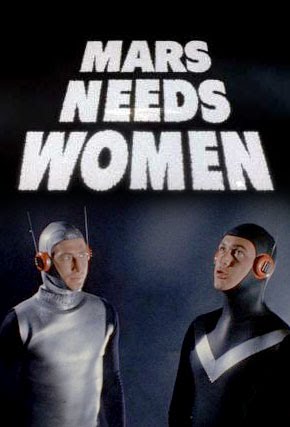
Mars Needs Women

This study looks at sci-fi movies which had a theatrical release, even if very small. It seems that Mars Needs Women (MNW) was made for television only. It's included here, "granfathered" in, on the coat tails of Larry Buchanan's work remaking 50s B sci-fi for television. Where his other projects were 50s sci-fi remade for the 60s, MNW was NOT a remake, but a new product by Buchanan himself. He wrote and directed it. Yet, MNW is very much a kindred spirit of 50s cheapy sci-fi in many ways -- complete with "aliens" who are exactly like us, but wearing hooded body suits.

Quick Plot Synopsis
Several young women disappear (via cheap camera stop). Messages are received coming from outer space. Once decoded, they say "Mars Needs Women." The martians contact the Air Force to say that remotely snatching women didn't work out, so they're coming to earth in person. The leader martian (looking like a 40s 'martian' in hooded unitard) tells Colonel Page that due to genetic decay, few women are born on Mars. The male-female ratio is now 100;1. They want to ask for volunteer earth women. Colonel Page refuses. Dop says they'll just steal them then, and pops out. The world is placed on high alert. Page scrambles fighters to shoot down the martian ship. The "Cheetah-15" (X-15) is kept at bay with force beam. The early F-111 is also kept at bay. The martians land near an abandoned ice factory in Houston. The leader (Fellow 1) says they'll need some chemicals, earth money, earth clothes and a car. Fellow 3 robs a Phillips 66 station, so they have money and a map. Fellow 4 steals a Buick from a parking lot. Fellow 5 steals some suits from a men's store. To complete Operation Sleep Freeze, each of the Martians is to go find a suitable earth woman and bring her back. Fellow 5 settles on a stripper. Another Martian sets his sights on a college "co-ed." Yet another scopes out an airline stewardess. Meanwhile, Fellow 1 has decided to go for Dr. Marjorie Bolen, (Yvonne Craig) a young, sexy, space geneticist (?) in town as an advisor for the Martian Hunt alert. Fellow 1 hypnotizes a reporter to hand over his identity papers, then drive back to Seattle and forget the whole thing. Fellow 1 then pretends to be the reporter so he can get close to Bolen. Fellow 1 charms Bolen, so they do some quasi-romantic walks and talks. Bolen starts to like the Martian-fake-reporter. Meanwhile, Fellow 3 has homed in on a homecoming queen as his target. Fellow 4 gets his co-ed. With four women reported missing, authorities know there will be one more victim. All the abductions are centered on the abandoned ice plant. Bolen points out the chemicals there could be used to "freeze" people for long space flights. The army plans to attack. At supper, Bolen lets slip the army's plans, so Fellow 1 rushes to the ice plant. He implores his fellows to abort the mission and flee. They argue. Fellow 1 admits to rediscovering "love". Hug. Kiss. The army arrives and starts shooting. The Martian ship flies away. Women not stolen after all. Bolen all weepy. Text as final frame: "Earth is the cradle of man, but he cannot live in the cradle forever." -- Konstantin Tsiolkousky. The End

Why is this movie fun?
From the 40s-style martian outfits, to the 50s-style aliens-want-our-women plot, MNW is a throwback to the golden age of B sci-fi. It's not quality cinema, but it is amusing as nostalgia.

Cold War Angle
More as a side-effect of using 50s motifs, MNW rehashes the metaphors of enemy infiltrators. Spy-phobia abounds.

Notes
They're After Our Women! -- One of the old traditional tropes for sci-fi was to play on the primal (male) angst that outsiders wanted to steal OUR women. (How DARE they?) This played out as metaphor with the likes of Ro-Man carrying off pretty Alice, or the Gill Man absconding with Julie Adams. In other movies, the angst played out less subtly, such as the Mysterians demanding five earth women for breeding purposes. MNW is one of the blatant stories. Very clearly, they state that they (the Martians) want our best babes for breeding. Like the Mysterians, at first, they ask politely. When that fails, they steal them. The basic plot line of MNW would still work if it had been a Trojan raiding party that captured some prime Greek girls, but were chased off by Athenian warriors, or if Apache raiders had captured some pretty settler women, but the raiders were chased off by squad of cavalry, etc. etc. For MNW, the raiders just happen to have come from the tribe of Mars, so it's sci-fi..

Choice Women -- The Martians select five women, who apparently meet their stated criteria of being "young, healthy and with good reproductive capabilities." By this, they don't mean healthy ovaries and wide-set hips. No, they want sexy single babes. These also happen to be American teen archetypes of "available" females. What a coincidence!
1. The Stripper = sensual, voluptuous and blatantly available (on display)
2. The Stewardess = pretty, sophisticated, unattached.
3. The Co-Ed = Young, independent, away from home.
4. The Homecoming Queen = pretty, popular, "The ideal young woman."
If the Martians had demanded five plain, but sturdily-built farm girls with wide hip bones, would the men of earth have fought so hard?

Mars Got Morals -- It's interesting that the Martians wanted only single, unattached young women. Perhaps Buchanan felt strongly that married women ought to be off limits to such abductions. Perhaps he figured his audiences felt this way, so he wrote it in. Either way, the morality of the 50s and early 60s was still in place. The "sexual revolution" of the later 60s had not yet eroded the sanctity of marriage. Buchanan's moral Martians are an example of the 'before' times.

Second Wave? -- Curiously, Tommy Kirk, who plays Fellow 1 in MNW, also played a Martian in the 1964 comedy, Pajama Party. He was supposed be an advanced scout for an invasion. After Go Go reported all the young ladies in bikinis, the Martian authorities apparently decided that staying home with a batch of new earth babes was a better plan.

Stock Footage Stars -- A bit less common, but figuring into MNW, are shots of the X-15 and the early F-111. Lest viewers scoff at the X-15 portrayed as a fighter, recall that X-15s were cast in the role of space fighters in Toho's Battle in Outer Space ('60)

Bottom line? You can't take MNW too seriously. It's an old plot, performed by lack-luster actors (except for Yvonne Craig, of course), with stock footage and ultra-cheap effects. Yet, if watched in the spirit of the Commando Cody serials, it can be entertaining -- in a "lite" sort of way. Forbidden Planet, it's not.

Friday, October 1, 2010

The Wizard of Mars


Easily overlooked in the increasing numbers of sci-fi films released in the mid 60s, The Wizard of Mars (WoM) as a very-low budget indie film that was 20 years behind its time. Some businessmen (vending machine operators, according to Wikipedia) wanted to make films. David L. Hewitt (writer in The Time Travelers agreed to help, acting as producer, writer and director. To his credit, Hewitt was able to get John Carradine, for marquee power. The film itself, however, suffered both from a tiny budget, one-film actors and the usual pitfalls a one-man-show piece is heir to. When released for television, the movie was retitled "Horrors of the Red Planet."

Quick Plot Synopsis
Four astronauts, Captain Steve, Charlie, Doc and Dorothy, are on the first manned orbital mission to Mars. Their task was to orbit and map only. A "freak" storm in space knocks out their control systems. They jettison the "main stage" prevent plummeting to the surface. With only nominal control, they are able to crash land on Mars. Once down, they have only enough battery to radio for help OR open the hatch. Doc persuades them to go out. They do, just before the ship catches fire. They have only enough oxygen for four days. They inflate two rafts and float south down the water-filled canal from the ice cap, following signals they're sure are their main stage. (which contains more O2 and supplies). They encounter some flaccid canal worms, and thick fog. The canal becomes a cave. Now on foot, the four wander through the cave, finding lava pits. They discover a hole back to the surface. There, they wander through a sandy desert, almost out of oxygen. The signals turn out to be a derelict NASA probe. Residual O2 in the probe gives them a couple more days. A sand storm blows through. The storm uncovered golden pavers. A golden road, says Dorothy. They follow it to an ancient and abandoned city on a mesa. Inside, the corridors are all lined with columns. These turn out to be tubes containing the hibernating bodies of the über-brainy martians. Through a sort of mind-meld, the martians tell Steve to go into another room. There, John Carradine's head floats, superimposed over various star field photos. He (the "wizard" of the title) is the manifestation of all the martian minds. He talks for a long time, about how his people were the masters of the universe, with a vast empire of a thousand worlds, etc. etc. They even conquered time, managing to pull themselves (in the city) out of time. The eons gave them time to realize that immortality was wrong. Life needs death. Trouble was, they could no longer affect the physical world. The wizard tells Steve what to do to put the city back into regular time. They place a small sphere (containing a model of the city) into the hub of a big pendulum/clcok works. it starts swinging. As time catches up with the city, it begins to crumble. The four astronauts run through the falling debris, finally getting out just before the city disappears. The all fall onto the sand, exhausted. The next moment, they're waking up on board their ship. They're dirty and the men have scruffy beard growth. Mission control calls. They're two minutes overdue for a check in. Two minutes? says Steve. Carradine delivers a few final lines about life and death. Fade to black. The End.

Why is this movie fun?
There is something very nostalgic about the style. If you look beyond the lame production techniques, there are a few nuggets of thought to muse over.

Cold War Angle
The story is more philosophical about life and mortality than anxiety over commies.

Notes
Old School -- The bulk of WoM is reminiscent of travel adventure B films from the 30s and early 40s. Back then, movies were still novel enough that images of different landscapes, caves, deserts, etc. (or exotic animals, for jungle flicks), was enough to keep audiences interested. Some 50s B films, such as Unknown World ('51) used this format, but this was no longer enough. By the mid-60s, it was really not enough.

Talk To Me -- Notable in WoM is Hewitt's screenplay is a heavy reliance on words, and near-total absence of action. Action shots and effects are expensive. Hewitt had some lofty intentions in his story, telling of a highly advanced race who could freeze time for themselves, but came to regard their immortality as a mistake. This part of the story is all delivered mostly in the Wizard's monologuing. The other characters were fairly shallow foils for dialogue. Steve: the brave leader. Doc, the obligatory scientist type. Charlie, the comic relief and Dorothy, the token helpless female. Hewitt's skills as a director and writer would improve, but they're pretty rudimentary in WoM.

Hype For Dollars -- The theatrical poster promised some pretty high-energy stuff. "We Triple Dare You to retain control of your mind as screeching creatures attack your brain!" and much more. Audiences in the mid 60s had seen some pretty impressive sci-fi effects. WoM was probably a major disappointment for them. WoP was a cheap mass-market product designed to make a little money for its investors, then disappear. The investors weren't making art, just a few bucks. That said, it does seem that Hewitt was trying to convey a deeper literary meaning via his story.

A Bit of Baum -- Frank Baum's Wizard of Oz formed only a scant framework for Hewitt to hang a story on. We do have four travelers, one a woman named Dorothy. The do find a yellow (or golden) road and follow it to an unusual city. Inside, they do talk with a projected floating head, and tell it that they just want to go home. As in Oz, it wraps up by being all a dream -- or almost. Sci-fi liked the trope of a time warp to put things back the way they were, in lieu of an actual dream. Hewitt wasn't out to recast the whole Oz story on Mars, however, so trying to parse out which astronaut was the scarecrow, etc. is probably a waste.

Easy Dubs It -- A familiar budget-saving trick in film making was to add the sound track in the studio, post production. One handy thing about having the characters wear their Mercury Program astronaut suits most of the time, is that you could hardly ever see their lips moving within those helmets. Easy dubbing. There are many long shots, or shots with the actors looking away where the dubbing was easy to.

Bottom line? For people who expect high-quality productions in their movies, WoM will be a mind-numbing bore. For people with a more sympathetic view towards the old 30s travel-adventure genre, or a taste for philosophical musing, WoM has a few nuggets.

Tuesday, June 15, 2010

Robinson Crusoe on Mars

This was one of the two big sci-fi films of 1964. The other one, First Men on the Moon was a big-budget production of an old classic. Robinson Crusoe on Mars (RCoM) was an A-grade modern story. Actually, RCoM was a modernized retelling of Daniel Defoe's 18th century novel. John Higgins and Ib Melchior (the screenwriter of Angry Red Planet and Journey to the Seventh Planet, among others). Director Bryon Haskins was no stranger to sci-fi either. He directed War of the Worlds ('53) and Conquest of Space ('55) among others. The talent of the team ensure that the story rises above budgetary limitations.

Quick Plot Synopsis
Mars Gravity Probe One, manned by Colonel McReady and Commander Kit Draper, use too much fuel dodging the ubiquitous meteor. They each eject in little Mercury-like escape pods, to land on Mars. Kit survives and looks for McReady. He finds Mac's pod, but he's dead. The monkey Mona, survived. Kit sets up camp in a cave. He finds rocks that burn, later discovering that they give off oxygen. Mona discovers pools of water in a cave. The cave pools also have edible plants. The isolation takes its toll, nonetheless. Kit sees a saucer land. Alien swan-ships (ala War of the Worlds) blast the surface so slave laborers can mine minerals. One slave escapes. He and Kit flee to the cave. The aliens leave. Kit names the slave Friday, teaching him english and sharing the chores. A meteor hits, causing a 'rain' of black ash. Friday saves Kit from being smothered. When the aliens return, (looking for Friday?) Kit and Friday flee deeper into the caves. These become vast linear caverns. Lacking water, they trudge towards the polar ice cap. Exhausted and parched, they make it. They press on (inexplicably) to the snowy ice cap where they make an igloo shelter under a rocky overhang. Another meteor hits, the fireball of which melts their igloo. Kit picks up a radar blip, but it's not the returning aliens, it is an earth rescue mission. Happy Ending.

Why is this movie fun?
The whole survival on a harsh planet story is fascinating and well told. The rescue and flight from alien oppressors

Cold War Angle
The usual Cold War themes are missing in RCoM.

Notes
Defoe's Enduring Act 2 -- Daniel Defoe's original novel had more subplots than just one man's resourcefulness to survive on a deserted island, and adopting a native nicknamed "Friday." The first part saw Crusoe taken captive by pirates and escaping, then becoming a plantation owner. The last part sees Crusoe return to Europe. His inheritance is gone, but sells his Brazilian plantation and retires wealthy. It is Defoe's 2nd Act, with Xtream DIY, that has captured imaginations for almost 300 years. Johann Wysse adapted the idea for his Swiss Family Robinson in 1812. Jules Verne adapted the idea in 1900. In the 60s, two famous TV series picked up the trope. Lost in Space ('65) set the story in space. Gilligan's Island ('64) parodied the trope. More recently, there was Castaway in which Tom Hanks plays a 1990s Crusoe. Kit Draper as the space-age's Crusoe has had a lasting appeal. His quest for oxygen, then shelter, water and food, still have a realistic enough feel to intrigue 21st century audiences.

Twilight of the God (Mars) -- RCoM was the last sci-fi movie about the Red Planet from its Age of Ignorance (innocence). From Aleta ('24) to Rocketship XM ('50) and Flight to Mars ('51), through Angry Red Planet ('60), there was always the assumption that Mars was habitable, even if harsh. Space probes, such as Mariner 9, (November '64) would dispel the old romantic notions that Mars was an almost-habitable place for humans.

God Takes a Bow -- While mention of God or quoting a scripture verse now and then was not unusual in the 50s, it was rare in 60s sci-fi. So, it stood out more, when Mantee reads (as voice-over) the whole 23rd Pslam ("the Lord is my shepherd...") Then there is the theological discussion between Kit and Friday at the water hole. Kit tries to explain God to Friday in pidgin english. "Supreme being. Father of the universe. BIG father." Friday knows this Big Father already, but by another name. While this segment might seem like a non-sequetur, it does follow Defoe's novel. Crusoe comes to believe in God while he's marooned. He shares the gospel with Friday. Interestingly, Higgins and Melchior kept this element.

Swan Sightings -- Of some interest to 50s sci-fi fans is the reappearance of the graceful droop-winged ships that starred in George Pal's 1953 War of the Worlds. Those ships are sometimes referred to as the "swan ships". In RCoM, they lack the long-necked heat rays. The ray sound effect is the same, though. Reusing the WotW models might have been an economy move, but it added to the fun to see them in action (and much zippier) on Mars.

Techno-canundrum -- What kind of advanced alien civilization, smart enough to build interplanetary ships, still needs old-fashioned manual slave labor to mine their rocks?

Annoying Monkey? -- Mona, "The Wooly Monkey" did serve a wider purpose than being a Disney-esque add-on to keep the younger kids amused. She gave Paul Mantee someone/something to talk to. This script device helped avoid the dreaded voice-over narration, or Mantee's character talking to himself way too much.

Holy Meteors, Batman -- For anyone who was a kid watching TV in the late 60s, the voice of Adam West (as Colonel McReady) is still that of Batman -- even though the TV series was yet 2 years away for West.

Bottom line? RCoM is a great movie that has held up well despite its age. One need not be a sci-fi fan to enjoy the story.

Wednesday, March 31, 2010

The Day Mars Invaded Earth

If you took the underlying premise of Invasion of the Body Snatchers ('56) and mixed in a bit of Angry Red Planet ('60), you would have The Day Mars Invaded Earth (DMIE). Black and white films were becoming less common by '63, so it was clearly second-bill drive in material. This low-budget production has its weak points, but maintains a moderate level of quality, a certain film-noir flavor and tension. It tells the tale of martian energy-intelligences replacing key people on a Mars probe program.

Quick Plot Synopsis
A NASA probe to Mars lands and. Its rover explores for a few minutes before being burned up by an energy surge. Dr. Dave Fielding feels oddly empty for a moment, but goes out to face a crowd of reporters. When he leaves, his double is seated at his desk. Dave flies home to California to be with his family who are staying in the guest house of a mansion belonging to his wife's family. The kids, 10 year-old Rocky and teen Judy are happy to see him, but his marriage to Claire is in deep trouble. Tensions between Dave and Claire make it less obvious, at first, that they are seeing their doubles walking around the estate. Eventually, things get obviously creepy and the family pulls together. They are unable to leave the estate, due to a stuck main gate. Dave encounters his double in the "Big House". Double-Dave tells him how martians are energy-like intelligence beings without bodies. They traveled to earth via the probe's radio transmitter. (that's what fried it) On earth, they plan to replace key people to squash any further earth missions to Mars. Since Dave's wife and kids would recognize a duplicate, they had to be replaced too. Family friend, Web, gets the gate open, but on his way back, Mars-Dave uses his energy-ness to burn Web into ash. The family all get in the car and leave with Mars-Web driving. The camera pans down into the empty swimming pool to reveal five body shapes of ash. The pool's jets turn on, washing the ash outlines away. The End.

Why is this movie fun?
The alien-takeover trope is usually fun. The empty mansion and estate make for an interesting closed environment for the drama. The unresolved ending, in which the duplicates all drive away happily on their way to subtle sabotage, is interesting. In DMIE, the pods win and probably still among us.

Cold War Angle
This is more allegorical than overt. The traditional fear of nefarious "others", the not knowing who you can trust, the sinister plot behind it all, these are solid Cold War angst themes.

Notes
Venerable Sub-Genre -- The alien-takeover sub-genre is one of the key features of 50s (and 60s) Cold War angst movies. The earliest include The Man From Planet X ('50) and It Came From Outer Space ('53). The most famous of the genre is Invasion of the Body Snatchers ('56). Films of this genre were becoming less common by the mid-60s, but it wasn't played out yet. DMIE is one of the lesser-known members of the set.

Angry Invisible Mars -- The red planet often got a hostile tone in literature and movies. H.G. Wells' famous 1898 novel described them as "intellects vast and cool and unsympathetic," who "drew their plans against us." In Angry Red Planet ('60) the martians expel the earthlings with a warning to never come back. We're too immature of a species. (e.g. war, greed, etc.) DMIE has a similar subtext as Mars-Dave tells Earth-Dave that they came to stop any future Mars missions from earth. They "invaded", not to take our home (as was often the case), but to preserve their own from us.

Blame the Aliens -- Several movies seek to place the blame on aliens for American space program failures. (of which there were many). War of the Satellites ('58), Cape Canaveral Monsters ('60), Planets Against Us ('62), etc., quietly admitted that NASA was not off to a good start. Rather than doubt our own genius, it was more fun to imagine alien sabotage.

Inexpensive Fancy Sets -- Most of the action in DMIE is set in and around the Greystone mansion in Beverly Hills. It was constructed in the late 1920s for the son of an oil tycoon, Edward Doheny Jr. His wife, Lucy, sold the estate in 1955 to a man who rented it for movie location shooting. The property later became a park and more movies were shot there. Some titles include The Invisible Boy ('57) and Picture Mommy Dead ('66). The orderly and tidy gardens of the estate make for an interesting contrast to the confusion the characters face.

Natural Noir -- The invasion angst premise just naturally lends itself to the noir style. Suspicion, uncertainty, fear, they all factor in. Director Maury Dexter uses the setting of the Greystone mansion fairly well. The staid and orderly grounds are ironic backdrops for uncertainty and fear (such as when Claire is 'chased' with the footsteps sounds). When Dave explores the "big house", Dexter uses a lot of up-angle camera and uplighting, giving the otherwise comfy surroundings an unsettled look.

Bottom line? BMIE is hardly a gem, and the pace is pretty slow at first. There are virtually no special effects, creepy aliens or fancy technology, etc. to satisfy the mainstream sci-fi fan. For more devoted fans of the genre, who enjoy the alien-takeover type, the latter half gets much more interesting.

Thursday, March 4, 2010

A Dream Come True

This soviet sci-fi, entitled Mechte navstrechu (MN) ("A Dream Come True"), came to American audiences in 1966 as Queen of Blood. MN is another member of that distinctive sub-genre of foreign sci-fi bought cheaply, dubbed in to english, some new footage inserted and re-edited. MN itself is mixed bag. On the one hand, it has some very captivating visuals. On the other hand, it is a potentially fascinating story told very weakly. Queen of Blood makes good use of MN's powerful visuals, but tells a very different story. MN is a much more romanticized view of space travel and first contact. Hence the need to put down here, in this 1963 survey, the original story line.

Quick Plot Synopsis
Several characters of a space research facility are introduced and developed at some length to emphasize their warm humanity. Tanya is a radio astronomer listening for "first contact". Andrey is an engineer who dreams of life around remote stars. Andrey likes Tanya, so shows her his "Crystalphone" which plays a song he wrote about exploring space. Far away, on the planet Centuria, they pick up Andrey's song. Intrigued, the Centurians launch a crew to travel to earth. En route, they encounter trouble. The Centurians launch a recording capsule to earth. Dr. Krylov discovers that the capsule is a video log of the Centurian ship, capturing their distress and probable crash on Mars. Soviet scientists urge a assembly of a rescue mission. The rocket ship "Ocean" is finished and a crew launched. En route to Mars, they encounter a massive solar burst. Powering their shields at maximum drains their energy. They can land on Mars, but not take off. This, they do. They find the Centurian ship, but only one dead alien aboard. A second ship, the Meteor, is sent from moon base to help. It cannot land on Mars, so launches the supplies as satellites and lands on Phobos. Andrey and Ivan find the Centurian escape pod on Phobos, with the alien woman barely conscious. The emergency ship can only carry 2, so Andrey stays behind. Ivan takes alien woman to Mars. They all meet up and the Ocean is now able to blast off. They return to earth, triumphant at a friendly first meeting with aliens (a successful rescue), even though it cost dearly (Andrey). The actual ending is ambiguous. Andrey and Tanya (at the lake on earth) are called by Paul to report for launch. Was it a flashback of Tanya's about good ol' days with Andrey? Or, was it all actually a fanciful dream conjured up by Andrey's romantic space song? (You decide.)

Why is this movie fun?
The sets and models for the Centurians have a luxurious quality. They're great fun to look at. The wild-eyed optimism about space travel and first contact, is so very different from the paranoia of the 50s, and later in the 70s and 80s (e.g. Alien).

Cold War Angle
The writers take a few digs at the West via the Dr. Laungton character, the American colleague of soviet head astronomer Dr. Krylov. Laungton frets that 'first contact' will be hostile and suspects invasion. His fixation on the evil intent of the "others" is a blatant counterpoint to soviet idealism and fixation on friendliness.

Notes
Poets & Lovers -- As is typical of propaganda, the hometown folk are cast as benignly human. They're artists, poets, playful, good with kids, and of course, engage in chaste courtship. They are do-ers and dreamers of grand peaceful futures. It is those dark-hearted politicians and technocrats in the west who rain on the bucolic parade.

Proto-iPod -- Andrey's "Crystalphone" invention plays music, and looks amazingly like the modern iPod Nano. His design is a bit rounded and made of dark brown plastic, but Tanya holds it and looks at it just like people today do with their iPods. All that's missing are the earbuds.

Customary Sacrifice -- Soviet films liked to glorify sacrifice. Someone is lost in the otherwise successful mission. In Nebo Zovyot, Somov dies of radiation bringing fuel to the marooned ship Rodina. In Der Schweigende Stern, the crew of the Capella die when a meteor hits their ship. Later, Chien Lu dies of a torn spacesuit. Talua is left behind to die. In MN, Tanya's love interest, Andrey, nobly gives his life (staying behind on Phobos) so the alien woman may be saved. This brave acceptance of losses is not very Hollywood, but somewhat similar to the Japanese ethos.

Texas on the Volga -- One striking theme amid the visuals is that the Russians, like Texans, like things BIG. Huge statues (matte art) decorate Gagarin Square and the Congress hall. A 5-story jumbotron brings news to the masses. Only the Soviet Union has the space program developed that can mount a rescue mission. Russians think Big.

Weak Delivery -- As a film, MN has a bland and amateur feel. Perhaps the director did not think his audiences could piece together the story from mere dialogue. Instead of letting the characters tell their story, the narrator is constantly interrupting to tell us what is going on. Instead of one cosmonaut saying to the other "Hey, we're low on fuel," the director just has them look at each other with mildly concerned expressions while the narrator blathers on and on about the lack of fuel.

Bottom line? MN may not be easy to find, but a hard core 50s-60s sci-fi fan will be rewarded. The sets and models are well worth it. As a propaganda piece, it is interesting too. For viewers accustomed to action films, the pace will seem slow and talky. Even so, the pace picks up in the last third of the film.

Thursday, February 18, 2010

Battle Beyond The Sun

American International Pictures bought the rights to the 1959 Soviet film Nebo Zovyot ('59). They had Roger Corman isn't mentioned in the credits, but is said to have acted as a producer. Francis Ford Coppela is billed as the associate producer. They edited down the original, keeping the basic story line, but expunging the more blatantly soviet elements. Aside from the necessary dubbing into english, they grafted in a brief bit of new footage of two monsters fighting. From the poster, you can see that they promoted Battle Beyond the Sun (BBS) as a monsters movie. The result was a B film that had some impressive scenes and models (from the original), though little of what the poster promised. BBS has a very 50s feel for 1962 audiences.

Quick Plot Synopsis
Read the plot synopsis for Nebo Zovot for the basic story. Briefly, in 1997, the space program of South Hemis has been preparing their rocket "Mercury" for a mission to Mars. A rival team from North Hemis launches theirs, "Typhoon", first. It wasn't well prepared and soon has navigation trouble. They're being drawn into the sun and have no fuel left to escape. The Mercury changes course and rescues them. The rescue uses up Mercury's fuel, so they have to land on an asteroid. An unmanned fuel ship is sent from earth, but it crashes. A second, manned, fuel ship is sent. It succeeds, but the pilot is mortally wounded by the monsters. The four return safely to earth for a heroes' welcome.

Why is this movie fun?
The original had many great 50s rocket and space station models and sets. Much of this remains. Even if becoming a bit dated by 1962, they're still great eye candy for the 50s sci-fi fan.

Cold War Angle
Some of the original film's moral message survives. Impetuous "races" to be first and one-upsmanship cause trouble. The tensions between the USSR and America get recast as rivalry between North Hemis and South Hemis. The hopeful note of reconciliation remains.

Notes
Cuttings -- Notably absent from the original are the reporter's initial dream sequence (the handy fictional too), and much of the early character development. Some of the closing human interest scenes logically removed too. There are the expected shifting nationalities of the characters. The American reporter Verst becomes the North Hemis captain Tawrence. The montage of western decadence, celebrating the Typhoon launching first, is missing. Most signs of soviet identity are cut (no proudly waving soviet flags) or hidden, but the red star on the fin of the rockets is often still visible. The trouble is caused by one man's reckless ambition (Tawrence), and not a nation's (as in the original) The closing monologue was left out.

Miscellaneous Monsters -- The ticket selling power of "hard" sci-fi had faded for American audiences by the mid-50s. A.I.P. must have assumed that a simple english-dubbed edit of Nebo Zovyot would not have sufficient appeal. Two monsters were created -- supposedly to resemble genitalia of both genders. These two oddities fight each other on the asteroid. Their inclusion was not necessary for the story line. All they really do is provide a different way for "Paul" to die. In the original, he dies from an unexciting overdose of radiation from piloting the unshielded fuel ship. Radiation death was not enough. Audiences wanted monsters, so Corman & Coppella pander up a couple gratuitous monsters.

Natural Non Sequitur -- Not only are the two monsters unnecessary for the plot, they exist in a vacuum -- literally. There was no atmosphere on the asteroid. How did they handle that? Further, for naturalists in the audience, how did survive there? Such giant mega-fauna require a vast food chain of lower life forms.

Naughty Nationalism -- Popular in the late 50s, was the notion that Cold War tensions could be blamed on nationalism. If only people could see beyond national boundaries and become one people, etc. etc. In BBS the post-war world is divided into two super-nations: North Hemis and South Hemis. Yet, like Orwell's 3-state world in 1984 the dissolving of many smaller nations into a few larger ones did not bring peace.

Identity Issues -- The english dubbing clearly recasts the Soviet team as South Hemis. The Americans (renamed Captain Tawrence and Dr. Martin) as recast as from North Hemis. This is a little contrary to American custom, as North Hemis included north america, northern europe, and northern asia. The rest is South Hemis. Yet, the supposedly South Hemis ship, the Mercury, has a North Hemis insignia superimposed on it to cover up the original film's "Rodina • CCCP" Who was supposed to be who? At a certain level. It doesn't matter.

Bottom line? For fans of "hard" sci-fi, there is plenty of serious space tech to enjoy. The original film may be too hard to find. Since the A.I.P version keeps the plot reasonably intact, this may not be necessary. Fans of alien space monster movies will likely be bored into a rage, as they'd have to wait through three quarters of the film to get two minutes of monster fight. Yet, BBS has a nice 50s flavor to it.

Monday, November 30, 2009

Assignment: Outer Space

Originally a 1960 Italian sci-fi movie called "Space Men", Assignment: Outer Space (AOS) is the title given to the english dubbed version released by Four Crowns. The film has a strong visual flavor of the late 50s. The winged rocket has a Bonstell style ala Conquest of Space and the interior sets are replete with surplus 50s electronics. The copy I watched had such washed out color that it was nearly a black and white movie. The story amounts to three loosely connected acts centered around a reporter sent on a routine space mission to get a story. The routine mission is cancelled, first for a rescue and then a mission to save the earth from destruction. This was Antonio Margheriti's first solo directing effort. He would go on to direct many more 60s Italian sci-fi space dramas.

Quick Plot Synopsis
Ray Peterson, reporter, is assigned to the crew of rocket BZ88, which is on a fairly mundane mission. He is smug and abrasive. The crew and commander already resent having a "leech" aboard. During a refueling stop, Ray saves a crewman from death by meteorite, but causes a huge fuel leak. The tension worsens. Ray finds out that the crewman he saved was the only female: Lucy. Romance develops. The routine mission is shelved as the BZ88 is called to effect a rescue. Rocket MS13 has engine trouble is going to crash on Mars. Ray uses pull in high places force his inclusion in the rescue. Tensions get worse yet. BZ88 cannot get to MS13 in time. One crewman bails out and falls onto Phobos. The rest die when MS13 hits the Martian atmosphere. BZ88 lands on Phobos and retrieves the bailed out crewman. The BZ88 must then rush off to Venus to help stop a rogue spaceship, the Alpha 2. For some reason, the Alpha 2's two "Photonic units" have set up a 5000 mile diameter heat sphere around the ship. The pilot is dead and the autopilot is set to bring Alpha 2 into earth orbit. This will incinerate anyone beneath it as it orbits, eventually killing all life on earth. Missiles fired at Alpha 2 blow up when they reach the heat sphere. Al deduces that there is a gap between the two hemispheres. He tries to fly his ship in the gap, but blows up. Ray volunteers to fly the space taxi in the gap. He reaches the pilotless ship and deactivates the autopilot and the heat spheres. This also traps him aboard. The others come save him before the Alpha 2 hits earth's atmosphere. The rocket BZ88 powers up with all aboard, to safety. The End.

Why is this movie fun?
The 50s flavor of cheap sets and minimal effects pervade the film, so fans of 50s B-grade sci-fi get a big nostalgia dose. The writer had evident ambition for attempting a serious space opera. This echos the "hard" sci-fi of the 50s, but with a farther-future scope, as would become more common in the 60s.

Cold War Angle
Lethal radiation from an errant man-made device threatens to destroy all life on the earth. The primary message in AOS has more to do with mankind's sense of character. The radiation threat has almost become a conventional trope for the characters to solve while engaged in drama.

Notes
Chevy In Space! -- AOS is famous for its low low budget effects. At one point, when the crippled rocket MS-13 is supposed to have crashed into Mars, the film cuts to an explosion. Trouble was, there was no matte. It's clearly just a fireball explosion in a parking lot. There is a building in the background, and the back end of 1958 Chevrolet Bel Air convertible in the right-foreground. It is a famous non sequitur.

Slow Talker -- The script is very slow paced and talky, especially in the first half. Action picks up in the second half, but a fair mount of the time, the camera is focused on two or more talking heads.

Say What? -- It may be that the english dubbing used contorted phrasing to better match the lip movements of the Italian actors. It may be that the original Italian dialogue assumed an Italian audience's perspective. Either way, the dialogue is at time bizarre and/or nonsensical. At one point, Al, gives a soliloquy: "Man, even in space, changes his position, but not his character. He is what he is, wherever he goes." Ray does not understand, so George tries to clarify. "To himself, every man is a whole world." What? Maybe it made more sense in the Italian. Later, when Ray is trapped aboard the Alpha 2, he can't regulate his oxygen tank, so begins to hyperventilate. "Too much air. My lungs are running wild. An orgy of air." Sakes man, get a grip.

Talk About EgoCentric... -- At one point, while Ray is trapped aboard the Alpha 2. He has shut down the ship's radiation sphere, so earth is saved, but also trapped himself aboard the doomed ship. He begins to weep like a big pansy. He utters a most un-heroic line. "What's the use of saving the world, if I'm going to be lost myself?" Now there's hero talk. He was only saving the word...for himself? Sakes again.

Inhuman Numbers -- A more pervasive theme in AOS is struggle the human spirit against the dehumanizing forces of modern technology. In AOS, people have numbers primarily. Life is presumed to be of secondary importance to whatever the mission is. For instance, the Commander upbraids Ray for saving cosmonaut Y13 because he spilled 500 gallons of fuel. Crewmen are expendible. In the end, however, the Commander, George, changes. At first, he's by-the-book and stoic. In the end, he defies high council orders to rescue Ray. Humanity triumphs over the dehumanizing future.

Bottom line? The pace of AOS can be agonizingly slow at times. The plot can seem fragmented (if not outright confused). Yet, the film has a 50s charm in its simple (crude) sets and models. It may be a movie only 50s sci-fi fans could like.

Monday, October 26, 2009

Nebo Zovyot (The Heavens Call)

This Soviet film never made a clean debut in America, simply dubbed into English as so many Japanese sci-fi films had. Perhaps this was because the story had pro-soviet messages and disparaged America. Nonetheless, Nebo Zovyot (NZ) was too grand and impressive to simply ignore. NZ was a "hard" sci-fi on the order of Conquest of Space ('55). Roger Corman bought the American rights to the film. He had it edited, dubbed and some new footage added. The result was his oft-maligned Battle Beyond The Sun. Footage from Nebo Zovyot also showed up in a couple of later 60s American B movies. As such, it seemed fitting to make note of this original, in its own time.

Quick Plot Synopsis
A reporter interviews a Dr. Kornev about his work in space travel. While writing his story, the reporter daydreams about such a future. In the daydream, he and others board a rocket that takes them to an orbiting space station. There, he learns of more techno-wonders, such as the large rocket, the Rodina docked at the station. A short while later, an American rocket, the Typhoon, arrives at the station too. With obvious impartial hospitality, the soviet scientists hold a dinner for the visitors. At the dinner, Kornev announces that the Rodina's will travel to the planet Mars in a few days, The Americans, Clark and Verst are taken aback. The Typhoon was secretly prepared to make the first Mars mission. The reckless American authorities order Clark to take the Typhoon to Mars immediately. In their haste to blast off, they inure Somov, the Rodina's pilot. Gordiienko steps in as the new pilot. He and Kornev take off in Rodina as planned. Not long after departure, things go wrong aboard Typhoon. Their course is off and they don't have enough fuel to correct it. Now they're headed for an asteroid belt and if they survive that, a collision course with the sun. Clark radios the bad news. Kornev decides they can help and fly Rodina to the rescue. Doing so, however, used too much fuel, so Rodina must land on the asteroid Icarus where they all get at least a fine view of Mars. A pilotless refueling rocket is sent to Icarus, but crashes. The men on Icarus despair. Verst awakens to see a fifth man on Icarus. It's Somov. He flew another pilotless refueling rocket to Icarus, but since it wasn't built for being manned, he suffered lethal cosmic radiation and dies. The four are able to blast off and return to a hero's greeting in the Soviet Union. The End.

Why is this movie fun?
The models and sets for NZ are impressive for late 1959.

Cold War Angle
Being a Soviet film, the messages are all from the other side. In this case, the Soviets are cast as the reasonable folks. The Americans are the reckless and impetuous ones. Avoiding easy jingoism, NZ suggests brotherhood as enlightened path.

Notes
Parallel Conquest -- NZ has much in common with George Pal's The Conquest of Space ('55). Both featured a manned mission to Mars, being launched from a big-wheel space station. Both films were in the "hard" sci-fi sub-genre. Both had their missions go awry such that pluck and daring were needed to save the day. Both featured elaborate enough models and props that later low-budget films would recycle them.

Models With Mileage -- The miniatures and model work in NZ were elaborate and well done. B-movie producers were already comfortable with recycling models and effects footage from prior films into their new ones. The lift off of the XM-1 showed up in several films. The rocket from Mission to Mars was reused several times too. The rocket interior set from Catwomen of the Moon was in at least three films. With recycling in mind, Roger Corman could see the gold mine of footage in NZ. Since American audiences had not seen the original, it would look fresh.

Children of Nebo -- Corman's more lavish re-use of NZ footage was his Battle Beyond The Sun ('63). That was not the end of it, however. Footage will also be mashed into Women of the Prehistoric Planet ('68) along with footage from Planeta Bur, another russian sci-fi epic.

Bottom line? Nebo Zovyot is not easy to come across. There doesn't appear to be a version with English subtitles either. Even without the dialogue, story is fairly easy to follow. The visuals are worth the effort.