1910s & 20s * 30s * 40s * Pre-50s * Frankenstein * Atomic Angst * 1950 * 1951 * 1952 * 1953 * 1954 * 1955 * 1956 * 1957 * 1958 * 1959 *
1960 * 1961 * 1962 * 1963 * 1964 * 1965 * 1966 * 1967 * 1968 * 1969 * 1970 * 1971 * 1972 * 1973 * 1974 * 1975 * 1976 * 1977 * 1978 * 1979

Wednesday, March 31, 2010

The Day Mars Invaded Earth

If you took the underlying premise of Invasion of the Body Snatchers ('56) and mixed in a bit of Angry Red Planet ('60), you would have The Day Mars Invaded Earth (DMIE). Black and white films were becoming less common by '63, so it was clearly second-bill drive in material. This low-budget production has its weak points, but maintains a moderate level of quality, a certain film-noir flavor and tension. It tells the tale of martian energy-intelligences replacing key people on a Mars probe program.

Quick Plot Synopsis
A NASA probe to Mars lands and. Its rover explores for a few minutes before being burned up by an energy surge. Dr. Dave Fielding feels oddly empty for a moment, but goes out to face a crowd of reporters. When he leaves, his double is seated at his desk. Dave flies home to California to be with his family who are staying in the guest house of a mansion belonging to his wife's family. The kids, 10 year-old Rocky and teen Judy are happy to see him, but his marriage to Claire is in deep trouble. Tensions between Dave and Claire make it less obvious, at first, that they are seeing their doubles walking around the estate. Eventually, things get obviously creepy and the family pulls together. They are unable to leave the estate, due to a stuck main gate. Dave encounters his double in the "Big House". Double-Dave tells him how martians are energy-like intelligence beings without bodies. They traveled to earth via the probe's radio transmitter. (that's what fried it) On earth, they plan to replace key people to squash any further earth missions to Mars. Since Dave's wife and kids would recognize a duplicate, they had to be replaced too. Family friend, Web, gets the gate open, but on his way back, Mars-Dave uses his energy-ness to burn Web into ash. The family all get in the car and leave with Mars-Web driving. The camera pans down into the empty swimming pool to reveal five body shapes of ash. The pool's jets turn on, washing the ash outlines away. The End.

Why is this movie fun?
The alien-takeover trope is usually fun. The empty mansion and estate make for an interesting closed environment for the drama. The unresolved ending, in which the duplicates all drive away happily on their way to subtle sabotage, is interesting. In DMIE, the pods win and probably still among us.

Cold War Angle
This is more allegorical than overt. The traditional fear of nefarious "others", the not knowing who you can trust, the sinister plot behind it all, these are solid Cold War angst themes.

Notes
Venerable Sub-Genre -- The alien-takeover sub-genre is one of the key features of 50s (and 60s) Cold War angst movies. The earliest include The Man From Planet X ('50) and It Came From Outer Space ('53). The most famous of the genre is Invasion of the Body Snatchers ('56). Films of this genre were becoming less common by the mid-60s, but it wasn't played out yet. DMIE is one of the lesser-known members of the set.

Angry Invisible Mars -- The red planet often got a hostile tone in literature and movies. H.G. Wells' famous 1898 novel described them as "intellects vast and cool and unsympathetic," who "drew their plans against us." In Angry Red Planet ('60) the martians expel the earthlings with a warning to never come back. We're too immature of a species. (e.g. war, greed, etc.) DMIE has a similar subtext as Mars-Dave tells Earth-Dave that they came to stop any future Mars missions from earth. They "invaded", not to take our home (as was often the case), but to preserve their own from us.

Blame the Aliens -- Several movies seek to place the blame on aliens for American space program failures. (of which there were many). War of the Satellites ('58), Cape Canaveral Monsters ('60), Planets Against Us ('62), etc., quietly admitted that NASA was not off to a good start. Rather than doubt our own genius, it was more fun to imagine alien sabotage.

Inexpensive Fancy Sets -- Most of the action in DMIE is set in and around the Greystone mansion in Beverly Hills. It was constructed in the late 1920s for the son of an oil tycoon, Edward Doheny Jr. His wife, Lucy, sold the estate in 1955 to a man who rented it for movie location shooting. The property later became a park and more movies were shot there. Some titles include The Invisible Boy ('57) and Picture Mommy Dead ('66). The orderly and tidy gardens of the estate make for an interesting contrast to the confusion the characters face.

Natural Noir -- The invasion angst premise just naturally lends itself to the noir style. Suspicion, uncertainty, fear, they all factor in. Director Maury Dexter uses the setting of the Greystone mansion fairly well. The staid and orderly grounds are ironic backdrops for uncertainty and fear (such as when Claire is 'chased' with the footsteps sounds). When Dave explores the "big house", Dexter uses a lot of up-angle camera and uplighting, giving the otherwise comfy surroundings an unsettled look.

Bottom line? BMIE is hardly a gem, and the pace is pretty slow at first. There are virtually no special effects, creepy aliens or fancy technology, etc. to satisfy the mainstream sci-fi fan. For more devoted fans of the genre, who enjoy the alien-takeover type, the latter half gets much more interesting.

Saturday, March 27, 2010

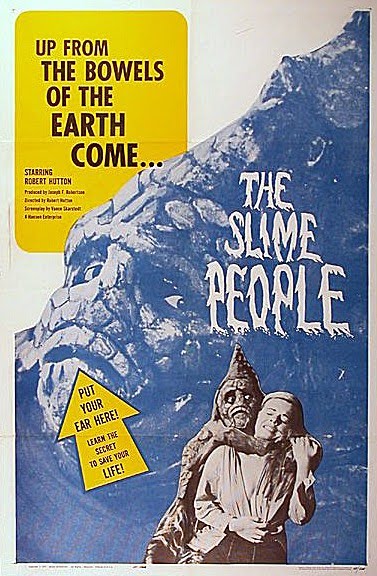
The Slime People

This low budget independent film was released in 1963, but clearly belongs to the 50s realm of low-B movies. It was shot in black and white, and has strong resemblance to the old serials. Somewhat typically, the science within the fiction is scant or bogus. Notorious for its very heavy use of fog machines, The Slime People (SP) tells the story of a band of five people trapped in LA, hunted by slime people. The movie is a mix of familiar elements. It starts out with the post-apocalyptic feel of Target Earth ('54) It progresses like a variation on Commando Cody ('53) meets militant Mole People ('56).

Quick Plot Synopsis
The movie starts right off with the titular slime people rising up from underground. They kill whomever they can find. Tom Gregory, local LA television personality, is flying to LA in his small Cessna. He lands at a small LA area airport which turns out to be deserted. Up drives professor Galbraith and his pretty young daughters, Lisa and Bonnie. They explain to Tom that the slime people enclosed LA in some sort of impenetrable dome. The fog also cools the temperatures so the slime men can thrive. Most people were evacuated before the dome was complete. Those trapped within, like themselves, are hunted down by the slime people. Tom takes them to his TV studio to look at newsreel footage which fleshes out their story. Slime people attack, so they flee. They try throwing some chemicals at the wall, but none of them affected it. En route to some Plan B, they run out of gas and hole up in a butcher shop's meat locker. During one foray for supplies, Bonnie is captured by the slime men. While rescuing her, Tom and Cal see the slime men's fog machine. Theorizing that salt neutralizes the wall, they set out with two buckets of brine, in hopes of ruining the fog machine that maintains the wall. The fog machine is guarded by many slime men, so there is much fighting. The professor throws one of the slime people's spears at the fog machine. It blows up. The invisible wall vanishes. The slime men clutch their throats and fall down dead. The army moves in and escort our plucky band out. Bonnie loves Cal, Lisa loves Tom and the professor is just proud. The end.

Why is this movie fun?
The starts off with the intriguing empty-city scenario. The acting is poor, but the less-seen faces are a nice change. Judee Morton has a real-girl prettiness that isn't the usual Hollywood mold.

Cold War Angle
Nuclear testing is to blame. Professor Galbraith theorizes that all the underground nuclear testing (in Nevada), has ruined the Slime People's natural underground habitat. They are then taking LA as a sort of revenge invasion.

Notes
Serial Flavor -- The low budget, the 2-dimensional characters, the marginal (to poor) acting, and simple sets, all give SP the flavor of the old theatrical serials of the 40s and early 50s. One could easily see Commando Cody, or Video Ranger being the ones to fight the slime people. The various scenes almost lend themselves to having been separate "chapters." The Landing. TV Studio Siege. Into The Hole. Safe Locker., etc. etc.

Brute Geniuses -- It's not uncommon in low budget B movies to have handy contradictions. Typical enough, is the contrary notions of an enemy (or monsters) who are both technologically advanced, yet personally cave-man crude. The slime people are somehow intelligent enough to have figured out how to turn air into an impenetrable solid in whatever shape they want, and make a machine capable of doing this. They are also advanced enough to created a modified environment to sustain themselves. Yet, they have big claw hands which can barely manage to throw their simple spear weapons.

Golden Rides -- Adding to the 50s serial flavor is that the characters drive up and down back roads around LA in a 1954 Cadillac coupe and a 1959 Mercury station wagon. Nothing more modern than the '59 Merc is seen. This suggests that SP might have been snot in 1959, and therefore be a delayed member of the Golden Era of sci-fi movies.

Commander to Crackpot -- Les Tremayne played Major General Mann in War of the Worlds ('53) In SP, he plays the bit part of skeptic and crackpot, Norman Tolliver. Being a skilled actor, Tremayne plays the Tolliver character too well. He doesn't quite steal the show, but he does manage to make the other actors look as lame as they are.

Rubber Monsters -- SP does not make viewers wait until the last 15 minutes to see the monsters. They appear before the title does. The rubber suits aren't all that badly done, and are wisely kept visible for fairly brief glimpses. Longer views of them (such as in the fight scenes) expose their low-budget-ness. Yet, to their credit, the producers had more than one made (such as the single robot 'army" in Target Earth) and hope editing would make it seems like a mob. Their pig-grunt gurgle noises get a bit too much play late in the story.

Bottom line? SP is a very low budget film that is likely to annoy or amuse viewers who are not fans of low budget 50s movies and/or the old serials. Given the evolving style of the 60s, SP seems quite anachronistic. Fans of the old serials like Video Ranger and Commando Cody might find a nostalgic soft spot for this film.

Tuesday, March 23, 2010

Matango: Attack of the Mushroom People

Toho Studios and Ishiro Honda are famous for kaiju movies, such as Godzilla, but Matango is every bit as powerful. It lacks the usual kaiju rubber-suit monster. Instead, Honda tells a moody tale of a group of castaways who have their humanity slipping away from them as they, one by one, turn into mushroom people. Matango became better known to American audiences through A.I.P's english dubbed version in 1965, for television. Matango developed something of a cult following, but also its share of detractors. The mushroom people themselves are not horrible enough for horror fans, nor monstrous enough for monster fans. Yet, setting costumes aside, Matango weaves a compelling, if gloomy, story about people succumbing to a dark side.

Quick Plot Synopsis
The movie opens in a Tokyo psychiatric ward. A lone man tells his tale. A group of seven people are cruising on a sailing yacht when a fierce storm brews up. The owner wants to maintain course. The wind breaks their masts. The waves take out the radio and engine. They drift helplessly through calm foggy seas. Eventually, they drift up to a fog shrouded island. It is uninhabited, They find an old fungus encrusted old research ship on the other side of the island, but no trace of the crew or passengers. The captain's log warns not to eat the mushrooms. Food and supplies begin to run low for our seven. Tensions rise and the old social order crumbles. The crewman ignores the skipper's authority. The rich man cannot buy obedience. The star uses seduction in a ploy for power. The writer seems to be going mad. One of them does eat the mushrooms. They are at first satisfying, soothing and narcotic. One by one, the castaways join in, becoming strangely placid, yet insistent that the remainder join them. Eventually, only the professor and his girlfriend remain as untainted holdouts. The mushroom people surround the couple on the beached ship. While the professor fights off some mushroom people, other mushroom people carry off the girl. When the professor finds her in the mushroom forest, she has eaten and become one of them. He fights to escape the surrounding mushroom people and makes it to the partially repaired yacht. This, he sails until picked up by a ship. Back in the psych ward, he finishes his tale. Unbelievable? He turns to face the light, revealing that his face has fungal lumps on it. The End.

Why is this movie fun?
The deeper themes and social commentary provide much food for thought. The sets, lighting and camera work create a strong mood.

Cold War Angle
This is left understated, but present. The research ship was guessed to be studying the effects of nuclear testing. Did radiation cause the mutant mushrooms that take over peoples' bodies and minds? Or, did the researchers unwittingly create the the insidious fungii while studying radiation effects? Either way, Honda quietly blames nuclear testing for the loss of humanity.

Notes
Print Precedent -- Takeshi Kimura's screenplay was inspired by a short story by William Hope Hodgson. "A Voice in the Night" was published in 1907. Hodgson's story was about two men aboard a becalmed schooner. One night, they hear a voice from an unseen small boat, asking for food. They give him some food and he tells his tale. He and his fiancee were shipwrecked and drifted on a raft to a foggy island. In the lagoon, they found an abandoned ship which was encrusted with many gray fungus growths. They set up quarters in the ship, but after awhile, noticed growths on themselves which would not go away. Out of extreme hunger, the woman, then the man, eat the mushrooms. They were becoming less human and more mushroom. The voice thanks the men on the schooner and departs.

Ancient Precedent -- There is an element of Homer's Odyssey in Matango. Odysseus and his men land on a strange island. Some of his men leave the ship to look for supplies but never return. Odysseus finds them in a village of lotus-eaters. The lotus fruits were both a nutrient and a narcotic. Once tasting the lotus, his men become placid, content and lost all desire to return home. Odysseus has to drag his men away, begging him to let them stay. The mushrooms had this same dual role of life-sustainer and soul-enslaver.

Pod Precedent -- Within the mushroom transformation in Matango is a sort of parallel to the pods in Invasion of the Body Snatchers ('56). Once having eaten even a little bit of mushroom, the person's humanity fades away. Taking its place is a new, stronger personality. They have a common mind to induce all the remaining humans to join them in mushroom-hood, much as the pod-people worked at turning everyone into pod-people. This creates a very similar feeling to the story about the loss of our humanity -- being taken over by something else.

Social Breakdown -- Another similar sort of tale was William Golding's Lord of the Flies ('54) in which a group of plane-wrecked British school boys start out with a semblance of civilization and order. Yet, as time passes on the island, their civilization breaks down into brutal savagery. We see a similar breakdown among the seven castaways in Mantango. Social order (labor vs capital, authority & obedience, even male & female social roles erode into self-centered savagery. Golding and Kimura spin similarly dark visions of mankind's more primal core.

Gilligan Noir -- It may be a strange cosmic coincidence that the crew of the shipwrecked yacht in Matango had a Skipper, crewman, a rich man, a movie star, a wholesome girl and a professor. Sound familiar? Sherwood Schwartz was developing the pilot for his new TV sitcom "Gilligan's Island" at almost the same time that Matango was showing in the western U.S. Perhaps he had seen Matango (still in its original Japanese), or perhaps he heard a synopsis of it and liked the character mix. With only a few weeks between Matango's release and Schwartz shooting, the former may not have had any influence on the latter. If not, it is a very strange coincidence.

Love Lost -- Another sub-plot is the inner conflict of love vs. survival. Professor Morai loves Akiko. When she becomes one of them, Morai is torn -- be with his love, or remain a human. When the other mushroom men surround him, his instinct for survival proves stronger. He escapes, but is forever haunted by regrets. Maybe escape from the "real" world (of sin and evil) and mushroom life with Akiko was the better path.

Bottom line? This Toho tale is definitely worth watching. The original, with english subtitles is better than the A.I.P. dubbed version (which sometimes comes across too silly). There is much thoughtful commentary on mankind and society in Matango's screenplay.

Friday, March 19, 2010

The Day of the Triffids

This is one of the big B sci-fi movies of the early 60s. Triffids has its share of low-budget issues, but this British production still has its moments and has its fans. Based (loosely) on John Wyndham's 1951 novel, the story is yet another variation on 50s post-apocolyptic visions. Triffids is actually two unconnected stories in one film about the end of civilization as we knew it. One story follows the travels of Bill Masen in search of other sighted survivors. The second story, filmed later and cut into the first, watches a husband and wife team of biologists, stranded in a remote lighthouse when civilization ends. They must battle the invaders alone.

Quick Plot Synopsis
A dazzling meteor show in the night sky has almost everyone watching. The shower also awakens some odd plants, Triffidus celestus, whose spores came to earth on a meteor. Awakened, they begin to grow, move and eat people.
Story One follows Bill Masen, a sailor whose eyes were bandaged from an operation. He awakens to an empty hospital and a virtually deserted London. Those remaining in the city are blind. The meteor shower ruined their optic nerves. Bill rescues a sighted 12 year old girl named Susan after a train wreck. Together, they make their way to France where sighted survivors are said to be gathering. In France, they find an enclave of a few sighted people, lead by a Christine Durant, caring for 40 blind people. Bill is torn between staying in the little community and moving on to Cadiz where a naval base is thought to house sighted survivors. A busload of sighted (but drunk) convicts takes over the manor. Bill, Christine and Susan narrowly escape the riotous party before the triffids attack the manor. The three travel south in an ice cream truck they found. In Spain, they come to an estate of a man whose wife is pregnant. They stay to help deliver the baby. While they stay, millions of triffids surround the compound's fence. Deducing that they are attracted to sound, Bill lures them away with the annoying ice cream trucks's music. This allows everyone else to escape to Cadiz and be rescued by submarine. Bill shows up at the last minute so the little ad hoc family is reunited.
Story Two follows Tom and Karen Goodwin, biologists living and working in a remote lighthouse off the coast of Cornwall. Their marriage is in trouble, and Tom has a drinking problem, in addition to being a self-pitying jerk. Triffids attack them too, eventually forcing them higher into the lighthouse. In a desperate last defense, Tom uses a seawater fire hose on the triffids. Seawater dissolves them. The world is saved by common seawater. Church bells ring. The end.

Why is this movie fun?
The post-apocollyptic city is well done and moody. Some of the effects are cheesy, but some are actually pretty solid. The trope of giant semi-sentiant, mobile carnivorous plants is too unique to be dull.

Cold War Angle
Wyndham's original novel was more clearly a communist invasion-angst analogy. The film comes across less so, but the insidious, unstoppable onslaught which crumbles "western'" civilization, still has its fit.

Notes
Fragile Empire -- Inherent in Wyndham's novel was the message about how fragile our mighty civilization is. Take away one common thing -- often taken for granted -- and just about everything crumbles. All of our (1960s) technologies and systems were rendered useless (as exemplified by the ship, the train, and the airliner) when no one could see how to operate them.

A Familiar Pair -- Story One is much like H.G. Wells' novel, The War of the Worlds. Instead of Martians causing civilization's collapse, it was carnivorous plants. A lone survivor tries to escape the invaders and link up with other survivors. Something ubiquitous on earth saves humanity. Story Two is a twist on the monster-onboard tale that will get retold a few more times. Instead of being trapped in a spaceship with a monster (as in It, Terror From Beyond Space), the claustrophobic cylinder of terror is a lighthouse.

Book Loose -- The screenplay is only loosely based on the novel. Some of the characters have the same names, though somewhat different roles. In the book, the plants are the escaped product of a reckless Soviet scientist. In the movie, they're from space. Other elements from the book can be identified, such as the bus load of rapacious convicts standing in for the brutal Torrence and his gang, etc. The book character of Josella is omitted. Christine Durrant becomes Masen's eventual love interest. While the book and the screenplay diverge, ( and this rankles some folks) the screenplay actually stands on its own fairly well.

Oops, There Goes Another Rubber Tree Plant -- The monsters themselves are one of the weaker parts of the movie. The producers did what they could (men in rubber plant suits), but making a huge plant move and be menacing was just too tall an order for their limited budget. Even Steven King would have trouble making plants frightening (on screen).

Spores From Space -- It is an interesting parallel to Invasion of the Body Snatchers that the plant invaders and consumers of humankind, come from space. This trope was familiar to sci-fi audiences, so helps the movie achieve the alien invaders mood.

Stiff Upper Lips -- There is an interestingly British spin to this end-of-the-world scenario. Order and decorum must be maintained. Londoners, stricken blind, dress themselves and attempt to stroll the sidewalks as if nothing were wrong. (why?) A blind railroad agent just sits at his ticket window, ineffectual, but faithful to his job. Stiff upper lips are most obvious in the crew of the airliner. All blind and out of fuel, they all know they're about to die. Yet, they stare blankly ahead, resolute to the end. Even the acting of Howard Keel as Bill Masen, has a "proper" British feel to it. Keel is the unexcitable hero. Compare him to Kieron Moore's more tempestuous Tom Goodwin.

Bottom line? Triffids is an unforgettable movie. It has its flaws and can get a bit talky at times, yet it has a good deal of entertainment value.

Monday, March 15, 2010

Reptilicus

The prehistoric monster-on-the-loose was no longer fresh in 1961 when Reptilicus was released in Denmark. Yet, it seemed several cultures wanted their own Godzilla story. This is the Danish kaiju, brought to you by Sidney Pink and Ib Melchior, the team that gave you Angry Red Planet ('60) and another Dano-American production, Journey to the Seventh Planet ('62). Shot in two versions, Danish and English, in 1962, the English version was delayed until January of 1963 to "fix" some problems. The science in the fiction is pretty scanty in Reptilicus. There is a bit of biology and a touch of paleontology, but the story is essentially the customary giant prehistoric creature rampaging through a modern city, being blasted by massive military firepower.

Quick Plot Synopsis
An oil drilling crew find blood and bits of leathery flesh on their bit. Later, a six foot tip of a tail is unearthed from the tundra. It is flown to the Copenhagen Aquarium for study. Due to neglect, it is allowed to thaw. They discover that it's healing itself. It is alive again. Dr. Martens lecture that the original dinosaur must be able to heal like a lizard that can re-grow a tail, or a starfish re-grows an arm. The new find is named "Reptilicus". No one notices that the tail has grown into a full beast. It eats a sleepy scientist and breaks out of the Akvarium. Reptilicus eats cattle and terrorizes the Danish countryside. The army cannot kill it due to its tough armor scales. A flame thrower does hurt it, though, and it flees to the sea. The navy tries to depth charge it, but are told to stop. All the blown up bits would become separate beasts. Reptilicus recovers and comes to terrorize Copenhagen. Screaming crowds run through the streets. The pretty scientists cook up a gallon of knock-out drug, which is placed in a bazooka shell. General Grayson fires the shell into Reptilicus' mouth. He drops slowly to the street. Presumably, the scientists destroy the beast without scattering bits, so the world is saved. Except for a severed arm on the sea floor, blown off by a depth charge. It begins to twitch. Fade to black. The End.

Why is this movie fun?
The monster-on-the-loose trope is usually fun. The model cities, toy tanks, screaming crowds: all fun viewing. The venue of Denmark adds some variety, and gives Los Angeles a break.

Cold War Angle
Unlike others in the giant monster sub-genre, Reptilicus is not linked to radioactivity. As such, he isn't developed as any kind of analogy for nuclear war, etc. Instead, Reptilicus is more of a monster movie.

Notes
Comic Relief -- The man who plays the night watchman, Peterson, is the Danish comedian, Dirch Presse. To uninitiated American audiences, Peterson was clearly the bumpkin-ish comic relief character. To Danish audiences, he almost upstaged the rest of the story. It would be akin to having Leslie Nielson or Robin Williams in a bit role of some other B monster movie.

Double Speak -- The english version looks, at times, like it is a dub of the Danish version. At other times, the words and lips line up perfectly. The reason is that the movie was shot in two takes. In one, the actors spoke Danish. In the second, they spoke English. Trouble was, they spoke it with a pretty obvious Scandinavian accent. A.I.P. couldn't accept that, so native english speakers provided the American-accent voice talent for the dub.

Ignore Monster, Visit Denmark! -- A fairly blatant secondary motive for the film Reptilicus is to promote Denmark as a tourism destination. General Grayson, Connie Miller and Capt. Brandt tour Copenhagen, making sure to hit all the key tourist sights. Ample use is made of Tourism Board stock footage. A swanky nightclub scene is inserted with Denmark's answer to Doris Day, Birke Wilke, singing "Tivoii Nights" about the charms of Denmark.

Better Bad Puppet -- The monster is clearly a marionette on a model landscape (or cityscape). While this "special effect" was pretty meager, even by the standards of the day, it was a far cry better than the most infamous marionette monster -- the atomic bird in The Giant Claw ('57). At least Reptilicus had some ferocious dignity.

A Tale of Two Dragons -- The Danish version and the American version are essentially the same, but with some notable differences. The most famous difference is that the Danish version has a small scene in which Reptilicus uses his little dragon wings to fly. This got cut from the American version. The Danish version has a more developed romance between Sven and Connie. The Danish version has a cute-comic scene with Peterson singing to children in a park. The American editors saw no need for that scene, since Presse had no American following. The American version added that the monster spewed green acidic slime. The Danes did not. The slime was added in post-production and does look rather pasted on. The American version also has the poor farmer father get eaten. The Danes did not. He, too, looks rather badly pasted in via post-production.

Bottom line? Reptilicus is member of the famous sub-genre of monsters ravaging cities. It is a low-budget version, but has the requisite elements. Fans of 50s kaiju will find entertainment value. Modern viewers jaded by CGI will probably laugh, or moan.

Wednesday, March 10, 2010

1962

Since the closing of science fiction cinema's Golden Age (the 1950s) far fewer sci-fi films were release each year. 1960 had far less than 1959. 1961 had a couple less than 1960. 1962 had a bit less than 1961. Curiously, almost none of them were "home grown." Reworked and dubbed foreign sci-fi films made up the bulk of the offerings for '62 audiences to enjoy.

Planets Against Us -- Italian production about stealthy alien cyborgs, all patterned after one dead human, sabotaging earth's space efforts.

Journey to the Seventh Planet -- Joint American & Danish production about an alien on Uranus that can conjure things, beautiful or terrible, from men's thoughts.

Creation of the Humanoids -- A future of mankind's slow extinction and eventual replacement by robots so advanced that even they don't know they're robots.

Underwater City -- A city on the sea floor is proposed as the answer to mankind's problems. It is built, but disaster strikes.

Invasion of the Animal People -- Originally a '59 Swedish sci-fi about an alien landing in northern Lappland and a Yeti which rampages.

The Brain That Wouldn't Die -- A mad/gifted surgeon rescues his fiancee's head from a car crash, then searches for a suitable body to transplant it to.

The First Spaceship on Venus -- English dub of the 1960 East German film "Silent Star". An earth mission finds traces of a dead civilization on Venus.

Battle Beyond the Sun -- English dub of the 1959 Soviet Sci-fi, about a Mars mission which must divert to save a doomed rocket. Roger Corman inserted some gratuitous and questionable monsters.

Planeta Bur -- A Soviet sci-fi, benchmarked here, but used in english-dubs in two later films.

Hand of Death -- Not yet reviewed, pending.

Thursday, March 4, 2010

A Dream Come True

This soviet sci-fi, entitled Mechte navstrechu (MN) ("A Dream Come True"), came to American audiences in 1966 as Queen of Blood. MN is another member of that distinctive sub-genre of foreign sci-fi bought cheaply, dubbed in to english, some new footage inserted and re-edited. MN itself is mixed bag. On the one hand, it has some very captivating visuals. On the other hand, it is a potentially fascinating story told very weakly. Queen of Blood makes good use of MN's powerful visuals, but tells a very different story. MN is a much more romanticized view of space travel and first contact. Hence the need to put down here, in this 1963 survey, the original story line.

Quick Plot Synopsis
Several characters of a space research facility are introduced and developed at some length to emphasize their warm humanity. Tanya is a radio astronomer listening for "first contact". Andrey is an engineer who dreams of life around remote stars. Andrey likes Tanya, so shows her his "Crystalphone" which plays a song he wrote about exploring space. Far away, on the planet Centuria, they pick up Andrey's song. Intrigued, the Centurians launch a crew to travel to earth. En route, they encounter trouble. The Centurians launch a recording capsule to earth. Dr. Krylov discovers that the capsule is a video log of the Centurian ship, capturing their distress and probable crash on Mars. Soviet scientists urge a assembly of a rescue mission. The rocket ship "Ocean" is finished and a crew launched. En route to Mars, they encounter a massive solar burst. Powering their shields at maximum drains their energy. They can land on Mars, but not take off. This, they do. They find the Centurian ship, but only one dead alien aboard. A second ship, the Meteor, is sent from moon base to help. It cannot land on Mars, so launches the supplies as satellites and lands on Phobos. Andrey and Ivan find the Centurian escape pod on Phobos, with the alien woman barely conscious. The emergency ship can only carry 2, so Andrey stays behind. Ivan takes alien woman to Mars. They all meet up and the Ocean is now able to blast off. They return to earth, triumphant at a friendly first meeting with aliens (a successful rescue), even though it cost dearly (Andrey). The actual ending is ambiguous. Andrey and Tanya (at the lake on earth) are called by Paul to report for launch. Was it a flashback of Tanya's about good ol' days with Andrey? Or, was it all actually a fanciful dream conjured up by Andrey's romantic space song? (You decide.)

Why is this movie fun?
The sets and models for the Centurians have a luxurious quality. They're great fun to look at. The wild-eyed optimism about space travel and first contact, is so very different from the paranoia of the 50s, and later in the 70s and 80s (e.g. Alien).

Cold War Angle
The writers take a few digs at the West via the Dr. Laungton character, the American colleague of soviet head astronomer Dr. Krylov. Laungton frets that 'first contact' will be hostile and suspects invasion. His fixation on the evil intent of the "others" is a blatant counterpoint to soviet idealism and fixation on friendliness.

Notes
Poets & Lovers -- As is typical of propaganda, the hometown folk are cast as benignly human. They're artists, poets, playful, good with kids, and of course, engage in chaste courtship. They are do-ers and dreamers of grand peaceful futures. It is those dark-hearted politicians and technocrats in the west who rain on the bucolic parade.

Proto-iPod -- Andrey's "Crystalphone" invention plays music, and looks amazingly like the modern iPod Nano. His design is a bit rounded and made of dark brown plastic, but Tanya holds it and looks at it just like people today do with their iPods. All that's missing are the earbuds.

Customary Sacrifice -- Soviet films liked to glorify sacrifice. Someone is lost in the otherwise successful mission. In Nebo Zovyot, Somov dies of radiation bringing fuel to the marooned ship Rodina. In Der Schweigende Stern, the crew of the Capella die when a meteor hits their ship. Later, Chien Lu dies of a torn spacesuit. Talua is left behind to die. In MN, Tanya's love interest, Andrey, nobly gives his life (staying behind on Phobos) so the alien woman may be saved. This brave acceptance of losses is not very Hollywood, but somewhat similar to the Japanese ethos.

Texas on the Volga -- One striking theme amid the visuals is that the Russians, like Texans, like things BIG. Huge statues (matte art) decorate Gagarin Square and the Congress hall. A 5-story jumbotron brings news to the masses. Only the Soviet Union has the space program developed that can mount a rescue mission. Russians think Big.

Weak Delivery -- As a film, MN has a bland and amateur feel. Perhaps the director did not think his audiences could piece together the story from mere dialogue. Instead of letting the characters tell their story, the narrator is constantly interrupting to tell us what is going on. Instead of one cosmonaut saying to the other "Hey, we're low on fuel," the director just has them look at each other with mildly concerned expressions while the narrator blathers on and on about the lack of fuel.

Bottom line? MN may not be easy to find, but a hard core 50s-60s sci-fi fan will be rewarded. The sets and models are well worth it. As a propaganda piece, it is interesting too. For viewers accustomed to action films, the pace will seem slow and talky. Even so, the pace picks up in the last third of the film.