1910s & 20s * 30s * 40s * Pre-50s * Frankenstein * Atomic Angst * 1950 * 1951 * 1952 * 1953 * 1954 * 1955 * 1956 * 1957 * 1958 * 1959 *
1960 * 1961 * 1962 * 1963 * 1964 * 1965 * 1966 * 1967 * 1968 * 1969 * 1970 * 1971 * 1972 * 1973 * 1974 * 1975 * 1976 * 1977 * 1978 * 1979

Saturday, February 26, 2011

They Came From Beyond Space

Embassy Pictures brought American viewers another Amicus sci-fi film from Britain. They Came From Beyond Space (TCBS) was a modest budget film -- not ultra-cheap, but not lavish either. It is yet another installment in the alien-takeover sub-genre. It does carry a distinctly British flavor to its paranoia.

Quick Plot Synopsis
A "V" shaped formation of meteorites lands in a farm field in Cornwall, England. A team of scientists is dispatched to investigate. While they examine the rocks, they are taken over by beings of pure thought who rode inside. One of the scientists is Lee, girlfriend of Curtis, the extra-brilliant scientist who was not allowed to travel with the team. Curious at the loss of contact, Curtis travels to the site anyway. The possessed humans have built a fence, posted guards with guns and have run up big bills buying all manner of equipment and supplies. Government agents investigate too, but a mysterious plague breaks out. People suddenly fall dead (apparently) with red spots on their skin. There is no known cure for the Crimson Plague. The possessed people convince the government that they're building a rocket to take the dead for burial on the moon -- as the only safe solution. Curtis senses something else is going on, so keep trying to get into the compound. Eventually, he succeeds, but is taken prisoner. His former colleagues are all possessed by aliens. Even some people thought dead of plague are alive and working. Curtis escapes his cell, stuns Lee and carries her out. He takes her to a geeky friend's lab. They devise an anti-possession helmet (almost a tinfoil hat), a set of goggles that can "see" who's an alien or not, and a ray gun to stun or kill them. They devise a process to free Lee of her alien. Using Lee pretending to be still possessed, they get back into the compound. They sneak aboard the rocket bound for the moon. Once on the moon, they are monologued by the Master of the Moon who tells how they evolved into energy beings but were dying out. They needed some new bodies to possess, but crashed on Earth's moon. In a play for pity, the Master says they just want to go home to die. Curtis lets down his guard and is captured. The Master plans to remove the silver plate in his head and transfer himself to Curtis. Meanwhile, Farge escaped and foments a workers' revolt. This interrupts the operation. The aliens are all dejected about losing. Curtis says earthlings would have helped them build a ship to go home, if they had just asked nicely. The energy alien leaves his host body, who gets all cheery and shakes hands with Curtis. The End.

Why is this movie fun?
Yet another alien-takeover flick could be dull, but the eclectic British flavor keeps it different. Curtis' very clean 1924 Bentley is quite a rare treat to watch. It's almost a co-star.

Cold War Angle
The alien-takeover trope is a handy metaphor for patriots being "turned" to ally with the Dark Side. The not-so-subtle moral of the story is that someone might look like a soulless fiend intent on conquest, but deep down, they're just regular guys. If we'd just talk more, we could all get along. Kumbayah.

Notes
Based on the Book -- Joseph Miller wrote a novel titled, "The Gods Hate Kansas" in 1941. This basing means that TCBS's roots are among the oldest of the alien-takeover tribe. TCBS follows the book's plot fairly closely, except for the location (Kansas vs. Cornwall). All the major plot points are there: Meteorites with aliens aboard, who had crashed on the moon. Energy beings take over people and start building a secret compound and a rocket. An unstoppable plague breaks out which turns out to be a tool of the aliens to get workers, the hero has a metal plate in his head so he can't be taken over AND the ending where the hero says they just had to ask.

Possessing Lineage -- Just as a recap, the notion of aliens taking over humans is old. The Man from Planet X ('51) even went so far as to have the taken-over humans acting as manual labor too. It Came From Outer Space ('53) also featured aliens taking over townsfolk to act as manual labor to repair their ship. Apparently, it's tough to find repair shops in this stretch of the galaxy. The most famous take-over film, Invasion of the Body Snatchers ('56) was an earth conquest theme, not a repair job. From that famous example, to lesser examples, such as War of the Satellites ('58) and The Day Mars Invaded Earth ('63), the plot device of aliens taking over humans for nefarious deeds was becoming traditional to the point of becoming cliche.

Forbidden Fruit Fascination -- A recurring element in British sci-fi, is the notion of a closed-off compound. There must be something in the British psyche -- like a cat that cannot resist an empty box -- that is fascinated by the idea of a cordoned off zone that no one is permitted to enter. Perhaps the Brits have an innate conspiracy theory gene. All of the "Damned" movies featured secret compounds.

Bottom line? TCBS is a notch above the cheaper B sci-fi of the mid 60s, yet it's not all that special either. The alien-takeover trope has gotten long in the tooth, so lost most of its tension value. The peculiarities inherent in a British film, such as the Bentley, add some interest.

Tuesday, February 22, 2011

In The Year 2889

Larry Buchanan produced modern remakes of three of American International Pictures' 50s B sci-fi films for A.I. Television. (Hence the VHS cover art in lieu of a theatrical poster.) The third of these remakes, In the year 2889 (2889), is a very close copy of Roger Corman's 1955 cheapy, Day the World Ended. TV movies are out-of-scope, but since it is a remake of a 50s sci-fi, it's worth including. Buchanan did very little to the script, so 2889 is essentially Corman's '55 movie with different actors and shot in color.

Quick Plot Synopsis
See the synopsis of Day the World Ended ('55) for the original plot and notes. Below is a very brief recap. The story opens with a montage of nuclear test blasts and a narrator reading the same Bible verse, 2nd Peter 3:12, about the heavens being on fire and elements burned with fervent heat. Captain John and his daughter Joann are set to wait out the fallout in his protected valley hideaway. Joann's fiance, Larry is late, and presumed lost. Several strangers arrive at John's refuge. Steve, the handsome young geologist and his badly irradiated older brother Grainer. Tim, the grizzled alcoholic rancher from other the ridge wanders in. Mickey (the hood) and his girlfriend Jada (the dancer) arrive to make it seven. John has the gun, so he's in charge. Steve likes Joann, but she pines for Larry. Mickey likes Joann in all the wrong ways. Tensions flare. Grainger "gets better" but craves raw meat, so stalks the woods. Another mutant creature stalks the woods too. Joann feels it's calling to her. Jada and Mickey fight over his shifting affections. Tensions flare. Mickey drowns Jada. Tim, distraught over his lack of hooch goes over the ridge into the deadly fog. John follows trying to retrieve him, but gets a lethal dose for his trouble. Joann goes outside in a trance, to the mutant. She screams, faints and is carried by said mutant. Steve interrupts. Joann flees to a stream. Steve too. It rains, and kills the mutant. Mickey gets John's gun and plans to kills Steve and take Joann. John, hiding a second gun, shoots Mickey dead. Steve and Joann hold hands. Text over still: "The Beginning". The End.

Why is this movie fun?
If you're familiar with the original, it is fun to see it re-enacted by another cast. Knowing the story already, lets you focus on how differently (or badly) the new actors play their parts. It's a compare-and-contrast moment.

Cold War Angle
This is, necessarily, the same armageddon angst as the original, but some missing bits of opening narration suggest that the producers did not feel the audiences of 1967 were living in quite as abject fear as they were in 1955.

Notes
Commonalities -- See the notes on the original, as much of it still applies. Overall, 2889 is a very close copy of DWE. In many cases, the dialogue is exactly the same. Certainly it is a scene-for-scene copy with only a few deviations. (cited below)

Differences -- While 2889 does not differ much from the original, here are the main differences: The Father/Captain is named John, not Jim. The Lovely Daughter is named Joann, not Louise. The Mutant Fiance is named Larry (a joke about the director?), not Tommy. The Handsome Geologist is Steve, not Rick. The Radiated Man is Grainger, not Reddik, and he's cast as Steve's brother, not just a random businessman. The Hood is Mickey, not Tony. The Dancer is Jada, not Ruby. The Rustic is now Tim the neighbor rancher, not Pete the Prospector. Tim has no mule, like Pete did, though he is still fond of hooch. A more significant plot change is that The Hood kills the Dancer more in cold blood. In DWE, Ruby is accidently stabbed with the knife while she and Tony struggle over it. In 2889, Mickey deliberately drowns Jada. The Hood got more odious.

Water: Our Savior -- Since the original film, many others have come out in which good ol' ubiquitous water is mankind's savior. Of course, water melted the Wicked Witch of the West in The Wizard of Oz ('39). Salt water killed the triffids in '63. Salt water also stopped the Monolith Monsters in '57. Rain killed the heat aliens in Night of the Big Heat ('67) and mutant Tommy in Day the World Ended ('55). Much later, it was plain ol' water that stopped M.Night Shamaylan's aliens in Signs. Of course, just as many movies used good ol' fire to stop the monsters/aliens. We like our simple cures.

NOT From the Book -- The title of 2889 is entirely misleading. Jules Verne wrote a short story by that title, published in 1889. American International had purchased the rights to Verne's story, but had no script to go with it. They applied their owned title to Buchanan's remake, even though the two have nothing to do with each other. Verne's storoy was a sort of day-in-the-life of an American newspaper editor in the year 2889. As such, it served as a vehicle for delivering several predictions and marvels, such as travel by pneumatic tubes. Verne imagined audio-file newspapers (podcasts) replacing print, but still had physical delivery. No internet. He imagined England becoming a de facto colony of the United States, but also imagined that France would still have her African colonies, etc. etc.

Bottom line? 2889 is an even cheaper production than the movie it copied, which was itself pretty cheap. The acting is marginal and the creature too cheap (basically, a fright mask) to have much appeal to modern audiences -- particularly those with no empathy for the nuclear angst of the 50s. Fans of the original movie, Day the World Ended may be amused at the reenactment.

Friday, February 18, 2011

Journey to the Center of Time

David L.Hewitt produced and directed this low low budget remix of the usual time travel ideas. That this film, Journey to the Center of Time, (JCT) bears more than a passing resemblance to The Time Travelers ('64) is no coincidence. Hewitt co-wrote the latter and directed the former. There is more on the parallels in the Notes section. Production values are low, as JCT tells yet another tale of man traveling to the future and earth's prehistoric past.

Quick Plot Synopsis
Dr. Gordon and his team are trying to use laser technology to photograph the past. Thus far, they can only go back 24 hours. Mr. Stanton is the bombastic new owner/director of the lab facility. He scoffs at their project and demands results within 24 hours, or he'll shut them down. While demonstrating their time lab for Stanton, Mark is compelled to push the 'laser cycling' beyond safe limits to force results. The time lab hurtles 5,000 years into the future. They see a sleek rocket and a war going on. "Aliens" (plain men) escort our four time travelers to their alien leader, Dr. Vina. She monologues about leaving a dying world, looking for a new home and how earth seemed nice until this war broke out. Earth combatants breech the aliens' defenses. A melee breaks out. Vina is shot with laser. She gives a cautionary warning as she dies. The other aliens help the travelers back to the time lab and send them on their way. The time lab overshoots the present and travels back into the past. Our travelers watch extended clips from old movies. WWII. Civil War. Cowboys and Indians. Sailing ships firing at each other. (history = war, apparently). They encounter another time travel ship hurtling at them towards the future. Mark radios it, but no response. Stanton panics and fires their laser at it, blowing it up. The time lab finally 'lands' in the year one million B.C. Stanton goes out to look around. Mark and Doc go to retrieve him. Karen stays behind, but is scared by a "giant" lizard. She fires the laser to fend it off, but shatters the laser's ruby in the process. She then runs outside too. They all meet up in a cave. Lining the cave walls are large precious gems. They look for a ruby to fix the laser. Stanton, as the greedy capitalist, just pockets gems. In a lava chamber, he greedily pulls another gem from the wall, which somehow causes more lava to rise. They try to flee along a narrow ledge, but Doc falls into the lava. Stanton gets back to the time lab well before Mark and Karen. He puts his pile of rubies on the laser table and sets the controls for home. This strands Mark and Karen. En route to the present, Stanton sees another time lab hurtling toward him. He hears Mark's radio warning, himself panicking, and firing. Stanton and the time lab blow up. Mark and Karen emerge from the jungle to find an empty time lab with settings the same as when they first landed. Oh well. Mark and Karen travel back to the present, but their time synchronization is off. They arrive several minutes too soon. Everyone in Time Central is frozen in the present. Worrying that when the present catches up with them that they might explode, or implode, or something bad, Mark and Karen get back into the time lab and set off for some undefined time in earth's future. They might be a new Adam and Eve for a brave new world. Star field, fade to credits. The End.

Why is this movie fun?
JCT is undeniably low budget and full of inane techno-blather, but it has 60s . It tries hard to be deep and complex. Despite some laggy padding, the story does at least move along to its denouement.

Cold War Angle
Like many of its 50s brethren, JCT is a cautionary tale about unchecked militarism in the future, and mega-weapons getting out of control. They arrive in the year 6,968 in the middle of a "nuclear war."

Notes
Time Travelers Retread? -- There are lots of similarities between JCT and The Time Travelers, but there are many differences too. This should be no surprise, as Hewitt co-wrote TTT and directed JCT. Below are some commonalities and differences.
Same Stuff: A time viewer project. Funding about to be cut off. Push the lasers beyond safe limits. Three scientists, one a woman, and a non-scientist. Future earth is bleak. A big fight between factions in the future. Return to present with people frozen. Time loops.
Different Stuff: A spherical 'ship' travels to the future instead of stepping through a portal. Obnoxious capitalist in lieu of comic relief janitor. Aliens in the future instead of mutants. Some of the travelers die. Instead of ending in a perpetual loop, Mark and Karen avoid the loop and set off for a (linear) future.

Ruby: The New DiLithium -- Throughout JCT the scientists keep talking about lasers and coherent light, etc., which is all fine and scientific. But, at other times, they talk about their ruby as if it were a Star Trek di-lithium crystal -- their quasi-nuclear power source. Near the end, Stanton piles some rough rubies he's collected in the cave, on the "laser" stand and somehow this restores the time lab's power. An amusing mix of fancy and factoids.

Slick Cheap -- Cheap sci-fi "space ship" sets in the 50s were cobbled together out of military surplus, and resembled the insides of a submarine. Note how cheap in the mid 60s had gone through an upgrade. Smooth orange octagonal walls (no boiler rivets) for the interior of the time lab. There were lots of flush-set blinking lights and that really cool quarter-opening sliding door. And what about that utterly pointless scissor lift that lowered Stanton three feet from the 'mezzanine' to the sunken-livingroom center area? It was still cheap, but it was following a different vision.

Want Babes? Be A Computer -- Note the background of the Time Central facility. The back wall is filled with their "computer" (lots of lights and non-moving tape reels.) Yet, this beast requires a bevy of beauties to attend to it. Half a dozen or so pretty, and leggy young women in high heels (and white lab coats) stand there in glamor poses. Hewitt (also the film's producer) must have been quite the man around town with the ladies. "Hey, I can get you part in a movie..."

Pre-Carol -- Watch for Lyle Waggoner in his brief role as alien squad leader. He doesn't get much for a part. This is before he became famous on the Carol Burnett Show.

Poupee, We Hardly Knew Ye -- The credits announce: "Introducing: Poupee Gamin" in the usual style for launching a career. Her part in JCT was minimal as Dr. Vina. She stood, for awhile, in her tight "bald" cap and very ample cleavage. Perhaps that was Poupee's outstanding feature(s). Yet, Poupee did not go too far. She played small parts in two more movies in 1967, then disappeared from the screen.

Spider-Rat-Bat Cameo -- In a nod to Ib Melchior, Hewitt included a very brief glimpse of the Spider-Rat-Bat creature from Melchior's Angry Red Planet ('60). Hewitt and Melchior collaborated on TTT. This brief glimpse occurs when our band of four are viewing glimpses of the future before they get there. No explanation. It's just there.

Bottom line? JCT is a rehash of time travel tropes and stocked with utterly stereotypic two-dimensional characters. The overall quality is marginal, and enough pointless padding to frustrate the attention-span-challenged. It feels like it was a one-hour TV episode padded out to just barely make "feature film" runtime. Yet, for fans of 60s time travel stories, it has plenty of psuedo-science babble and LASERs. Lots of laser talk. The result, while not deep nor cerebral, has some entertainment value.

Sunday, February 13, 2011

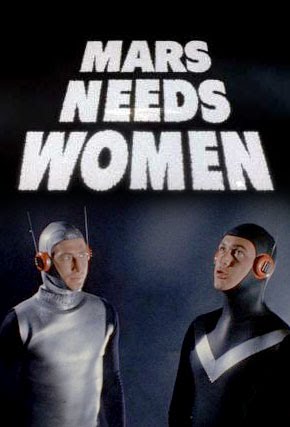
Mars Needs Women

This study looks at sci-fi movies which had a theatrical release, even if very small. It seems that Mars Needs Women (MNW) was made for television only. It's included here, "granfathered" in, on the coat tails of Larry Buchanan's work remaking 50s B sci-fi for television. Where his other projects were 50s sci-fi remade for the 60s, MNW was NOT a remake, but a new product by Buchanan himself. He wrote and directed it. Yet, MNW is very much a kindred spirit of 50s cheapy sci-fi in many ways -- complete with "aliens" who are exactly like us, but wearing hooded body suits.

Quick Plot Synopsis
Several young women disappear (via cheap camera stop). Messages are received coming from outer space. Once decoded, they say "Mars Needs Women." The martians contact the Air Force to say that remotely snatching women didn't work out, so they're coming to earth in person. The leader martian (looking like a 40s 'martian' in hooded unitard) tells Colonel Page that due to genetic decay, few women are born on Mars. The male-female ratio is now 100;1. They want to ask for volunteer earth women. Colonel Page refuses. Dop says they'll just steal them then, and pops out. The world is placed on high alert. Page scrambles fighters to shoot down the martian ship. The "Cheetah-15" (X-15) is kept at bay with force beam. The early F-111 is also kept at bay. The martians land near an abandoned ice factory in Houston. The leader (Fellow 1) says they'll need some chemicals, earth money, earth clothes and a car. Fellow 3 robs a Phillips 66 station, so they have money and a map. Fellow 4 steals a Buick from a parking lot. Fellow 5 steals some suits from a men's store. To complete Operation Sleep Freeze, each of the Martians is to go find a suitable earth woman and bring her back. Fellow 5 settles on a stripper. Another Martian sets his sights on a college "co-ed." Yet another scopes out an airline stewardess. Meanwhile, Fellow 1 has decided to go for Dr. Marjorie Bolen, (Yvonne Craig) a young, sexy, space geneticist (?) in town as an advisor for the Martian Hunt alert. Fellow 1 hypnotizes a reporter to hand over his identity papers, then drive back to Seattle and forget the whole thing. Fellow 1 then pretends to be the reporter so he can get close to Bolen. Fellow 1 charms Bolen, so they do some quasi-romantic walks and talks. Bolen starts to like the Martian-fake-reporter. Meanwhile, Fellow 3 has homed in on a homecoming queen as his target. Fellow 4 gets his co-ed. With four women reported missing, authorities know there will be one more victim. All the abductions are centered on the abandoned ice plant. Bolen points out the chemicals there could be used to "freeze" people for long space flights. The army plans to attack. At supper, Bolen lets slip the army's plans, so Fellow 1 rushes to the ice plant. He implores his fellows to abort the mission and flee. They argue. Fellow 1 admits to rediscovering "love". Hug. Kiss. The army arrives and starts shooting. The Martian ship flies away. Women not stolen after all. Bolen all weepy. Text as final frame: "Earth is the cradle of man, but he cannot live in the cradle forever." -- Konstantin Tsiolkousky. The End

Why is this movie fun?
From the 40s-style martian outfits, to the 50s-style aliens-want-our-women plot, MNW is a throwback to the golden age of B sci-fi. It's not quality cinema, but it is amusing as nostalgia.

Cold War Angle
More as a side-effect of using 50s motifs, MNW rehashes the metaphors of enemy infiltrators. Spy-phobia abounds.

Notes
They're After Our Women! -- One of the old traditional tropes for sci-fi was to play on the primal (male) angst that outsiders wanted to steal OUR women. (How DARE they?) This played out as metaphor with the likes of Ro-Man carrying off pretty Alice, or the Gill Man absconding with Julie Adams. In other movies, the angst played out less subtly, such as the Mysterians demanding five earth women for breeding purposes. MNW is one of the blatant stories. Very clearly, they state that they (the Martians) want our best babes for breeding. Like the Mysterians, at first, they ask politely. When that fails, they steal them. The basic plot line of MNW would still work if it had been a Trojan raiding party that captured some prime Greek girls, but were chased off by Athenian warriors, or if Apache raiders had captured some pretty settler women, but the raiders were chased off by squad of cavalry, etc. etc. For MNW, the raiders just happen to have come from the tribe of Mars, so it's sci-fi..

Choice Women -- The Martians select five women, who apparently meet their stated criteria of being "young, healthy and with good reproductive capabilities." By this, they don't mean healthy ovaries and wide-set hips. No, they want sexy single babes. These also happen to be American teen archetypes of "available" females. What a coincidence!
1. The Stripper = sensual, voluptuous and blatantly available (on display)
2. The Stewardess = pretty, sophisticated, unattached.
3. The Co-Ed = Young, independent, away from home.
4. The Homecoming Queen = pretty, popular, "The ideal young woman."
If the Martians had demanded five plain, but sturdily-built farm girls with wide hip bones, would the men of earth have fought so hard?

Mars Got Morals -- It's interesting that the Martians wanted only single, unattached young women. Perhaps Buchanan felt strongly that married women ought to be off limits to such abductions. Perhaps he figured his audiences felt this way, so he wrote it in. Either way, the morality of the 50s and early 60s was still in place. The "sexual revolution" of the later 60s had not yet eroded the sanctity of marriage. Buchanan's moral Martians are an example of the 'before' times.

Second Wave? -- Curiously, Tommy Kirk, who plays Fellow 1 in MNW, also played a Martian in the 1964 comedy, Pajama Party. He was supposed be an advanced scout for an invasion. After Go Go reported all the young ladies in bikinis, the Martian authorities apparently decided that staying home with a batch of new earth babes was a better plan.

Stock Footage Stars -- A bit less common, but figuring into MNW, are shots of the X-15 and the early F-111. Lest viewers scoff at the X-15 portrayed as a fighter, recall that X-15s were cast in the role of space fighters in Toho's Battle in Outer Space ('60)

Bottom line? You can't take MNW too seriously. It's an old plot, performed by lack-luster actors (except for Yvonne Craig, of course), with stock footage and ultra-cheap effects. Yet, if watched in the spirit of the Commando Cody serials, it can be entertaining -- in a "lite" sort of way. Forbidden Planet, it's not.

Thursday, February 10, 2011

The Reluctant Astronaut

Universal produced several comedies starring Don Knotts, who wanted film work beyond his famous role as Barney Fife in The Andy Griffith Show.TV series. The Reluctant Astronaut (RA) isn't the stronger of Knott's films. Given the progress of NASA's Gemini program by the mid-60s, men traveling into space was no longer fiction. RA is only barely a science fiction story -- though often categorized as one. Leslie Nielson co-stars in an unusual straight role.

Quick Plot Synopsis
Roy Flemming is a 35 year old who still lives with his parents. He is the operator of a rocket-themed ride at a kiddie park. Ironically, his also very afraid of heights. Roy is keen on Ellie, who operates the hot dog stand. Ellie is not keen on Roy. Unbeknownst to Roy, his father sent in a job application for him to NASA. He was accepted as a WB-1074. Roy is terrified at the thought of being a real astronaut and wants to decline. His father (the proud WWI veteran) is full of pride and hears none of it. To not let his father down, Roy travels to Houston (by bus, not airplane). At Houston control, Roy finds out that a WB-1074 is a janitor. He is relieved and worried. The folks back home think he's an astronaut. Roy travels back to set the record straight, but he is met with much acclaim by the townsfolk. Even Ellie shows interest in him now. Roy modifies his confession into a desire to quit the space program. His father confesses that he's no war hero, but spent the war as a librarian at Fort Dix. Hence is eagerness for Roy to be a real hero. Roy agrees to go back, but is even more conflicted. When his father and his cronies arrive in Houston for a surprise visit, Roy dons a spacesuit and pretends to be an astronaut. He bungles one thing after another in his tour, culminating with launching himself in the rocket sled. This gets him fired as a janitor. Now his father and friends all know. Roy drowns his sorrow in a bar. Meanwhile, the NASA brass learn that the Russians will be launching their automated capsule in 48 hours, carrying a mere dentist to prove how automatic their system is. NASA has its automated Eclipse capsule ready but no one slated to ride in it. Bumbling Roy is even less-capable than a dentist, so they hire him back. He is suited up and sent up with several comic gags along the way. Up in space, there are yet more gags, including the requisite weightless gags. Roy accidentally ruins the onboard computer (tape reels!), so the capsule cannot land itself. He also accidentally damages the radio so he can't hear NASA instructions. Recalling his kiddie-ride spiel about retro rockets, he manages to push the right button and bring the capsule down for an ultra-soft landing on the aircraft carrier deck. He is a genuine hero. He marries Ellie back home. They board an airline flight for their honeymoon, but Roy hides in the bushes again. "I hope she has a good time." The End.

Why is this movie fun?
A Don Knotts comedy is automatically fun, even if it's not his best material. The view of NASA in the mid 60s -- with all its earnest enthusiasm -- is a side perk.

Cold War Angle
Being a comedy, RA isn't the venue for somber messages. Nonetheless, there is the oneups-manship of America and Russia, where their respective space programs became a surrogate for the usual darker Cold War competition.

Notes
Loose Knotts -- Don Knotts is best known for, and won Emmy Awards for his Barney Fife character in The Andy Griffith Show. The first run of the TV series (in black and white) ran from 1960 to 1965. Knotts wanted to do some other (bigger) projects, and did do a movie with Warner Brothers: The Incredible Mr. Limpet in '64. In 1965, there was a rumor that the show was going to cease after that season (which later turned out not to be true). Knotts, about to be cut loose from Barney Fife, figured it was a good time to pursue other interests, and agreed to a five-movie deal with Universal. The TV series was renewed, but Knotts stuck with his movie deal. In the spirit of no-hard-feelings, Knotts did a few cameo appearances on the second run of the series.

Nervous Franchise -- Don Knotts developed his nervous-man character, but the Mayberry character of Barney Fife had built-in limitations. In his movies, Knotts was able to portray zany nervous guys far beyond what would fit into Fife. The Roy Flemming role in RA was not his strongest. The Ghost and Mr. Chicken ('66) and Shakiest Gun in the West ('68) were better. Nonetheless, RA does have many of the usual gag scenes wedged in.

Apollo Cameo -- Note the actual footage of the rockets used in the films. Much of it is of the Apollo 1 mission (AS-201). This unmanned flight put a dummy command module atop the Saturn 1B. In RA, we get many stock footage shots of the AS-201 project, including its dramatic clear-blue-sky launch -- which took place on February 26, 1966. The goal of the mission was to test the new Saturn 1B mainstage, and to test the J2 engines of the third stage, to see if the J2s could be shut off and restarted in space. This cold restart was a critical step for a moon mission. The J2s did restart just fine. AS-201 was a success. Watch for mockups of the Apollo capsule too.

Unlovable Dame -- Unlike other comedies with love interests, the character of Eillie Jackson sours the fun. Her cold disregard for poor smitten Roy makes her hard for viewers to like. When she fawns over Roy once he's "somebody" she feels even less likable. When at the end, Roy marries Ellie, it feels more like a big mistake than a resolution. He might have been better off with the large-framed woman in the bar.

Other Roles --- Note Leslie Nielson as the dashing Major Gifford. Later audiences would have Nielson pigeonholed as a comedy actor, but in RA, he plays a straight (and somewhat flat) part. Forbidden Planet gave him more to work with. Also note Jesse White as chief janitor, Donelli. White would go on "fame" as the long-running but lonely Maytag Repairman ('68-'89).

Bottom line? Fans of "real" sci-fi (saucers, aliens, monsters, machines, etc.) won't find much thrill in RA. Given the realities of space travel in the mid 60s (Gemini program, etc.), it's not especially sci-fi. Yet, it is a mild and harmless diversion.

Sunday, February 6, 2011

Alphaville

This movie may only barely qualify for this study. Imdb lists it as having shown in New York in late 1965. Alphaville" une etrange aventure de Lemmy Caution is the original French title, but is sometimes called Dick Tracy on Mars, though probably never released as that. Written (sort of) and directed by Jean-Luc Godard, Alphaville is said to be a parody of many genre -- sci-fi, detective stories, etc. Based (loosely) on the popular Lemmy Caution spy stories stories of the 50s, Godard weaves an "etrange" dystopic tale with what can only be characterized as an odd sense of humor.

Quick Plot Synopsis
Secret agent Lemmy Caution has travelled from the Outlands to the city of Alphaville in search of a fellow agent named Henri Dickson. Lemmy pretends to be a journalist named Ivan Johnson. His goal is to find Dickson, but also contact a Professor Vonbraun. Alphaville is an emotionless city controlled by a super computer named Alpha 60. Those who don't adapt to the computer-controlled culture, either commit suicide or are executed. Vonbraun's daughter Natasha meets Lemmy and agrees to go to a gala with him that night. Before that, Lemmy finds Dickson in a cheap hotel. Dickson is a despondent alcoholic who failed in his mission to get to Professor Vonbraun. Dickson dies (suicide at hands of a seductress) but before he dies, he tells Lemmy to make the Alpha 60 self destruct. He gives Lemmy a book of poetry: Capital of Pain. Lemmy travels to where Natasha works as a programmer. They travel to the gala, which turns out to be the ceremonial executions of those who refuse to assimilate. They get a final statement, are shot, and fall into a swimming pool. Observers applaud. Lemmy meets Professor Vonbraun there, and tries to capture him. He fails and is beaten by policemen. They take him to headquarters where the A60 interrogates him. The A60 tells him to talk with the chief engineer. This man tells a bit of backstory about Vonbraun coming from the Outlands as Leonard Nosferatu, but changed his name. Outlanders come as spies to bring the professor back. In a large computer room, the A60 announces that it has decided to launch an atomic attack on the Outlands. Lemmy returns to his hotel room, where Natasha is waiting for him. He has her read some of the poetry. Many words unfamiliar to her. They're not in the official "bible" (a daily-revised dictionary of approved words). She recalls words that have since been banned. Police inspectors burst in room and haul Lemmy back to the A60 headquarters. The A60 tells Lemmy to join them or die. Lemmy tells the A60 some poetic riddles, then shoots his way out. He finds the professor in his control room. He asks the professor to come back to the Outands, but he refuses. Lemmy shoots him. After a bizarre car chase scene, Lemmy rescues Natasha from the A60 interrogation room. All the other people are acting fall-down drunk. (the A60 is shorting out on the poetry riddles). Lemmy carries out Natasha and drives her out of the city. Slowly, Natasha realizes the forbidden words for what she feels. "I...Love...You..." The End.

Why is this movie fun?
Fun is not the right word. Alphaville was actually rather difficult to watch. It not only has several obtuse existential messages, it is delivered in equally obtuse existential style. Yet, even in this, there is an interesting dystopic view reminiscent of 1984.

Cold War Angle
Despite the (supposed) veneer of parody, Godard still seems to be delivering a message of warning about despotic state control and its subsequent dehumanizing effects. (especially the loss of poetry) There is, too, the Grand Omega Minus project that the A60 conducts. It sends agents out to other "galaxies" to destabilize them with riots, student unrest, and family squabbles. Communists were often seen as agents of discord.

Notes
Control Freaks, Before Hal -- Kubrick's "Hal" is the most famous controlling super computer (with deadly results). But, Hal was not the first. A year before Hal was the Alpha 60 which controlled an entire city, not just spaceship. Before that, was the supercomputer in The Invisible Boy ('57) which brainwashed people to do its bidding. Before that, was NOVAC in Gog ('54) which began killing scientists. In the last case, the computer was hijacked by enemy spies, but NOVAC embodied the growing suspicion of supercomputers going "bad." After Hal, there will be more despotic computers. "Colossus" in 1970 would be another.

Parody or Poetry? -- Godard's Alphaville is said to be a parody of sci-fi, detective stories and other genre. As a parody, it must require a particular frame of mind to sort out. Sci-fi is spoofed in that the characters talk of space travel and planets, yet everything is within driving distance. Lemmy says his space ship was a "Ford Galaxy". Traveling away through "interstellar space" is a highway out of Paris. Was this funny? Lots of people are killed on-screen in the movie. Not exactly comedy. Despite the truly strange elements, Godard seems to be trying to deliver a serious message about the dehumanizing trajectory modern civilization is on.

Rampant Existentialism -- Much of Godard's film oozes with existentialist philosophy. The A60 teaches people that "no one lives in the past. No one lives in the future. All there is, is the present." While interrogating Lemmy, the A60s asks a riddle. "What is the privilege of the dead?" Lemmy answers, "To die no more." Even the many excerpts of poetry express a similar notion. Near the end, the A60 says (perhaps while scrambled by Lemmy's riddle): "Time is a tiger, tearing me apart, but I am the tiger," and then, "It is my misfortune that I am myself." Yet, dialogue aside, the entire presentation of Alphaville is in the existentialist point of view. Things come and go for no apparent reason. Quick cuts to neon signs. Flashing lights. Semi-random scene changes, non sequitur scenes, etc. To someone who denies the linear notion of time, such randomness might seem logical.

Odd Scenes of Note
There actually too many to list, but here are a few:
The Pool of Death -- Men who would not assimilate were executed -- shot while standing on the diving board of an indoor pool. They all wait their turn in an orderly line. Each gets to make some last statement before the machine guns blast them. The dead fall into the pool where young women in white swimsuits and caps dive in and fish them out -- performing some aqua-ballet moves as part of the show.

The Reversible Chase -- Lemmy steals a car to flee police headquarters. He is chased by two police cars. On the slick streets, Lemmy spins 180. The police cars do too, and the chase resumes with Lemmy doing the chasing. They all stop, put their cars in reverse, and re-resume the chase in reverse gear. This was bizarre enough to almost be funny.

Pointless Vending -- At one point, for no particular reason, Lemmy stops to put some coins in a vending machine. Down the chute falls a little block that has "Merci" printed on it. Lemmy looks disgusted, tosses it over his shoulder and walks on. What was the point of that? Another non sequitur sight gag from Godard?

Bottom line? Alphaville is a very strange movie indeed. Even with english subtitles, it is so disjointed as to be hard to follow. It does have a place in the sub-genres of dystopia visions and technophobia. For the mainstream sci-fi fan, however, it may be just to weird to watch.

Wednesday, February 2, 2011

The Vulture

This indie production was a joint, American, Canadian and British project. The Vulture was written, directed and produced by the same man, Lawrence Huntington. Normally, this one-man-band-ism spells doom for a film, but Huntington was an experienced producer, directed many films before The Vulture and written several of those too. His movie played second-feature to The Deadly Bees. They gist of The Vulture is a crime drama, which Huntington had a great deal of experience with. The film only barely qualifies as sci-fi, being mostly crime-horror, in the Hound of the Baskervilles idiom.

Quick Plot Synopsis
On a dark and stormy night in Cornwall, a woman takes a shortcut home through a graveyard. She is stopped by the sight of grave stone wobbling. The ground opens up. She runs, with the sound of flapping wings overhead. She screams and faints. In the hospital, her hair has turned white and she rambles about seeing a huge bird with the head of a man. Everyone thinks she's gone mad. The grave belonged to a Francis Real, who legend says turned himself into a vulture and carried off a young boy. The boy's family buried him alive. Just before this, Real pronounced a curse on the Stroud family. Supposedly, the was buried with his box of gold coins. That, the inspector thinks, is the real crime -- grave robbing. Eric Lutens, renowned Nuke-u-lar scientist and his wife are visiting her uncle Brian at his Cornwall mansion. Eric learns of the curse and seems to take it very seriously. Everyone else dismisses it as superstition. He thinks it's a case of Nuke-u-lar Transmutation. There is a creepy and mysterious sexton skulking about, and an odd old professor Koniglich who seems to know a lot. Uncle Brian does not heed Eric's warning to keep his windows closed. He carried off in the night, and found dead in a sea cliff cave. Brian's brother Edward is next, then Eric's wife Trudy, so he packs her off to London for a flight back to America. Eric returns to check out the mystery. Trudy is lured to Koniglich's house with a fake telegram. Edward is carried off by big talons too. Trudy doesn't want to wait at Konigligh's house, but since her car won't start, she waits on the road for a bus. The big talons carry Trudy off too. Eric gets to Koniglich's house too late, but finds a basement science lab and reactor. At the controls sit a skeleton. Eric now knows that Konighlich had used his personal lab and reactor to experiment with nuclear transmutation, trying to beam out the bones of his ancestor (F. Real) into his lab, and back to life. He did not know that Real had been buried with his pet vulture, so the two merged into one monster -- one bent on revenge. He spots Trudy's handkerchief so knows she's been abducted. He rushes to the seaside cave. Trudy awakens in the cave, horrified at the large bird with Koniglich's head. Eric calls down, telling her to shoot him with the small pistol he gave her. She does. Vulture-man staggers out of the cave. Eric shoots him again with his .45. Vulture-man falls to the rocks below. Eric bundles up the body, weights it with an anchor and drops it into the sea. Eric and Trudy take a nice slow boat back to America. He is smug that the police will believe he was right all along when they find Koniglich's underground lab. The End.

Why is this movie fun?
Most of the runtime plays as yet another family curse / monster mystery films, but the last third of the film as actually rather fast paced with suitable tension to keep it interesting.

Cold War Angle
This is thin, but it was tampering with things nuclear that created (yet another) monster. Mismanaged science takes its toll.

Notes
Better Baskerville? -- Huntington's mystery-curse story plays out much like Doyle's Sherlock Holmes story. A family curse for a wrong in the misty past. A strange creature with a legendary, supernatural flavor. A science-minded man searches for a rational explanation. The last member of the cursed family is saved. Now, whereas Doyle's monster (the Hound) turned out to be trumped up reality, Huntington let sci-fi mumbo jumbo provide him with a real monster. The trusty boogey man -- nuclear energy -- created yet another monster.

Better "Claw" -- The 1957 film The Giant Claw is much maligned for the goofy puppet which was supposed to be the terrifying monster bird from space. All credibility fell away when the puppet was fully seen. Bird monsters are just tough to do. But, Huntington managed to avoid The Claw's mistake(s). He never gave you a good square look at the man-bird. You only got glimpses of the claw feet. Only at the end did you get more of a view, but even then, it was in close-up or in passing, so you never really got to see how cheap or goofy the man-bird costume was.

Plot Hole? -- Who was the skeleton in the lab? There were two "men" at some point. The dead Real and the living Koniglich. For the movie, we have one man-bird and one skeleton. Was that the skeleton the real Koniglich and the bird-man (the transmutated Francis Real from 1749) pretended to be Koniglich? Did the real Koniglich somehow merge himself with the essence of bird and man, and those were Real's bones in the chair? Whoever the skeleton was, he died quickly, sitting in a console chair, reaching a bony finger for a button. Doesn't suggest it was Real. The skeleton added an air of creepy to the scene, but it made no sense in the plot.

Characters -- While the plot of The Vulture is fairly predictable, and most of the acting is uninspired, there are a few highlights. Edward Craddick does a good job of the red herring sexton. Robert Hutton, as Eric, is fun to listen say Nuke-u-lar every time. Broderick Crawford bombasts around like a Type A Dr. Watson, so you're almost glad when he gets nabbed. Akim Tamiroff, as Koniglich, plays his role with more flavor. He's just fun to watch.

Hot Car -- Vintage muscle car fans will be amused by the "fast car" that Eric "hires" while (supposedly) in London. Despite the dark photography, a quick eye can see he's driving a red 1966 Mustang fastback -- with left-and drive! All the other cars in the film are British and right-hand drive. The soundtrack even gives the Mustang a deep growling exhaust note.

Bottom line? The Vulture starts out slow, with the rather well worn trope of a family curse and a monster. Things do pick up nearer the end, and while still predictable, Huntington does manage to keep one's interest. For sci-fi fans, there is little science beyond some bizarre blather and a couple minutes in a "lab". Still, it was entertaining.