1910s & 20s * 30s * 40s * Pre-50s * Frankenstein * Atomic Angst * 1950 * 1951 * 1952 * 1953 * 1954 * 1955 * 1956 * 1957 * 1958 * 1959 *
1960 * 1961 * 1962 * 1963 * 1964 * 1965 * 1966 * 1967 * 1968 * 1969 * 1970 * 1971 * 1972 * 1973 * 1974 * 1975 * 1976 * 1977 * 1978 * 1979

Tuesday, November 30, 2010

Daleks' Invasion Earth 2150

Following up on the success of the first Dr. Who feature film. AARU productions put out a second. Daleks' Invasion Earth 2150 (DIE) was, like the first movie, a big screen remake of six episodes from the small screen's second season. Peter Cushing again plays the Doctor, but this time with a bit more zeal. Roberta Tovey plays young Susan again. The rest of the cast are new. In several ways, this sequel rises higher than the first film, in having more action and a faster pace.

Quick Plot Synopsis
Policeman Tom Campbell fails to stop some jewel thieves. He rushes to what he thinks is a police box, and stumbles into the Tardis. Dr. Who was just about to depart, so he must come along. Inside are the Doctor, Susan and the Doctor's niece, Louise. The arrive in London, at the year 2150. London is in ruins. A scruffy man named Wyler helps Louise and Susan hide, but Tom and the Doctor are taken prisoners by the Daleks and their human mind-controlled minions, the "robomen." The prisoners are put aboard a "flying saucer" ship to be transported to a Dalek mine operation. Susan and Louise have fallen in among humans living underground and plotting rebellion. They stage an attack on the saucer, freeing the Doctor, though the attack is crushed. The Doctor and a rebel named David head to the country to find the mine. The Doctor is certain that the mine is the key to the invasion. Susan and Wyler head for the country too. Louise and Tom ride in the saucer. Wyler and Susan are betrayed into the Daleks' hands. Tom and Louise are helped hide by a miner. A profiteer takes the Doctor and David to the mine. The minor says that the Daleks are trying to break open the earth so its metallic core is expelled. They then plan to make the earth into a space ship. The Doctor hatches a plan to divert their seismic bomb down an alternate shaft to a magnetic anomaly. Tom succeeds in getting to the shaft, but the Doctor captured when the profiteer sells him out. Using loose boards, Tom fashions diverter in the vertical shaft. The Doctor is brought to the Dalek leader. The Doctor uses the Dalek PA system to order the robomen to attack the Daleks. The do, but eventually, the robomen are all killed. This gave Tom time to finish the diverter. The bomb is dropped down the shaft, but bounces off the boards, down the diagonal shaft. It blows up sooner than expected and releases great magnetic waves. These suck the Daleks down the shaft. Many things explode. The remaining Daleks take off in their saucer ship, but it too is drawn to the mine shaft. It crashes and explodes. Anything else Dalek explodes and burns too. Dr. Who declares that the earth is safe from further Dalek invasion since we know their weakness -- magnetism. The End.

Why is this movie fun?
DIE has more action and a busier plot than the first movie. It was amusing to see that 200 years in the future, Londoners would still be driving around 50s-vintage vehicles. The saucer in DIE was pretty cool, and well done. (much better than the Ed Wood-ian wobbly hubcap of the TV series)

Cold War Angle
Beneath the surface-level replay of War of the Worlds and dabbling in Nazi archetypes, is still the notion that a hostile power (in this case, the Daleks) recklessly plan to use a nuclear bomb to make the Earth more to their liking.

Notes
Dalek SS -- Where the first movie tapped into exiting "Nazi" ehtos, DIE takes it up a notch. The robomen are helmeted, and dressed in black (The Daleks' SS troops). They round up prisoners, whip the stragglers and obey orders from their superiors without question. DIE's robomen are more military than the TV series portrayed them. On TV, they came across more like zombies -- stiff, awkward and slow. They were also dress in plain clothes. Only the silver headgear with metal mutton-chops set them apart. In DIE, we have the classic nazi visuals of guard towers with search lights and forced labor camps.

A Nod to Wells -- The trope of an invasion of England, and a battlefield in London, owe much to H.G. Wells. His novel War of the Worlds (1898) was not the first to depict England invaded, but it is the most famous. There is something deeply visceral to the British, about seeing their great city in ruins. It's a trope they return to many times.

Deviations -- While the screenplay of DIE follows that of the television series, in large part, there are numerous deviations. Most notable, is the replacement of Barbara and Ian (as seen on TV) with the Doctor's niece Louise and the chance policeman, Tom. Necessarily missing from the TV version was the budding love story between Susan (a young woman of 23) and the rebel David. DIE still used Roberta Tovey (aged 11), so the romance threads had to go. Another notable change was the omission of the Daleks' beast, the Slyther. A notable addition in DIE was that of magnetism being the Achilles Heel of the Daleks. On the TV show, they're simply blown up in the end. In the movie, massive magnetism sucks them (and their space ship) into the earth.

Who Was Boring First? -- Someone is boring deep into the earth so they can explode a nuclear bomb to exploit a crack in the earth? Haven't we just seen this? Crack in the World used this exact same premise. CitW was in production in late 1964, released in theaters in May '65. DIE was released in August '66. The television episodes upon which its screenplay was based, aired in November and December of '64. Their teleplays obviously predate that.

Comic Quirks -- In the first movie, Ian is played as a comic-relief bumbler. Actor Bernard Cribbins plays the role of the "other" man in Tardis (constable Tom Campbell) as the serious hero most of the time.. Yet, director Gordon Femyng still inserted a comic scene which seems oddly out of place. The scene is aboard the Dalek saucer, when Tom "hides" by tagging along with a squad of robomen. They all act in unison -- rather like a drill team. Tom is always comically out of sync. Later, there is a retread of the classic unstoppable food conveyor gag, made famous by Lucille Ball.

Bottom line? Dr. Who aficionados consider the two feature films to be non-canonical, since they deviate (somewhat) from the TV series. As stand-alone films, they hold up well enough, even if some of the quirkiness of the series leaks through.

Friday, November 26, 2010

Dr. Who and the Daleks

The "small screen"' once again provided material for the "big screen". Dr. Who and the Daleks (DWD) was a feature film recreation of a series of Dr. Who episodes airing in late 1963 and early 1964. The film brought the British Dr. Who phenomenon to America, though without the pre-existing viewer fan base. Peter Cushing has marquee power.

Quick Plot Synopsis
Dr. Who and his two granddaughters, Susan (10) and Barbara (20-something), are visited by Barbara's boyfriend Ian. While the Doctor is showing Ian his time travel device, Tardis, Ian accidentally pushes the lever. They arrive on a dark and desolate planet with a petrified forest and ashy soil. They see a distant city and are startled a few times and find a box of drugs outside the Tardis. Everyone wants to leave, but the Doctor. The Tardis fails to leave because, the Doctor says, it's "fluid link" has leaked. They need more mercury. So, they go to explore the city in search of mercury. The city (a maze of corridors and small rooms with sliding doors) is the home of the Daleks -- small mutants who must live inside their tank-like robo-suits because of the radiation on the planet. Dr. Who and the others are getting weak from radiation poisoning. The Daleks agree to let young Susan fetch some drugs from the Tardis, thinking the drugs will help them be free of the robo-suits. While out, Susan meets Alydon, one of the Thal -- humanoid inhabitants of the planet. He gives her more drug, knowing the Daleks will take the first box for themselves. She returns. The drugs make everyone feel better. The drug has no such effect on Daleks. So, they plan to exterminate the Thal by luring them into the city with a promise of food. The Doctor and others, escape from their cell by capturing a Dalek. They thwart the Dalek trap just in time and flee with the Thal. The Daleks then plan to kill all the Thal by exploding a neutronic bomb, adding to the planet's radiation levels. The Thals are encouraged to fight and mount a two-pronged attack on the city. The frontal assault only gets the Doctor and Susan captured. The infiltration by a couple Thal, Ian and Barbara succeeds. They manage to get to the control room just in time. They start a melee in which the Daleks mostly blast each other in "friendly fire", but also blast their control panel. Power cut, the Daleks all go dark and the countdown stops at 3 seconds. The Thal are happy and wave goodbye. The Tardis does not go back to London as planned, but lands amid a Roman infantry charge. The End.

Why is this movie fun?
As an introduction to Dr. Who, DWD gets a couple of major tropes in play fairly quickly. Cushing is good. The Daleks are amusing as mechanical baddies.

Cold War Angle
There are several of these. First, is the customary prophetic warning. There was a massive war on the planet which rendered it nearly lifeless. Second was the caricature of earthly "hawks" in the Dalek's obsession with wiping out their enemies with yet larger bombs. Third, is the more subtle thread of the Thal as caricature of earthly "peaceniks" and pacifists who, ironically, are goaded into becoming fighters. A subtle message there. The Cold War world was no place for flaccid pacifism.

Notes
As Seen on TV -- The plot line of DWD follows fairly closely the collective plot of the seven television episodes of Dr. Who aired on the BBC between December 21, 1963 and February 1, 1964. In many cases, the movie matches the teleplay scene for scene. Susan finds the flower. Barbara smears food glop on the Dalek's "eye", leaping the chasm, etc. etc. Fans who had watch the TV show two years earlier would recognize DWD as a bigger-budget remake. It was not a new story.

Deviations -- For Dr. Who purists, some of the deviations in DWD might make it hard to warm up to. For one, Peter Cushion plays the Doctor as a sort of genial absent-minded professor. Television's William Hartnell played the Doctor as more gruff and devious. The Doctor in the TV series was understood to be a time traveler from somewhere else. In DWD, Cushion's Dr. Who is implied to be an earthling inventor. In the television series, Ian Chesteron is the brave hero type, often saving someone. In DWD, Roy Castle's Ian is spun as more of a comic relief bumbler. Barbara in DWD has less depth, serving more as the damsel in distress (with very tall 60s hair). Susan is played by a much younger actress (10 instead of 18), but this actually works better in DWD than in the series. A huge difference, too, is that DWD is shot in widescreen Technicolor. The series was shot in black and white.

Daleks as NeoNazis -- The Daleks proved to be very popular with British audiences. They made many appearances in the run of the television series and were even good for another feature film. Why so popular? In the British cultural pantheon of archetypes, the Daleks play out as classic Nazis in robotic form. They hate anything that isn't their kind. They obsess over "exterminating" anyone that's not one of them. They are cold, remorseless and bent on world domination. If, instead of robotic pepper shaker outfits, the Daleks were shown as people costumed in black uniforms with swastika arm bands, and wearing tall boots, but acted exactly the same fway, viewers would easily accept them as "typical" Nazis. In this, the Daleks make "good" archetypal über villains. Cultural pantheons need classic villains.

Bottom line? DWD will have more appeal to Dr. Who fans than to someone who had never seen the series. The story is complete enough in itself, but can drag at times. DWD may be worth watching for the Daleks alone. They have a sequel coming, after all. (Daleks: Invasion Earth 2150)

Monday, November 22, 2010

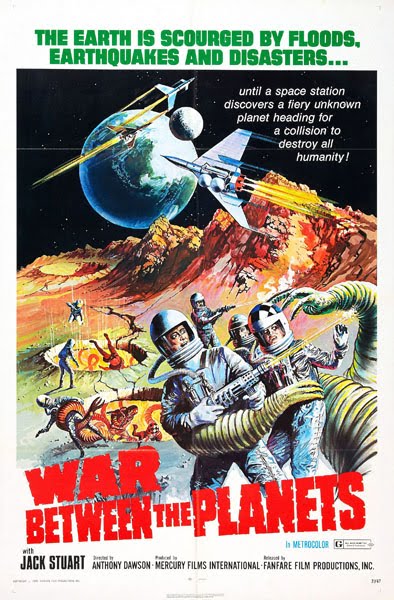
War Between the Planets

The third film in the Gamma One quadrilogy was titled Il pianeta errante (The Errant Planet) in its original Italian. The english dubbed release in America was retitled War Between the Planets (WBP). Director Magheriti's economizing continued. Sets, costumes and props were reused from the first two movies, but the cast was different. WBP is yet another rouge-planet film, though not a strong one. Yet, the proto-Star Trek-like saga continues.

Quick Plot Synopsis
The earth is being wracked by earthquakes, tsunamis and storms. Scientists cannot find a source. Computers suggest an unknown planet may have moved into the solar system in Gamma One's quadrant. Space Command's leader, General Norton, sends his best "space man" to space station Gamma One to find the cause. Once back on Gamma One, Commander Rod Jackson barks out orders and is a jerk to his clandestine girlfriend, Lieutenant Terry Sanchez. Gamma One has been wracked by odd gravity forces too. Jackson's second-in-command, Dubrowski is miffed at having his earth-leave canceled. He belittles Jackson's love life. A fist fight breaks out, but is interrupted. General Norton and Jackson's finacee, Janet Norton, are coming. A faint distress call from station Echo alerts Jackson to the likely place to find the errant planet. He mounts a recon squadron of ships to find it. In his absence, the General arrives as also barks out a lot of orders. Dubrowski, Sanchez and some others take another ship and join the recon party. Dubrowski is intent to blow up the planet as revenge for the death of his wife in an earthquake. One of Jackson's ships finds the planet. It has many odd features, such as very low density, able to alter its direction and an ability to expel and recover a "school" of asteroids. it can alter it's gravity too. One of Jackson's ships is caught in a gravity burst/ It crashes on the surface and begins sinking in red goo. Eventually, the others go EVA to explore the planet's surface, some of which is solid. Dubrowski falls into the red goo and sinks away. Jackson, Sanchez and Perkinson go down a crater, into a labyrinth of caverns. The walls are lined with red "arteries", the floor has moving "breathing valves." They seek a deep enough place to plant their anti-matter bomb. An artery grabs Sanchez. She drops the detonator into some goo. Perkinson must use some extra circuits in Jackson's helmet as an alternate detonator, so they trade helmets. There is a tremor and a cave-in which traps Perkinson. Jackson must hack the arteries with an axe to open passageways so he and Sanchez may escape. Eventually, they do and float back to their rocket. All ships power away and the order is given to detonate. The errant planet is destroyed. At a solemn funeral for Dubrowski and Perkinson, Janet realizes she's lost Jackson. Jackson, Sanchez and Dubrowski's red-headed son Ricky walk off hand in hand. The End.

Why is this movie fun?
There are the usual charms of "spaghetti space opera" films. Of particular interest is the notion of a planet-sized life form. Commander Jackson's very tall, Trump-esque hair is amusing.

Cold War Angle
There is a subtle subtext about nuclear arms control that is late-Cold-War thinking. It is a capital offense to have weapons of mass destruction. Yet, there is early-Cold-War thinking too. The way to deal with an outside threat is to gather up one's nukes and go blast it!

Notes
Planet Life -- An intriguing trope in WBP which gets little exploration, is the idea of a planet-sized life form that can exist (and move) in space. It apparently has an outer protective shell with hard spots, soft gooey spots, and some breathing vents. It exhales and inhales its own air It has a circulatory system and a heart. (The narrator speaks of a pulse) Perhaps the planet-beast's ability to generate intense gravity is how it gets around? The script does nothing with this living planet -- no science-blather theorizing. The pianeta errante is just something threatening Earth which (therefore) must be destroyed. Sci-fi potential, but wasted.

Curse You Wells! -- The American distributors of Magheriti's movies must have been miffed that H.G. Wells took the best title: War of the Worlds. They kept dancing around it, getting as close as they could. War of the Planets, Battle of the Worlds, War Between the Planets. The Italian titles at least represented their films. The American titles were poor fits, but as close as the promotors could get to the ideal Wells denied them.

Tedious Triangle -- Repeating the character formula of the previous two Gamma One dramas, the commander of Gamma One is a macho hunk who has a back-story relationship with a beautiful officer aboard Gamma One. As a side note, Roddenberry's Star Trek pilots employed the same trope. An added, but pointless, wrinkle in WBP, is that commander Rod Jackson is engaged to General Norton's daughter Janet. Perhaps a politically expedient, Jackson doesn't really love Janet (apparently). Instead, he has real feelings beneath all his jerk facade, for Lieutenant Terry Jackson, the communications officer. The triangle adds nothing beyond banal drama.

Jerks in Space -- Similar to how, in the first two movies, Mike was frequently a jerk to Connie, Rod is frequently a jerk to Terry. Like Connie before her, Terry demurely puts up with his jerkness, and melts into smiles at any crumb of civility. Apparently, Magheriti liked these characterizations. Was this an Italian role model?

Prop Watch -- Viewers will see the cool "Jetson" cars from the previous two movies, in the first few minutes. The model city is the same too. Also reused are the various rocket models from the previous two and from Assignment Outer Space. The Gamma One sets are, of course, reused too.

Bottom line? WBP is a weak installment in the Gamma One series. The first 3/4ths of the film is slow, talky and filled with distracting drama. Once the recon squadron finds the mystery planet, things get brisk, but it takes a long time getting there. Fans of Magheriti and/or the Gamma One style of films, will be more forgiving. Viewers accustomed to bold action and deep plots, will probably be annoyed.

Thursday, November 18, 2010

War of the Planets

MGM gave the second installment in the Gamma One Quadrilogy the rather incongruous english title of War of the Planets (WotP) and re-using the Italian poster from the first movie, Wild Wild Planet. The Italian title of the second installment was, I Diafanoidi Vengono da Marte, at least mentions the hostile aliens: the Diaphinoids. There really isn't a war of planets. It's the humans against the wispy energy beings. As part of a four-film package deal, WotP shared sets, costumes and cast with the first film, Wild Wild Planet, but much like a television episode, the stories are unrelated. Like the first episode, Wild Wild Planet, WotP suffers from a too-ambitious script.

Quick Plot Synopsis
Captain Dubois of Space Command gets out of his car to report for duty. He sees green lights in the sky which rush up to him and possess him. It's New Year's Eve on earth and all of its space stations are celebrating with parties. The parties aboard Gamma One are famous. The fun is interrupted by a distress call from Delta 2. Something is attacking them. The transmission is cut off. A rocket is sent to investigate. Inside, the crew are motionless (and slightly greenish tinted). Some are dead, but some alive, though catatonic. A green fog envelopes and invades Delta 2. The recon team fire their lasers. Their communication ends. Delta 2 disappears. HQ orders all stations evacuated. Halstead and a small team defy orders and stay aboard Gamma 1. The green fog penetrates Gamma 1, but Halstead and his men hole up in a room lined with lead-titanium. They fire lasers too. The fog leaves. Halstead is congratulated and chewed out by his superiors. The green lights appear in earth's sky. Dubois enters to deliver a message from the Diaphinoids. Join with the collective. Host a Diaphinoid, or die. HQ complies. Green-ified people, including Connie, are loaded into rockets. Halstead and others are too. The Diaphinoids take them to Mars. In an unmanned mining complex, the Diaphinoids plan to complete the "hosting". Some humans resist and are killed. Halstead and his men start a big brawl with the possessed humans. They break a window, escape and stagger through the thin martian air to a small supply rocket. Dubois and the possessed humans asphyxiate. An attack fleet of rockets from earth come to blast the Diaphinoids. Halstead and group barely escape in the little rocket. The mining base and all Diaphinoids are destroyed. Back on earth, Halstead gets a belated Happy New Year kiss from Connie. All is well again. The End.

Why is this movie fun?
There is something of an "old shoes" comfort in seeing the cast, sets, props, etc. from Wild Wild Planet again. The trope of alien-takeover is like an old friend too -- been around for ten years. There is also something entertaining in the Italian-style chaotic script. Never a dull (or at times, logical) moment.

Cold War Angle
Alien-takeovers are usually a Cold War trope. In WotP, however, it seems to be more sci-fi tradition than socio-political metaphor.

Notes
Old Possessions -- The concept of mysterious (incorporeal) aliens taking over human bodies was pretty old stuff by the mid 60s. It wasn't totally new in 1956 when Invasion of the Body Snatchers made the trope famous. Nonetheless, in the mid 60s, it was enjoying a new surge of popularity in Italy. Mario Bava used it in his Planet of the Vampires in 1965. Perhaps not-so-coincidentally, Bava also had his evil intelligent beings exist as "lights" until they enter a human.

Diaphinoid Saga -- The possessed Dubois tells Halstead that the Diaphinoids are energy beings who used to live on the planet Diaph in the Andromeda galaxy. They existed symbiotically with corporeal hosts there, but the hosts all died off. The Diaphinoids want humans to be their new hosts.They promise peace and bliss in the union. The "hosting" is apparently more involved than mere take-over, which is what they've done thus far. They had a slick sales pitch, to try to sell the idea to the humans, promising utopian bliss. Their use of deadly force suggests that the symbiosis was going to be more akin to conquest.

Plugging Holes in Space -- A 90 minute screenplay was too small to contain all the subplots the writers had in mind. The result is a collection of odd holes in the plot. Here are some proposed solutions: The Diaphinoids, as energy beings, can travel intersteller distances without ships, at the speed of light. A few of them find earth and decide they're suitable host bodies. They inhabit Dubois and a few others, who send a message calling in the rest who beset the space stations. The Diaphinoids can "possess" a human, but it is a limited arrangement in which the human still has too much autonomy. (q.v. all the arguing Dubois does with his Diaphinoid) A true merger requires (somehow) the presence of uranium. Hence the need to ship all people -- the possessed and prospects for it -- to the mine facility on Mars. If the possessed human dies, the Diaphinoid does too. It must be harder to un-possess a human or the Diaphinoids would simply pop out before their host died. They don't. That's why the fleet can blast them all. How do they know they got them all? All of them were in the mine expecting permanent hosts.

Take Two -- The two cool future cars that debuted in Wild Wild Planet got a bit more screen time at the beginning of WotP. Also, note that in the final scene, Connie is wearing the same yellow and green blouse outfit that she was wearing at the dinner party in WWP.

Bottom line? WotP is weaker, as a story, than the first movie. It suffers many of the same flaws. It makes a bit more sense if viewed right after the first. Watch it as a sort of Italian prototype for Star Trek, the Original Series, and it's not so bad.

Sunday, November 14, 2010

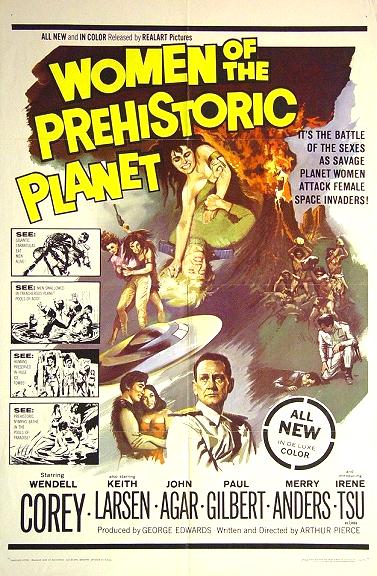
Women of the Prehistoric Planet

Somewhat mis-titled, Women of the Prehistoric Planet (WPP) is an indie production very much in the Star Trek morality play ehtos. By its title, WPP could easily be confused with Voyage to the Planet of Prehistoric Women, ('68) but that is a completely different film. WWP is not another derivative of Planeta Bur, but a new work written and directed by Arthur C. Pierce, who brought us The Human Duplicators ('65) and Mutiny in Outer Space ('65). Partially a social commentary on racism, partially a love story and partially a jungle flick, WWP struggles to be many things. It was mostly shot on a sound stage, so it has a small-scrreen feel to it.

Quick Plot Synopsis
Three space ships of some unnamed advanced civilization (of humans) are traveling back home from some far flung mission. The commander of the mini-fleet, Admiral King, hears that there is trouble aboard one of the ship, the Cosmos 3. The trouble is a mutiny by some of the Centaurian crew/passengers. The backstory is that Centaurians (played by asian actors) are a race whose once-great civilization collapsed (war?), leaving them poor. The mutiny on Cosmos 3 caused it to crash land on a steamy prehistoric planet. King's superiors do not approve a rescue, but King turns the Cosmos 1 around anyway. Traveling at near-light speed, their three month trip meant that 18 months elapsed for the survivors of the Cosmos 3. When the Cosmos 1 lands, they find the crashed ship but no survivors. A young man, Tang, is the son of two survivors -- a white officer and a centaurian woman. Aboard the Cosmos 3, a centaurian woman named Linda runs away. (yearns for freedom). She meets Tang and the two fall in love. Scout parties from the Cosmos 1 go through several jungle movie adventures, including losing an expendable crewman in a "pool of acid", attack by a dinosaur, and attack by a giant spider. Tang and Linda are attacked by a band of generic cavemen. King's men rescue Linda, but shoot Tang (a manly flesh wound). Volcanic instability forces the Cosmos 3 to leave. Linda runs away again, just before launch. She finds Tang and they live happily ever after. Departing, Admiral King remarks to his log, that the previously uncharted planet should hereafter be called: Earth. The End.

Why is this movie fun?
The Star Trek flavor of WPP has nostalgia value. Seeing veteran 50s B sci-fi star John Agar (now with a touch of gray) adds more nostalgia value. The lovely Irene Tsu adds eye candy value. Seeing TV actors of the 70s in early bit parts is fun too. Stuart Margolin, who later plays "Angel" on Rockford Files, is an expendable comic relief crewman (who gets killed by the cat-sized "giant" spider).

Cold War Angle
WPP is a morality play about racism. The only hint of a Cold War theme is the subtly implied disaster which befell the Centaurians.

Notes
Women? -- While the title and poster suggest that viewers will get to see multiple women on the prehistoric planet, there seems to be only one, and she's not even of the planet. She's an alien. Linda falls in love with Tang, She leaves the civilized confines of the Cosmos 1, trading her pink jumpsuit for a racy silk wrap. None of the other women of the Cosmos stay on the planet.

Race Relations -- WPP is blatantly a social commentary on race relations (from a mid-60s point of view). Even though the screenplay tries to preach fairness, some of the subtle signals send contradictory messages. The crew members of the Cosmos are portrayed as superior. The Centaurians as inferior. The crew are clearly all-white. They dress in tidy white uniforms with snappy cravats. They are in control, follow orders, and are concerned for others. The Centaurians are "rustic," (and all played by asians) Their outfits are sleeveless. Their men are hotheads and trouble makers. (their women are nice, though). Even the "progressive" notion of Tang being the mixed-race son of a "white" and a Centaurian, is undermined by his apparent comfort at being a cave man. Subtle signal: "They" are savages at heart. Star Trek (TOS) would dabble in the race topic too, with similar, but more exaggerated "others": the Klingons.

Enduring Dino-Caveman World -- Evolutionists say that cavemen and dinosaurs never shared the same soil. The more popular view, that they did, is seen again in WPP. We have a token dinosaur (enlarged iguana) and a cameo of savage cavemen near the end.

Color Me Expendable -- The soon-to-be tradition of having an expendable crewmen on your "away team" was not confined to Star Trek. Those familiar with TOS can spot his expendability well in advance of his fate. Watch the short-sleeved member of the search party. He's not quite bright enough to understand time paradoxes associated with travel near the speed of light. He is also wearing a red cravat. Dead giveaway. (pun intended) The others wear yellow. Sure enough, when they're crossing the wobbly log over the pit of acid, who falls in? Surprise! (not)

What's the Matter With Wet? -- Poor Linda falls into the little pond, fainted at the sight of the big mean snake (which Tang shoots with his metal crossbow). Tang takes her back to his cave. She wakes up with only an animal print sheet on. He took her clothes off because they were wet. Why is this always accepted by screenwriters? Of course, it was Irene Tsu. I suspect that if Tang had fished out Chief Bradley, he would have let him dry off in his clothes.

Odds and Ends -- Note that the space ship, resembling a chrome football, is sometimes silver, and other times gold. Note that giant lizards on prehistoric earth are highly flammable -- shoot them, and they burst into flames. Note that earthquakes are bad enough to force a ship to take off, but will subside shortly after it does.  Gavin MacLeod is sometimes cited as playing the helmsman. We mostly just see the back of his head and that is a full head of dark hair. The credits, however, do not list MacLeod.

Bottom line? WPP is a low-budget indie production with unimpressive effects. Fans of 50s B movies will see much similarity. By the mid-60s, the bar was higher than that. Yet, there is a 60s flavor to it, as a sci-fi space opera making social commentary. Viewed with a charitable attitude, WPP has its moments.

Wednesday, November 10, 2010

Queen of Blood

The 60s saw quite a few foreign sci-fi dubbed into english, with new english-speaking actor footage inserted. Queen of Blood (QoB) is a bolder and more expansive example of that sub-genre. While others stayed fairly true to their original stories, Curtis Harrington (writer and director) turned the original, Mechte Navstrechu, on its head. Much of the first half of QoB is made out of footage from the 1962 original. The second half of QoB is almost all new footage starring John Saxon, Basil Rathbone, Judi Meredith and Dennis Hopper. Harrington turned a sentimental soviet sci-fi romantic piece into a moody sci-fi horror story.

Quick Plot Synopsis
See the original plot synopsis here. Briefly, signals are received on earth from an alien spaceship on its way to earth. It crashes on Mars for unknown reasons. Earth sends one team of astronauts to mount a rescue. After that team encounters trouble en route and is low on fuel, a second ship is sent to help out. Turns out there were no survivors on the main alien ship. An escape pod is found on Phobos, with an alien woman still barely alive. They all regroup and take her aboard their ship for the trip to earth. On the way, she regains consciousness, but cannot speak. She does not eat, but has strangely hypnotic eyes. She feeds on Paul, drinking his blood. He is found dead the next day. Anders argues that she should not be killed, but studied on earth. She gets him the next night. Allan ties her up, but that next night, she uses her heat vision to burn the ropes. She is feeding on Allan, but Laura interrupts her. In a mild scuffle, Laura scratches the alien, who runs screaming. Allan revives and finds the alien dead. She bled to death (green blood). As they land on earth, Laura discovers dozens of pulsating eggs hidden around in the ship. Dr. Farraday wants them saved for study. Fade to black, The End.

Why is this movie fun?
Two reasons. One, is that it uses the very cool models and set shots from Mechte Navstrechu which are a visual treat. Two, is the well paced moody monster flick that is the (mostly) new material in the second half.

Cold War Angle
There is more of an ancient xenophobia in QoB than anything political or nuclear. In this, it is more akin to Bram Stoker's Dracula, in an era when people feared the influx of foreign immigrants, than an angst analogy over nuclear disaster.

Notes
Laungton's Nightmare -- In the original soviet movie, the token westerner, Dr. Laungton, is derided for his worry that first contact with aliens might be dangerous. QoB plays out perfectly as the alternate ending as imagined by Laungton. Ironically, QoB reinforces the soviet writers' assertion that westerners are fearful pessimists. Harrington takes their romantically optimistic vision (MN) and turns it into a grim horror piece.

Specimen or Beast? -- An ethical question raised during QoB, (a couple times) is whether the guilty party (the alien "queen") should be put to death for her "crimes" or preserved for science to study. Allan (John Saxon) espouses the cowboy justice point of view in wanting her killed for her first crime. Anders and later Dr. Farraday argue she is too valuable to science to kill. Anders even suggests that her survival is so important that he, Laura and Allan should give blood donations to the queen to keep her (a) from getting so hungry she kills them and (b) to keep her alive for study on earth. Science demanded it's "pound of flesh".

Foundations of Alien -- QoB is one of the movies cited as a precursor to the 80s blockbuster Alien. Great things seldom come totally out of the blue, but draw upon foundations set by others. It! Terror from Beyond Space ('58) featured the crew trapped in a ship with a killer alien theme. QoB repeats this, but with the feeding-upon-them twist. Of course, the other famous It was The Thing ('51) in which the alien used human blood to nourish its eggs. QoB draws on this too. Night of the Blood Beast ('58) featured an alien which implants embryonic "young" into the body of a living human host. QoB adds the eggs while it repeats the monster-onboard device.

Cut n' Paste -- While most of the first half of QoB reuses footage from Mechte Navstrechu, several model scenes (rockets, mostly) are used from Nebo Zovyot. Corman acquired the rights to both, so used them like a clip library. Viewers will note that the moon base "Lunar 7" is also reused from Corman/Harrington's prior re-edit movie Voyage to the Prehistoric Planet ('65).

Commie-ectomy -- Unlike most movies in the re-edit sub-genre, There is almost no dubbing. Only one TV announcer is kept and dubbed, as well as one small scene where a scientist talks via a videophone to an assistant. Other than that, all the original Russian actors are cut out Their roles are roughly filled with english-speaking stars. Distant shots of the Russians in their space suits are kept. The Americans are given roughly similar (though cheaper looking) spacesuits. The result was pretty well done, such that someone not familiar with the original would not notice any discontinuity.

Bottom line? QoB is actually a pretty well done mash-up of prior soviet sci-fi footage and new footage. While its story line is entirely new, it is well presented and develops a fair bit of atmosphere.

Saturday, November 6, 2010

The Secret of the Telegian

Once deemed a "lost" member of Toho's "mutant" series, Denso Ningen ("Transmitted Man"), the film actually just fell victim to economics. The American distributor, Herts-Lion International, on financial hard times, did not issue it for theatrical release.(Hence the Japanese poster) Instead, dubbed into english and retitled as The Secret of the Telegian (SoT) went straight to the television market in the mid-60s -- often in black and white prints, cropped to 3:4 ratio. Even in that, it was not very widely distributed. SoT is a weaker member of the "mutant" series, and while told as a crime drama, is more sci-fi than others.

Quick Plot Synopsis
A man enters a carnival "Cave of Horrors" with several other visitors. He is confronted by someone, who stabs him with a bayonet. Detectives find few clues. A science reporter, school mate of detective Kobayahi, finds an electronics part in the cave. A professor tells him it is part of a cryotron -- a sort of super-transistor which needs cold temps to work. The killer sends military ID tags to his next victims, who are a band of shifty gangster types. The slowly revealed back story is that they all killed (or thought they had) a fellow soldier at the end of WWII to cover up their theft of government gold. Sudo did not die, however, and is out for revenge. Another slowly revealed back story is that the soldiers also killed (or so they thought) a scientist named Dr. Nikki who was working on a matter transmitter. Both Sudo and Nikki survived, somehow. 14 years later, Nikki has working transmitter machines. Sudo is using them to get revenge. Detective Kobayashi and reporter Kirioka slowly figure out what's going on. They trace Sudo to a desolate farm, but can prove nothing. The police find Nikki there, and his machines, but still no proof. Sudo disappears. Meanwhile, one of the gangsers, Taki, is killed while in police protection. The gangster leader, Onishi, hides in a remote coastal village, but Sudo somehow knew he would and has a transmitter machine delivered there. Sudo appears and stabs Onishi with a bayonet. The police give chase. Sudo makes it to his hidden transmitter and starts the process. However, back at the ranch, a nearby volcano erupts. The tremors damage the house, shutting down the receiver. Sudo dissolves (amid moans of agony) into oblivion. The End.

Why is this movie fun?
SoT is well paced and has many nice visuals. It is fun to see the matter transporter gaining traction as a sci-fi device.

Cold War Angle
There is more of a latent message about the deadly legacy of WWII than anything. (It just keeps on killing) Of particular note, is the total absence of things nuclear. No radiation-spawned monsters or mutations. SoT appears to be Cold War free.

Notes
Mutant Family -- SoP (Denso Ningen, 1960) was the second of Toho's "mutant" series. Unlike the more famous kaiju series with giant rubber-suit monsters, the "mutant" series focused on ordinary people changed or altered. SoP came first, with corporal Sudo being only somewhat changed. His existence had some fragille or ephemeral quality due to being transported several times. In The H-Men ('59), the first of the mutant series, men are transformed by radiation into shape-shifting water-beings. In The Vapor Man,('60) an unscrupulous scientist inadvertently creates a man who can turn himself into vapor, and back again. One could include Matango ('63) (Attack of the Mushroom People, '65) since eating the radiated mushrooms turns the people into mushroom beings.

Semi-Noir -- Director Jun Fukuda was more comfortable with crime drama than sci-fi, so it's little wonder that SoP is played out as a murder mystery. The killer just happens to have a sci-fi trick to carry out his attacks. Little time is spent on the matter transporter itself. It just is. (but looks pretty cool too). A crime-drama setting was common in the mutant series. In the noir-vein, Onishi and all his men are unscrupulous criminals. Few mourn their deserved deaths. The anti-hero, Sudo, could almost garner some pity for Onishi's treason and attempted murder, but his ruthlessness at killing innocent peripheral folks (like the cabaret worker, policemen, workers, etc.) make it hard to feel bad for him, either. A rather un-noir feature, is that the good guys, the detectives and Kiroka are pretty clean and noble.

Transport -- Not much is made of Dr. Nikki's matter transporter machine. The idea in movies was not new. Andre Delambre was working on one in The Fly ('59). Others followed, but SoP's was one of the early ones. All we are told about is that it uses "cryotron" circuits -- which act as super-transistors. To work, they must be kept cold. This requires refrigeration units, providing a handy link to the outside world for the detectives to follow.

Follow the Money -- How did Dr. Nikki and Sudo build all those expensive transporter machines in such secrecy? The gold. Lt. Onishi was stealing gold bars from the government, on the eve of the surrender. There were two boxes of them in the cave with Nikki and Sudo. Taki blew up the cave entrance a bit too hastily, following the (supposed) killings of Nikki and Sudo. (just how they survived multiple gunshot wounds AND being buried in a cave-in, was never explained). When Onishi and his men went back a year later to dig out the cave, they found no bodies AND no gold. THAT is the bankroll that built Nikki's machines.

Muted Beauty and the Beast -- Easily lost amid the more flashy crime drama angle, is the hint of monster-love-story. Sudo falls for Akiko, the pretty sales executive of the refrigeration company. Sudo appears to have "stalked" her on her walk home (alone down dark deserted alleys? What was she thinking?). Perhaps he had intended to take her with him then, but was thwarted by the police chase. Later, Sudo invites her (as a company rep.) out to his 'facility' -- a remote and desolate ranch -- and at a time ensured that she would have to spend the night. The beast was certainly trying to get his beauty.

Babe of Interest -- Actress Yumi Shirakawa was no stranger to being the babe of interest in Toho's sci-fi films. She played Kiyo in Rodan. She was Etsuko, whom the Mysterians wanted. She was Chikako, the nightclub singer pursed (and protected by) the liquid men in The H-Men.

Bottom line? While not exactly "lost", The Secret of the Telegian can be harder to find. Fans of Toho's "mutant" sub-genre will enjoy it -- even though it is the weaker of them. SoT has some appeal to fans of Japanese crime stories, or a fondness for noir. The prime techno-gadget gets little development, but does look cool (in a 50s sense). The color & widescreen version has interesting visuals.

Tuesday, November 2, 2010

1964

After the abundance of sci-fi films at the end of the 50s, the scarcity of sci-fi releases in the early 60s felt like a drought. 1964 was the year things started to improve. There were a couple of major films, but the low-budget indie market was getting stronger too. Below are the sci-fi films of '64, in roughly chronological order. (those with no specified release date are at the end)

Children of the Damned -- Another variation/sequel on the theme of scary gifted children begun by Village of the Damned.

Last Man on Earth -- Vincent Price stars in this first movie adaptation of Matheson's novel "I Am Legend."

The flesh eaters -- A pirana-like bacteria trap some people on an island. An unscrupulous scientist among them wants to make it a weapon.

Gorath -- Toho Studios' big-budget retelling of When Worlds Collide ('51) but with a few twists.

The Human Vapor -- Dub of Toho's story from 1960. A variation on The Invisible Man, but he can turn himself into vapor.

Horror of Party Beach -- Toxic waste turns dead sailors into zombie monsters with a fondness for oblivious young women.

Robinson Crusoe on Mars -- Defoe's classic tale recast for the space age. An astronaut is stranded on Mars, but finds ways to survive.

The Creeping Terror -- Astoundingly odd indie film. An alien rocket lands on earth, releasing a slow and shambling monster which goes around eating people.

The Time Travelers -- An experiment to view the past becomes a time portal. The scientists become trapped in the post-apocalyptic future.

First Men on the Moon -- A film adaptation of H.G.Wells' classic tale. Features Lionel Jeffreies as Cavor and Ray Harryhausen animation.

Ikarie XB-1 -- A Czech film dubbed into english. A space ship travels to explore a mysterious "green planet" but encounter a radiation-induced sleeping sickeness en route.

The Atomic Brain -- aka Monstrosity. A shifty scientist is hired by an abusive rich old woman to transplant her brain into the body of a young buxom blonde.

The Earth Dies Screaming -- British tale of alien robots who invade earth, shutting down infrastructure, killing many, turning some into zombies.
Frozen Alive -- British crime-drama. A scientist in suspended animation is sought for the death of his wife.

Invasion of the Neptune Men -- Japan is invaded by robot-like beings from Neptune. Earth, and a group of school boys, are saved by hero "Iron Sharp" (or Space Chief).

Unearthly Stranger -- British sci-fi drama. Wife of scientist working on mental teleportation turns out to be an alien, teleported to kill him.

Santa Claus Conquers the Martians -- Silly Christmas special. Santa is kidnapped by martians to make joy for douer mars kids. Teaches all martians joy.
---